




Southeast Asia’s fintech industry is flourishing, driven by soaring adoption of digital payments, alternative lending, and wealthtech.
The region’s strong fundamentals, coupled with a growing digital economy, promise continued growth and innovation in the coming years, a new report by Royal Park Partners (RPP), a fintech-focused corporate finance advisory firm, says.
Financial inclusion opportunities for Southeast Asia’s fintechs
The report, released in December, explores the driving factors and key trends in Southeast Asia’s fintech market, highlighting Southeast Asia’s robust fundamentals which have been propelled the fintech sector’s rapid growth.
First, the report emphasizes Southeast Asia’s relatively underdeveloped traditional financial infrastructure and its large pool of financially underserved populations, which present significant opportunities for digital financial services.

It notes that while COVID-19 accelerated the digital shift, Asia-Pacific (APAC) still face significant financial inclusion challenges with 820 million unbanked and 1.8 billion underbanked adults.
In Southeast Asia alone, 85% of adults are underbanked, translating to approximately 300 million individuals lacking adequate access to financial services.

Micro, small and medium-sized enterprises (MSMEs), which account for over 97% of all businesses in Southeast Asia, represent another major opportunity for digital financial services providers.
These businesses face a significant credit gap of US$300 billion with over half of MSMEs struggling to access formal credit, hindering their potential and economic progress.
A growing young and middle-class
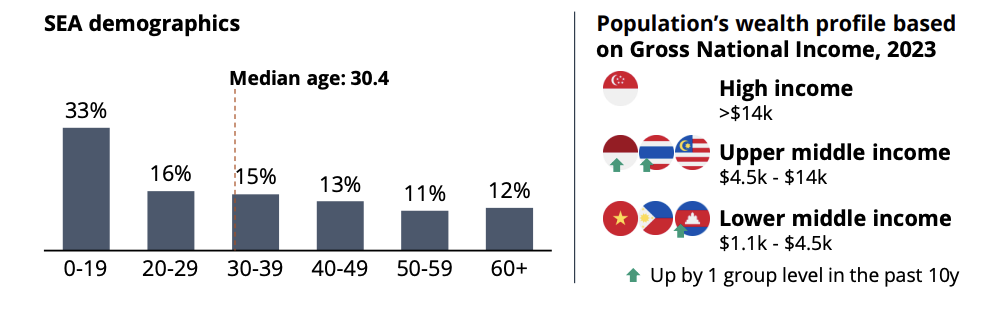
The second driver Southeast Asia’s fintech boom is the region’s growing tech-driven youth and middle class, two demographics that are fueling demand for digital-first financial services.
Southeast Asia’s youth, aged 15 to 34, account for over a third of the population. Meanwhile, the region’s burgeoning middle class has grown at a compound annual growth rate (CAGR) of 6% since 2015, and is projected to expand further, increasing by 5% annually through 2030.
The rise of economically empowered households in Southeast Asia is poised to fuel demand for tailored savings, insurance and wealth management solutions. Simultaneously, increasing purchasing power and discretionary spending have driven a need for seamless, real-time, and secure payment systems.
Payments: a rapidly growing market in Southeast Asia’s fintech scene
The report highlights payments as a booming market in Southeast Asia, spurred by a shift toward cashless transactions and a growing cross-border economy.
QR code payments are driving this trend, with volumes surpassing US$13 billion in 2023 and over 85% of retailers in Thailand, Vietnam, and Indonesia now accepting the payment method.
Moreover, ongoing ASEAN integration initiatives to connect real-time payment systems are boosting cross-border digital payments and fueling regional commerce.
The rise of “super-apps” is another prominent trend in Southeast Asia’s payment landscape. Super-apps like Grab, Gojek, and Shopee have evolved from single-service platforms into comprehensive ecosystems offering diverse services, including food delivery, digital payments, financial services, and more, all within a single app. These platforms have become central to everyday life, amassing a combined user base of approximately 310 million across the region.
Digital payment transaction value in Southeast Asia is projected to grow at a 19.8% CAGR between 2024 and 2029, reaching nearly US$1.7 trillion.

Southeast Asia remains heavily reliant on cash, a dependency which is attributed to cultural preferences but also infrastructure gaps and legacy issues with digital platforms.
However, this reliance is projected to decline, driven by the growth of digital payments, as well as the several governments-led initiatives towards financial inclusion, the report says.
Alternative lending: addressing credit gaps
Alternative lending, including buy now, pay later (BNPL), is another booming fintech vertical in Southeast Asia. These platforms are bridging credit gaps, playing a crucial role in the supporting local economies. According to the report, alternative lending platforms have facilitated a 20% annual growth in SME financing and are set to expand further.

Countries leading the charge, like the Philippines, have seen the fastest growth in fintech lending to SMEs, with disbursements increasing by 35% year-over-year (YoY) in 2023. The country’s US$221 billion SME credit gap underscores the immense opportunity for alternative lending solutions.
Consumer adoption of BNPL has also surged, with now 40% of Filipino users relying on BNPL for budgeting and immediate expenses.
The Philippines has emerged as a key alternative lending market in Southeast Asia, accounting for 59% of deal volume in 2024.
Southeast Asia’s alternative lending market, including BNPL, is projected to grow at a 45% CAGR, rising from US$26 billion in 2021 to US$116 billion by 2025.

Wealth management undergoes profound transformation
Another growing fintech vertical in Southeast Asia is wealthtech. This sector is thriving, driven by Southeast Asia’s tech-savvy population and rising middle class seeking better and more accessible wealth management solutions.
In particular, robo-advisory players are gaining traction among younger investors through data-driven super-apps. Robo-advisors leverage artificial intelligence (AI) and algorithms to provide tailored digital financial planning and investment services at low cost
According to the report, 40% of individuals under 35 years old in Singapore are now using robo-advisory services. Popular platforms include StashAway, a Singapore-based platform which reached US$1 billion in assets under management (AUM) within 3.5 years, and Endowus, an award-winning wealth and fund platform, which surpassed US$7 billion in AUM within five years of operations.
Micro-investing and digital brokerage platforms are also gaining ground in Southeast Asia. These platforms enable low-income users to participate in the financial markets, enhancing the accessibility of wealth management and fostering greater financial inclusion across the region.
Notable players include Tiger Brokers, an online broker headquartered in Singapore, which has experienced a staggering 539% CAGR in account openings in the city state; and Finhay, the largest online investment platform in Vietnam with more than 2.7 million registered users.

Featured image credit: edited from freepik
