




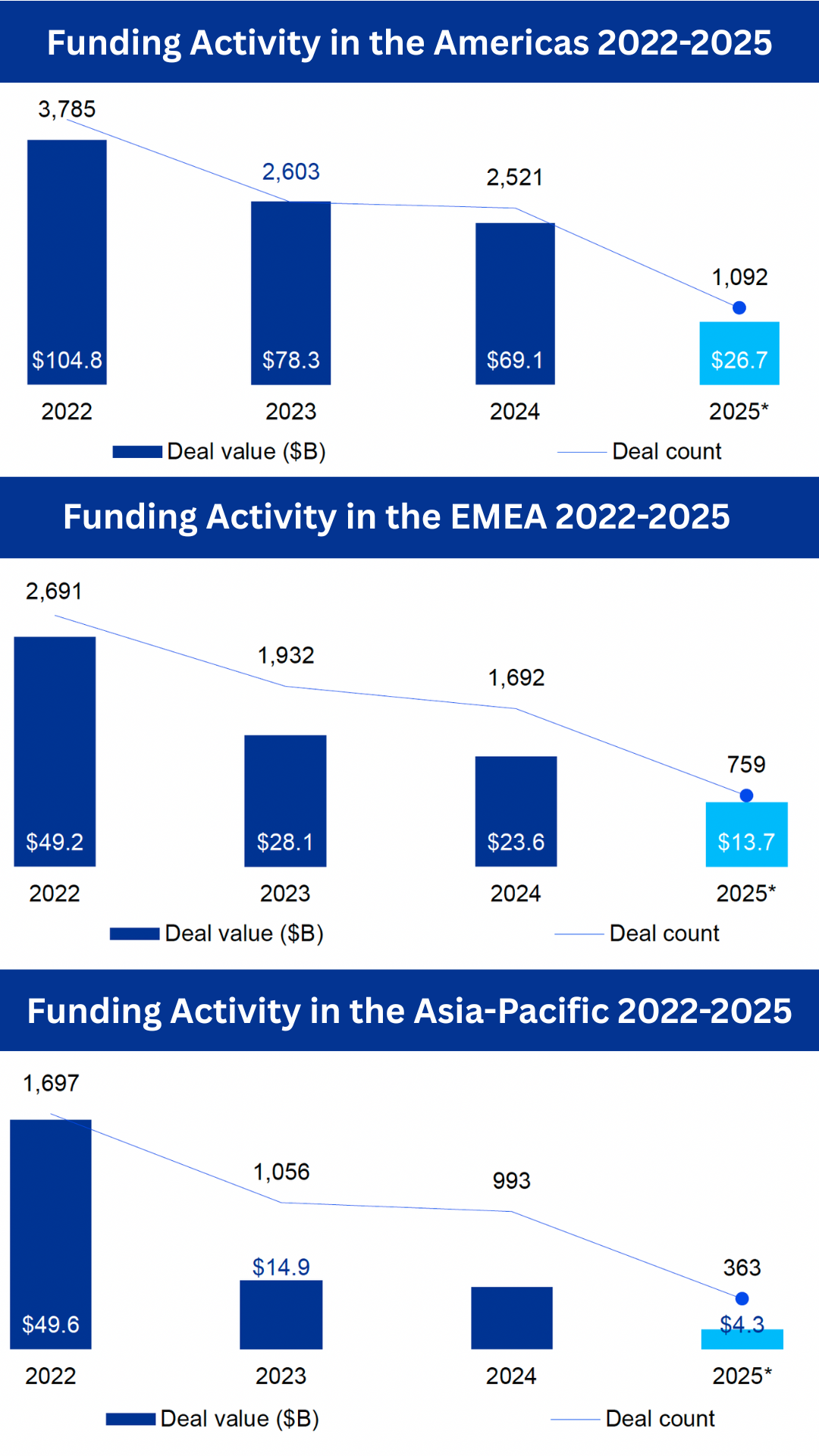
Fintech funding in Asia-Pacific has slumped to levels not seen in over a decade, with only US$4.3 billion invested across 363 deals in H1 2025, a sharp drop from US$7.3 billion in the previous half.
For a region that has long prided itself on being a cradle of digital financial innovation, the slowdown feels like a pause, even a reality check, in an industry that was once awash with capital and lofty valuations.
The malaise isn’t confined to Asia. Globally, fintech investment reached US$44.7 billion across 2,216 deals in the first half of the year, according to KPMG’s Pulse of Fintech H1 2025.
That makes it the weakest six-month period for the industry since 2020, when the world was grappling with the onset of the pandemic.

The US and the wider Americas still dominate the charts with US$26.7 billion in funding, followed by Europe, the Middle East and Africa at US$13.7 billion and Asia at US$4.3 billion.
Against these numbers, Asia-Pacific looks small, underlining just how selective investors have become. Rising interest rates, tighter capital markets, and the drag of geopolitical uncertainty have collectively reshaped the investment landscape.
Gone are the days of speculative bets on any startup that promised disruption. Instead, investors are now picking their battles carefully.
Artificial intelligence, digital assets, and regulatory technology continue to attract money, while once-popular areas like payments have seen funding fall sharply.
This global reset has set the stage for Asia-Pacific’s numbers to look subdued, but the region’s story is more layered than the headline figures suggest.
Small Pool of Deals but Clear Signals for the Market
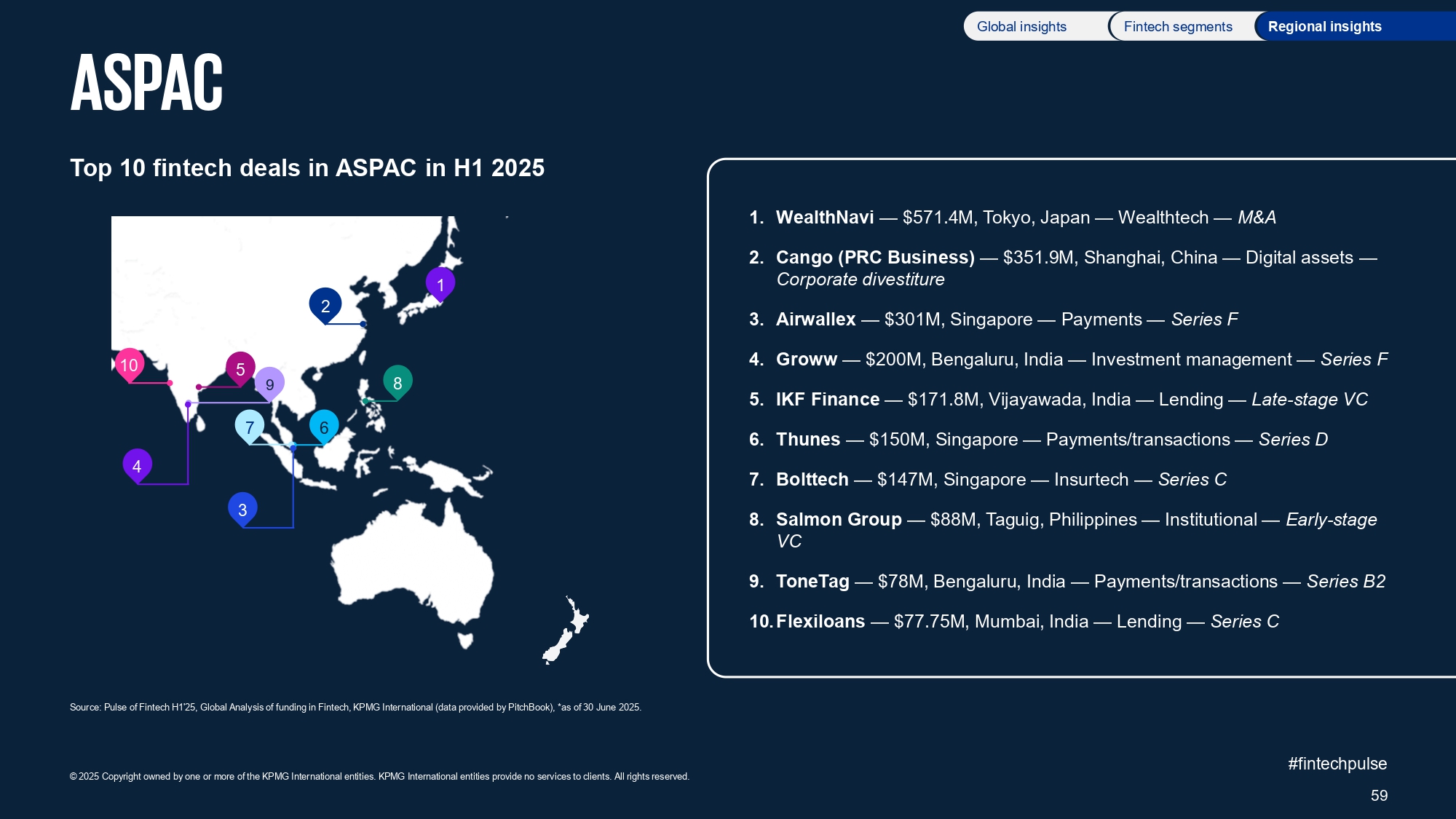
While the US$4.3 billion headline looks weak, the region still produced some deals worth noting. Only seven crossed the US$100 million mark in the first half of the year, but each reflected a sharper focus on substance over style.
Japan’s MUFG took over robo-adviser WealthNavi for US$571 million, signalling confidence in wealthtech as a long-term play.
Singapore’s Airwallex raised US$301 million, cementing its status as one of the region’s most influential payments players with global ambitions. The country also contributed with Thunes, raising US$150 million and Bolttech, US$147 million.
India’s Groww attracted US$200 million, continuing its role as one of the country’s strongest fintech stories. Even the Philippines got a seat at the table with Salmon Group pulling in US$88 million, a welcome sign of investor interest beyond the usual hubs.
KPMG reports that India remains the region’s busiest market by volume, clocking 99 deals worth US$1.5 billion. Yet that too was down from the previous six months, showing that even the region’s strongest performers are feeling the chill.
Singapore continues to box above its weight class, pulling in mid-to-late stage deals and reinforcing its position as a mature hub rather than just an experimental playground.
Investors Are Paying More Attention to the Plumbing
The narrative in Asia is less about fading investor appetite and more about a shift in priorities. Instead of chasing consumer-facing apps, investors are turning their gaze towards infrastructure plays that form the backbone of financial services.
Tier-two and tier-three banks across Asia are renewing their core systems.
Fraud and financial crime solutions are in demand as scams proliferate across the region. Wealth management tools are becoming more attractive in Southeast Asia, where a rising middle class is hungry for better investment options.
It is a quieter, less glamorous story than the unicorn-chasing days of old, but in many ways a healthier one. This is fintech growing up, with discipline replacing exuberance.
Investors are rewarding companies that can demonstrate operational efficiency, regulatory compliance, and the potential for long-term profitability.
We’re Still Talking About AI
Artificial intelligence has quickly become the darling of fintech investors, even in a cautious market. Globally, the Pulse of Fintech H1 2025 noted that AI-focused fintech drew US$7.2 billion in the first half of the year, putting it on track to surpass 2024 levels.
Much of this interest is in “enablement”, the application of AI to reduce costs, streamline processes, and tackle pain points like AML and KYC.
In the Asia-Pacific, the same themes are taking shape. From Japan’s experimentation with AI-driven advisory to Singapore’s interest in AI-native fraud detection, the technology is no longer a futuristic add-on but a core differentiator.
As KPMG notes, agentic AI (systems capable of handling sequential tasks based on real-time data) is particularly appealing, and early-stage AI fintechs are already commanding higher valuations than their non-AI peers.
For Asia, this AI wave dovetails neatly with the region’s infrastructure focus. Banks and regulators alike see AI not only as a tool for efficiency but as a way to leapfrog legacy limitations.
It explains why, even in a lean funding environment, AI solutions are still managing to draw capital.
Clearer Frameworks Give Digital Assets More Room to Grow
Another bright spot in an otherwise muted landscape is the resurgence of interest in digital assets.
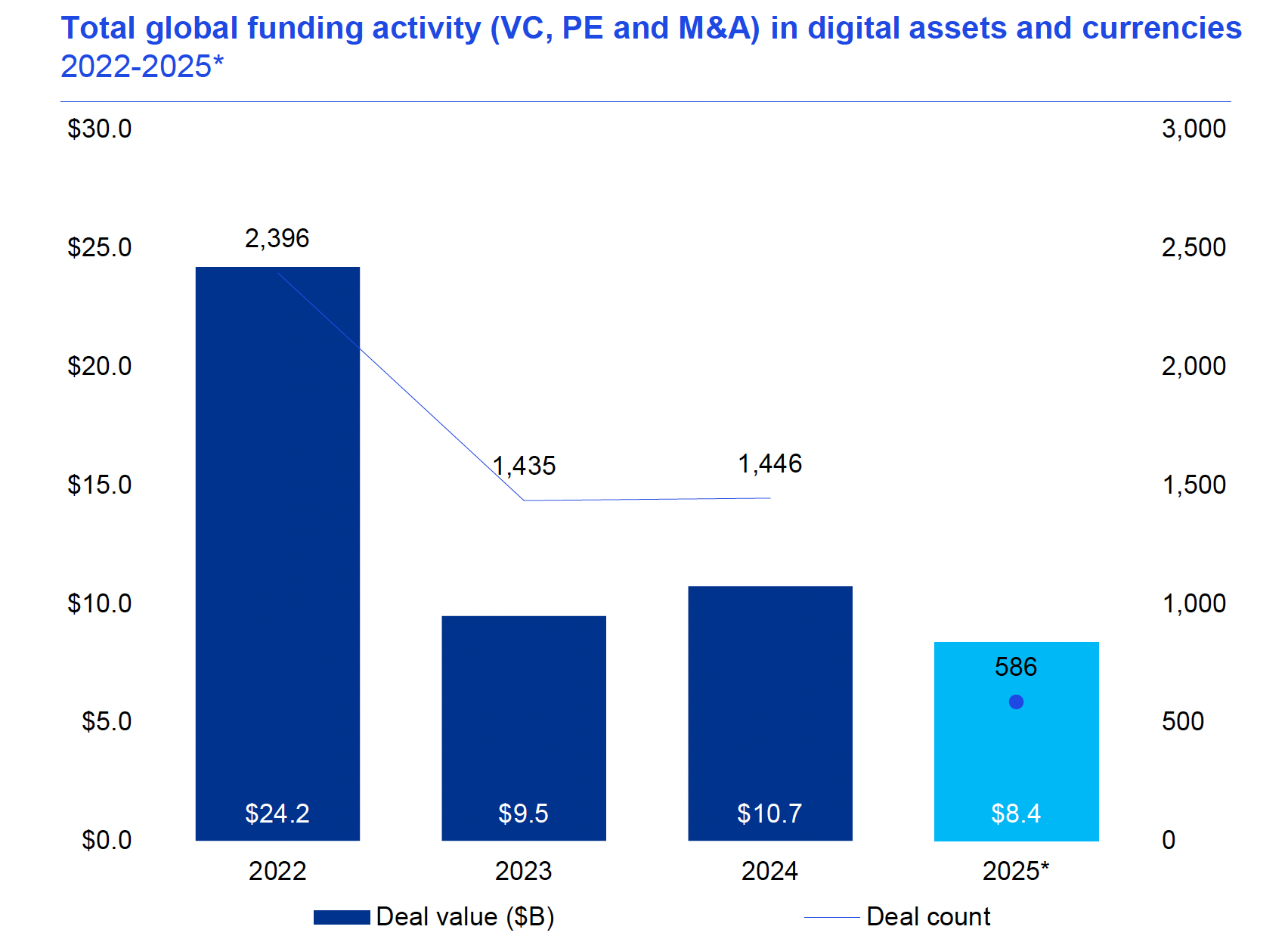
Global investment in the sector hit US$8.4 billion in the first half of 2025, already close to matching all of 2024 and ahead of 2023.
The Americas dominated with the largest deals, including Binance’s US$2 billion raise out of the Cayman Islands and Kraken’s US$1.5 billion acquisition of US-based futures trading platform Ninja Trader.
Asia-Pacific has not seen deals on that scale, but there have been moves worth noting.
China’s Cango sold off its legacy domestic business to Ursalpha Digital for US$251.9 million as part of a pivot into Bitcoin mining, while Japan’s Gaudiy raised US$69.4 million to expand its Web3 and fan economy platform.
At the same time, regulators are stepping up to provide the clarity investors have been asking for. Hong Kong passed its Stablecoins Bill and launched a licensing regime.
Japan eased requirements to allow government bonds and deposits to back stablecoins, and even opened the door for potential crypto ETFs.
Singapore continues to refine its rules to hold on to its reputation as one of the world’s most trusted hubs.
These moves are critical signals to the market that digital assets are moving beyond speculation and into real-world utility.
Stablecoins, in particular, are gaining traction in cross-border trade, remittances, and treasury management.
The fact that Circle’s IPO in the US jumped 168% on its debut only adds to the momentum. Clearer rules could unlock new flows of institutional capital into the space for the Asia-Pacific.
Southeast Asia’s Steady Hand
Within the wider Asia-Pacific, Southeast Asia remains one of the more encouraging subplots. Singapore continues to attract significant deals, but there are signs of activity spreading.
The Philippines’ Salmon Group funding round is one example, while Indonesia and Vietnam are seeing growing interest in infrastructure and embedded finance solutions.
Payments investment globally may be faltering, but Southeast Asia still presents an exception of sorts.
Mobile-first adoption and regulatory flexibility mean the region is well-positioned to benefit when global funding in payments eventually rebalances.
The same is true for wealthtech, where competition is expected to intensify as specialised players try to capture Southeast Asia’s growing middle-class wealth.
In many ways, Southeast Asia reflects the balance that investors are now seeking. Young markets with room to grow, but with enough regulatory maturity and proven use cases to justify selective bets.
What the Second Half of the Year Could Bring
The second half of 2025 will likely see more of the same caution, but not without opportunities. It seems like the story of fintech in Asia-Pacific this year is more about recalibration rather than just a downward decline.
Stablecoins and tokenised money are set to gain traction in Asia. Payments investment could shift further towards Southeast Asia. Wealthtech is on track to become a battleground as more firms vie for middle-class investors.
I, for one, believe that AI will remain the star attraction, particularly as regulators and institutions seek scalable solutions for compliance and customer engagement.
It is also best to note that the absence of billion-dollar mega deals does not mean the region is losing its spark. Instead, it signals a maturing market where infrastructure, regulation, and profitability matter more than ever.
Southeast Asia’s quiet resilience, combined with regulatory clarity in Hong Kong and Japan, suggests the region is laying the groundwork for its next phase of growth.
Rather than just chasing the hype, investors are now looking for value. And that may ultimately be what makes this cycle more sustainable.
What looks like a slump could turn out to be the pause before the push.
Featured image by EyeEm via Freepik.
