

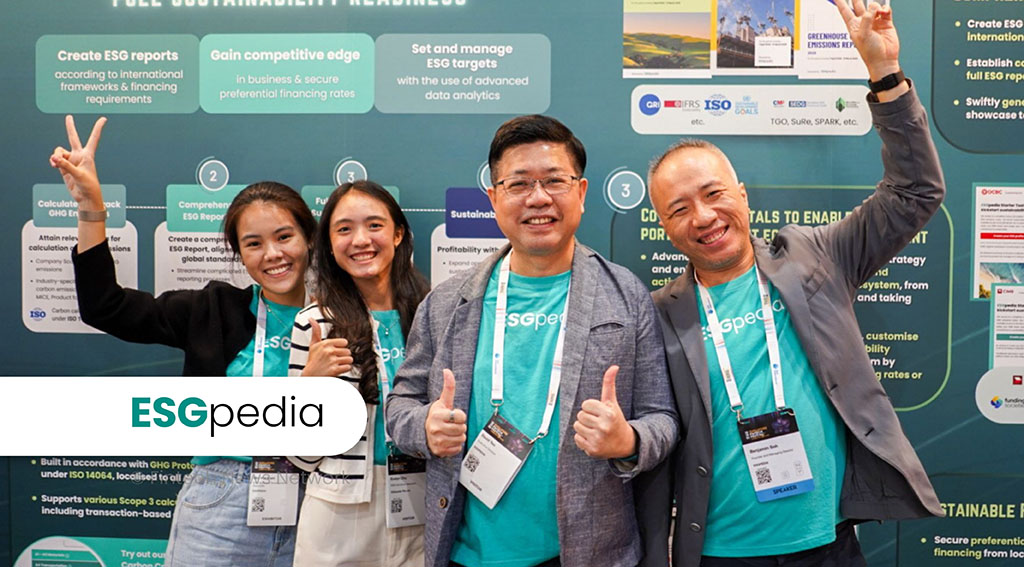
ESGpedia has worked with several financial institutions to support the development of their sustainability programmes, enabling companies and SMEs to engage in Sustainability-Linked Financing, achieve credible greenhouse gas (GHG) emissions reductions, and strengthen overall sustainability capability.
Partners include banks such as CIMB, Maybank, and OCBC, as well as the Mongolian Sustainable Finance Association (MSFA).
ESGpedia’s digital platform provides carbon accounting and ESG reporting solutions, allowing companies to quantify and account for emissions across business activities and generate Sustainability Reports in accordance with international reporting frameworks and ISO 14064 methodologies.
The platform also supports banks and associations in implementing Sustainability-Linked Financing programmes and ESG risk monitoring, helping financial institutions integrate sustainability into their operations.

Within a year, ESGpedia has assisted more than ten financial institutions across Asia in providing over 250 Sustainability-Linked Loans (SLLs), contributing to data-driven sustainable finance across the region.
Through the platform, banks can engage with their clients on data collection, emissions calculation, and monitoring of Sustainability Performance Targets (SPTs) linked to SLLs.
The system allows financial institutions to customise assessments to meet their sustainability requirements and incentivise clients with preferential financing rates, promoting adoption of sustainable practices while managing costs and resources.
By embedding ESG criteria into risk assessments, banks can better mitigate climate-related risks and mobilise capital towards meaningful impact.
Many businesses have used ESGpedia to connect with partner banks and access sustainable financing programmes, advancing their ESG strategies, enhancing operational resilience, and strengthening their appeal to investors and customers.
CIMB Singapore has partnered with ESGpedia for its SME Sustainability-Linked Loan/Financing Programme, launched in 2024.
The programme has enabled over 100 companies to set credible GHG reduction targets, unlocking rebates on loan interest or profit rates upon successful verification.
The programme offers tiered KPIs linked to tiered interest or profit rate discounts, providing greater rebates from the second year onwards based on achievement of SPTs.
The collaboration has supported CIMB Singapore in directing financing towards measurable sustainability outcomes in a transparent and scalable manner.
Maybank has strengthened its myimpact SME Programme through a partnership with ESGpedia, launched in November 2024.
SMEs participating in the programme can quantify GHG emissions, set decarbonisation targets, and generate Sustainability Reports.
The platform enables Maybank to monitor clients’ progress on SPTs linked to SLLs, supporting the bank’s guidance on decarbonisation and engagement with the SME community.
Participants have reported benefits including improved operational efficiency and enhanced credibility with partners and regulators.
The Mongolian Sustainable Finance Association (MSFA) has partnered with ESGpedia on the Switching On the Green Economy (SOGE) project, establishing a centralised Measurement, Reporting, and Verification system for the agri-food sector.
The collaboration provides a national ESG data repository to facilitate market access to sustainable finance instruments.
Using ESGpedia, MSFA has implemented a structured solution for ESG assessments, verification, and data-driven analysis, connecting enterprises with certification bodies and supporting companies in accessing sustainable finance opportunities.
ESGpedia also supports OCBC in its SME Start-ESG Programme, providing a platform for SMEs to obtain a baseline measurement of GHG emissions, a prerequisite for SLLs.
Verified emissions data from ESGpedia allows OCBC to structure SLLs to support sustainability initiatives, helping SMEs improve performance and meet sustainability requirements of large corporate customers.
Benjamin Soh, Founder and Managing Director of ESGpedia, said:

“Through the platform’s Sustainable Financing module, ESGpedia strengthens capabilities and facilitates the tracking of sustainability outcomes against financial incentives. We remain committed to bridging the gap and empowering both financial institutions and businesses alike in advancing their sustainability strategies.”
ESGpedia will participate in the Singapore Fintech Festival 2025, highlighting partnerships with financial institutions across the region and the role of technology in advancing sustainable finance.
A key advantage of technology platforms like ESGpedia is that they allow banks to implement Sustainability-Linked Financing programmes without extensive in-house digital infrastructure, accelerating market access and improving accessibility to sustainable finance for clients.
By linking sustainability outcomes to financial incentives, banks can support greener business models and shape long-term environmental impact.

Featured image credit: Edited by Fintech News Singapore, based on LinkedIn post by ESGpedia
