



Efforts to modernise cross-border payments have accelerated over the past decade, yet retail transactions remain slower, more expensive, and less transparent than domestic instant payments.
While many jurisdictions have rolled out real-time payment systems, sending money across borders continues to rely on fragmented foreign exchange processes, prefunding arrangements, and sequential settlement mechanisms that introduce cost and risk.
Project Rialto, a collaborative experiment led by the BIS Innovation Hub together with the Bank of France, the Bank of Italy, Bank Negara Malaysia, and the Monetary Authority of Singapore, explores how these frictions could be addressed without dismantling existing payment infrastructures.
The project focuses on retail use cases such as remittances and person-to-person payments, which are particularly relevant for emerging and developing economies across Asia.

Rather than proposing a new retail digital currency or replacing domestic payment rails, Project Rialto examines how instant payment systems can be connected to an automated foreign exchange and settlement layer using tokenised central bank money.
Why Cross-Border Retail Payments Still Lag Behind
Retail cross-border payments account for hundreds of billions of dollars annually, yet they remain structurally inefficient.
Foreign exchange conversion and settlement are the two most persistent sources of friction. Transactions involving less liquid currency corridors often face wide spreads, limited transparency, and extended settlement times.
These challenges are especially pronounced in remittance-heavy regions such as Southeast Asia.
Despite progress under the G20 cross-border payments roadmap, most improvements have focused on messaging standards and correspondent banking efficiency.
Instant payment systems have transformed domestic payments, but their benefits stop at national borders.
Project Rialto addresses this gap by asking whether instant cross-border payments can be achieved while maintaining the safety and finality associated with central bank money.
Positioning Project Rialto in the BIS Innovation Agenda
Project Rialto draws on a sequence of earlier initiatives led by the BIS Innovation Hub.
One of these, Project Nexus, demonstrated how domestic instant payment systems could be connected through a shared hub model to support cross-border retail payments.
Another strand came from Project Mariana, which examined the use of tokenised central bank money and automated market makers to enable wholesale foreign exchange settlement on distributed ledger technology.
Rialto brings these two lines of experimentation together.
Domestic instant payment systems continue to handle customer-facing transactions, while a cross-border distributed ledger network is introduced to support foreign exchange conversion and settlement between intermediaries.
The model positions the distributed ledger component underneath current payment rails, enabling service providers to participate without maintaining digital wallets or touching the infrastructure directly.
For central banks across the Asia-Pacific region, including Bank Negara Malaysia, this design holds particular relevance.
It reduces the need for direct operational involvement while enabling settlement in a safe and trusted asset aligned with central bank principles.
A Two-Layer Architecture Designed for Incremental Adoption
At a structural level, the Rialto model is organised around two tightly integrated functional layers.
One layer is anchored in domestic or regional instant payment systems, supported by an interlinking mechanism.
Payments are initiated, cleared, and settled in fiat money within each jurisdiction, relying on existing infrastructures and governance frameworks.
As a result, customer experience, regulatory oversight, and compliance arrangements remain largely unchanged from today’s domestic payment environment.
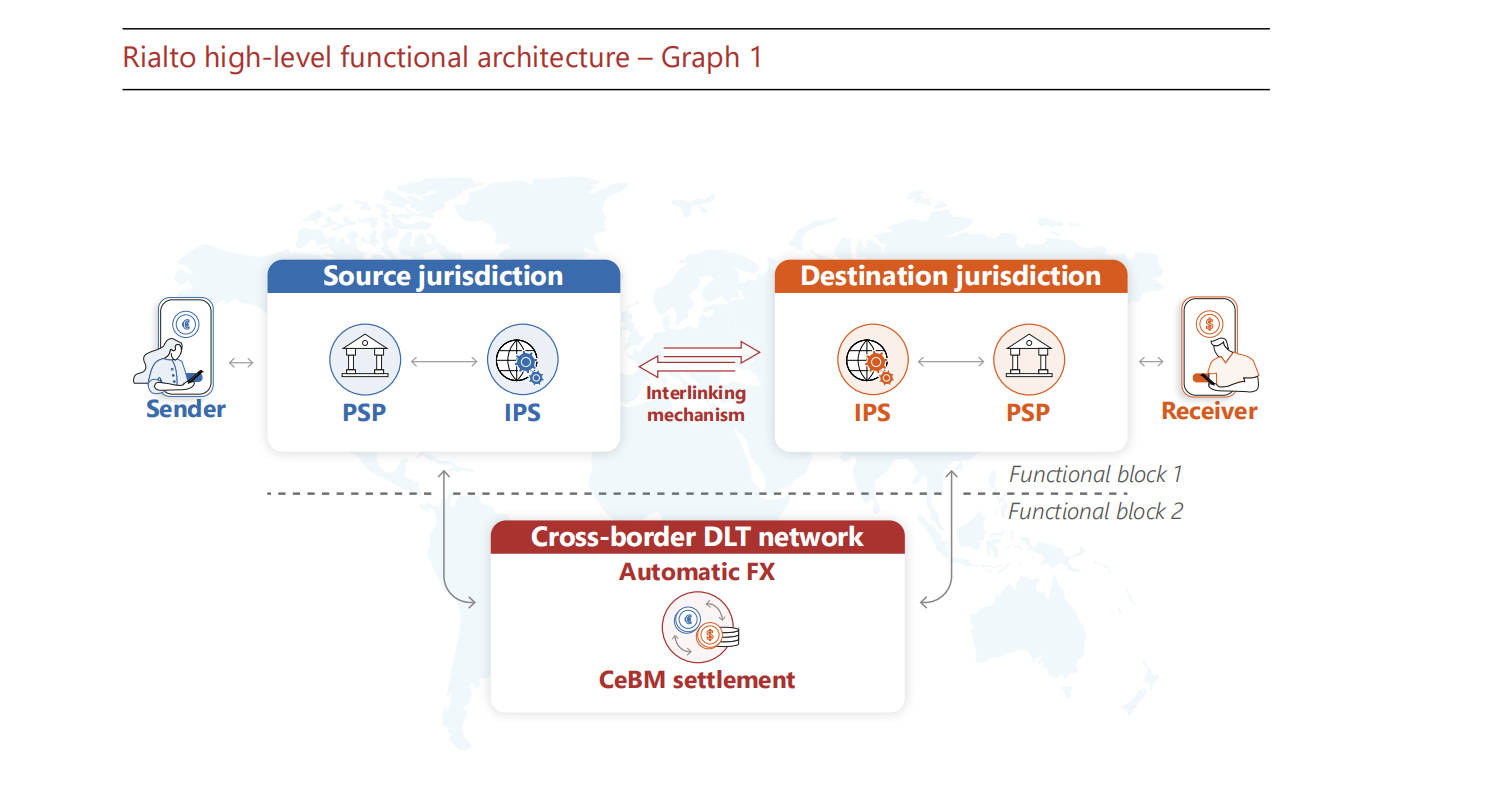
Alongside this sits a second layer built on a cross-border distributed ledger network.
Within this environment, intermediaries exchange tokenised representations of central bank money to complete foreign exchange conversion and settlement.
Foreign exchange and settlement activities are therefore isolated from retail payment processing. This separation allows new functionality to be introduced without requiring payment service providers to redesign their core systems.
Taken together, the two-layer structure reflects a pragmatic approach to payment system innovation.
Progress in cross-border payments, as the project illustrates, is more likely to come from interoperability across systems than from wholesale replacement.
How a Rialto Transaction Works in Practice
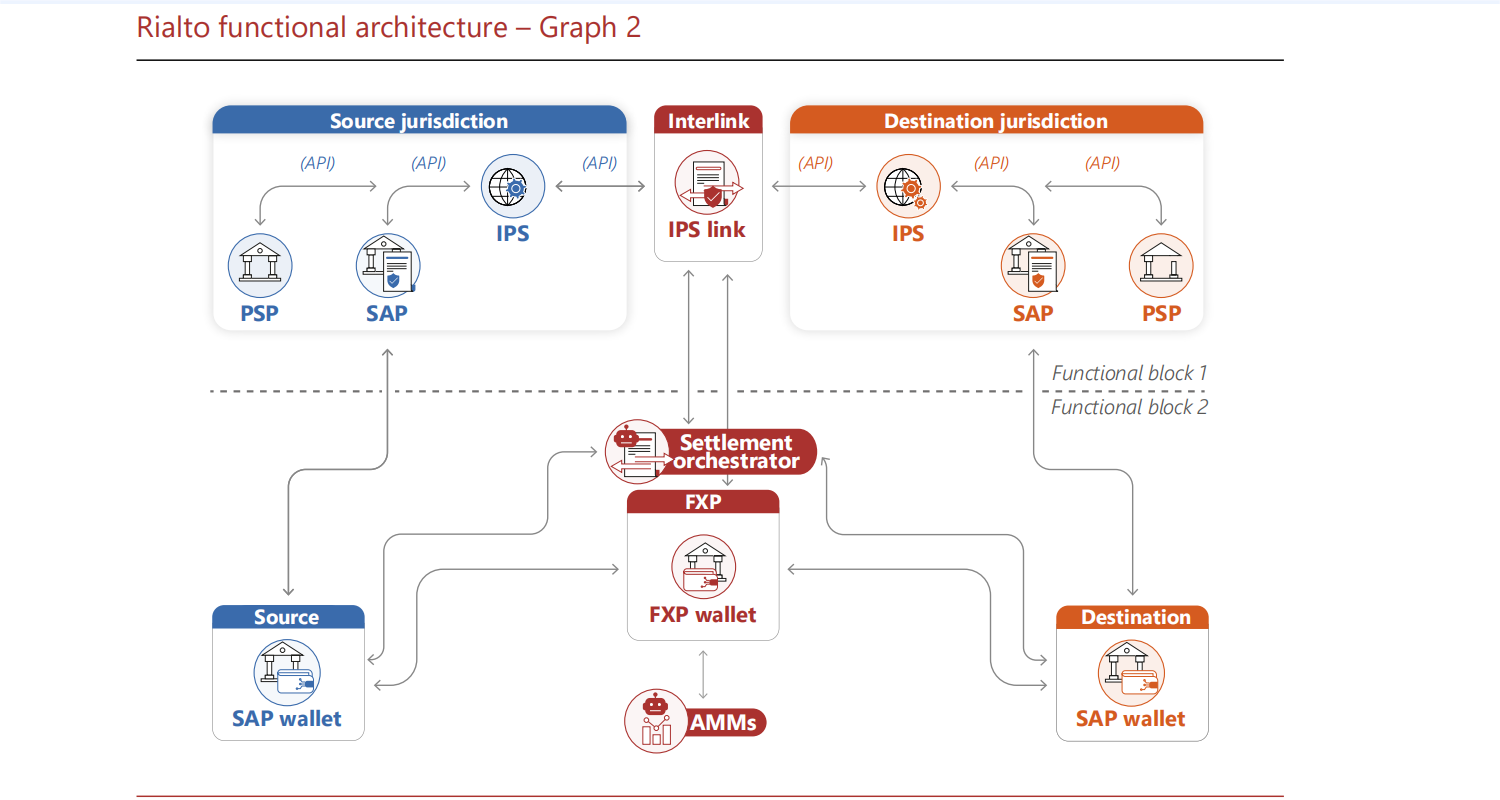
A cross-border transaction under the Rialto model begins with a request for a foreign exchange quote.
The sender provides the payment details, including the destination country, currency, and transaction amount, with the option to specify either the amount to be sent or the amount to be received.
Using this information, the instant payment system interlink requests a binding exchange rate from a foreign exchange provider.
Pricing is derived from an automated market maker that draws on liquidity pools backed by tokenised representations of central bank money. Fees and exchange rates are disclosed upfront, giving the sender clarity before committing to the transaction.
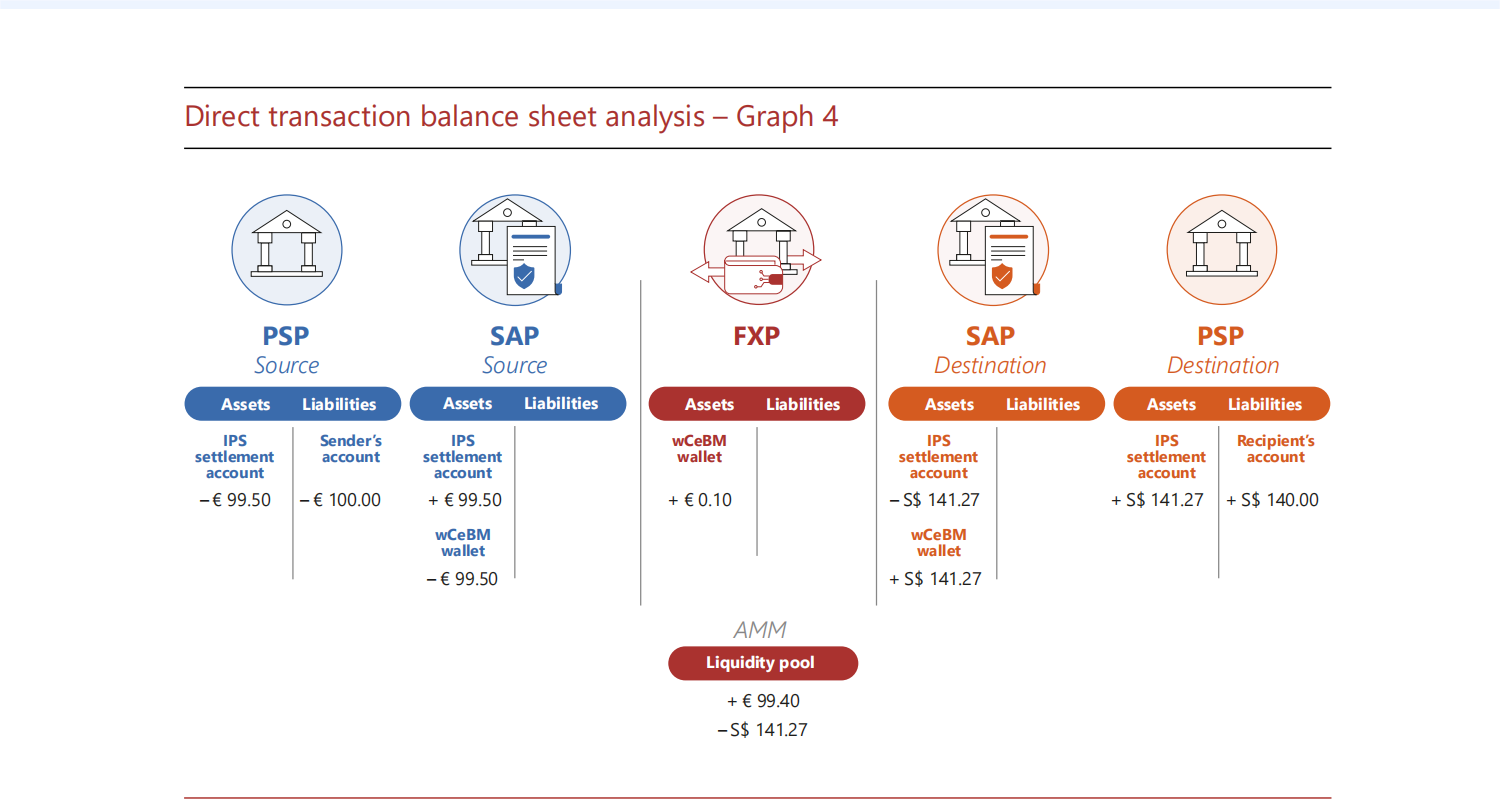
Once the sender confirms, funds are earmarked within the source instant payment system. Both the source and destination intermediaries then validate the transaction, including compliance checks, before any settlement takes place.
Only after all conditions are satisfied does settlement proceed on the distributed ledger.
Tokenised central bank money is transferred from the source settlement access provider to the foreign exchange provider and onward to the destination settlement access provider.
The transaction settles on a payment-versus-payment basis, ensuring that neither leg can complete without the other.
Following confirmation of settlement, the destination instant payment system credits the receiver. The source payment service provider subsequently finalises the debit to the sender, completing the transaction.
Automated FX with Accountability Built In
Automated market makers play a central role in Rialto’s foreign exchange design.
Continuous liquidity provision allows AMMs to execute currency exchanges algorithmically instead of using a standard order book.
At the same time, retail payments require certainty around pricing. Exchange rates must be locked in at the point of confirmation, and consumers cannot be exposed to execution risk.
To address this constraint, the Rialto model assigns regulated foreign exchange providers a clearly defined role.
Rather than being displaced, FX providers are responsible for issuing binding quotes to the instant payment system interlink.
Any slippage that occurs during execution is absorbed by the provider, which earns a spread or fee in return for managing that risk.
Through this structure, automation is introduced without removing human accountability or regulatory oversight from the foreign exchange process.
Extending Coverage Through Vehicle Currencies
Currency liquidity varies significantly across regions and corridors.
In many cases, direct foreign exchange between two currencies may be limited, expensive, or unavailable at scale.
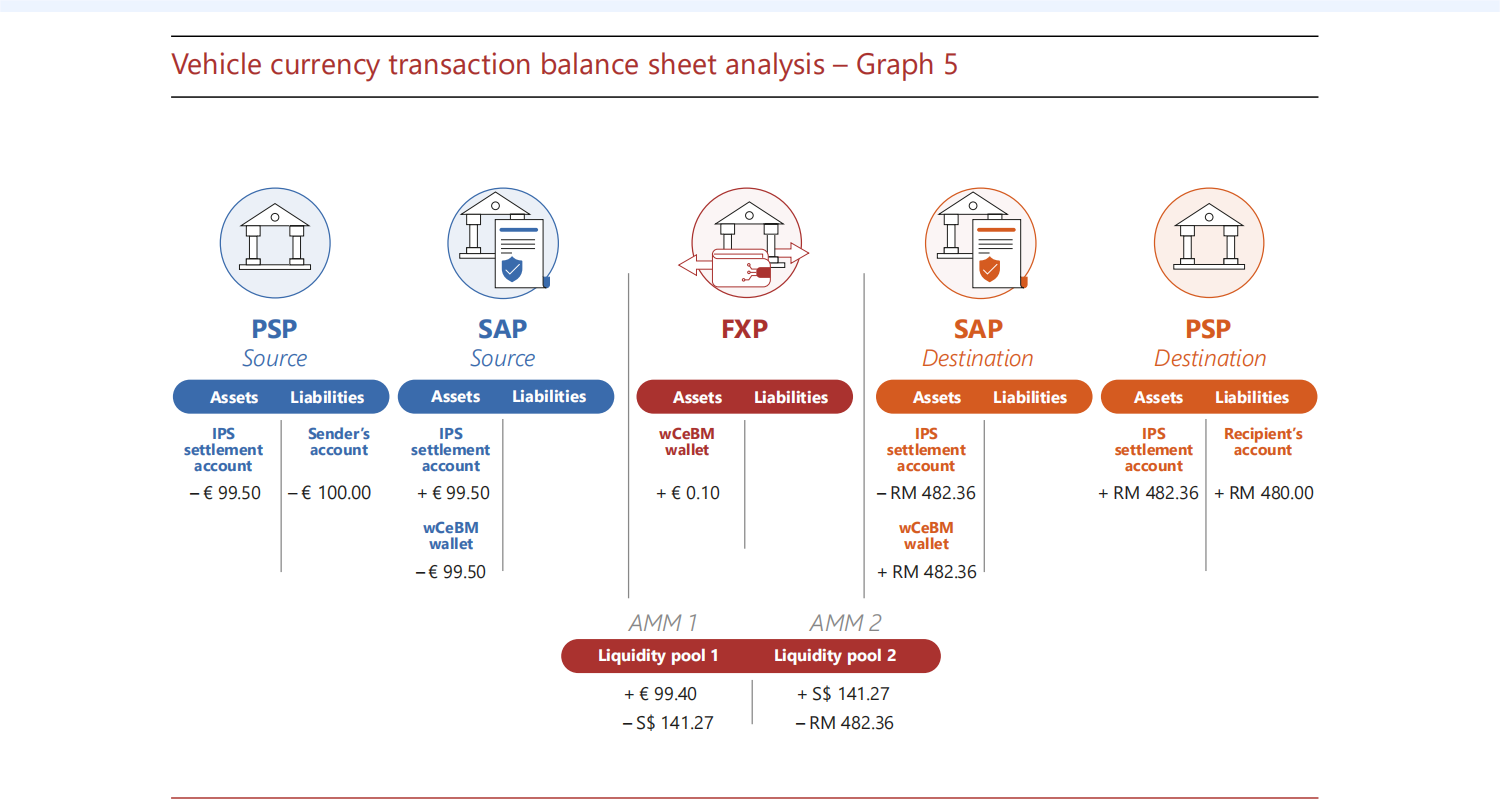
Rialto addresses this challenge by supporting vehicle currencies within a single atomic transaction.
Instead of executing a direct conversion, the system routes the exchange through a more liquid intermediary currency using two automated market makers.
Both legs of the conversion are settled together on a payment-versus-payment basis. This design preserves settlement finality while expanding the range of corridors that can be supported efficiently.
For economies across Southeast Asia, where remittance flows often involve less liquid currency pairs, this capability has particular relevance.
Resilience and Failure Handling by Design
Robust payment systems are defined as much by how they handle failures as by how they process successful transactions.
Project Rialto explicitly tests scenarios involving compliance rejections, participant outages, and technical disruptions.
If a transaction fails compliance checks at the destination, settlement does not occur and earmarked funds at the source are released.
In cases where a disruption arises after on-chain settlement but before final crediting, predefined procedures may require a new atomic transaction in the opposite direction to mitigate financial loss.
Two design elements underpin this resilience. Funds are earmarked before settlement, and settlement itself follows a two-phase process that requires confirmation from both source and destination intermediaries.
Structuring transactions in this manner allows the system to lower reconciliation risks and isolate partial failures before they impact the wider ecosystem.
Economic Considerations for PSPs and Banks
Beyond technical feasibility, Project Rialto examines the economic implications of its proposed model.
Retail remittance costs remain above international targets in many corridors, with fees and foreign exchange margins accounting for a significant share of total transaction costs.
Automated foreign exchange mechanisms have the potential to improve pricing transparency and execution efficiency.
However, these benefits come with trade-offs. Automated market makers require liquidity to be locked into pools, which can affect balance sheet efficiency for participating institutions.
At the same time, settlement in tokenised representations of central bank money reduces credit exposure between intermediaries. This may lower the need for prefunded nostro balances, particularly in corridors where settlement risk is currently managed through conservative liquidity buffers.
Profitability for payment service providers depends on how fees are distributed across the transaction chain.
In the Rialto model, PSPs, settlement access providers, and foreign exchange providers each charge for distinct services.
The interaction between these fees and automated pricing dynamics will play a decisive role in determining commercial viability.
What Project Rialto Ultimately Demonstrates
Project Rialto is positioned as a proof of concept rather than a deployment blueprint. It does not attempt to define an end-state architecture or mandate implementation timelines.
Instead, its contribution lies in showing that instant cross-border retail payments can be combined with automated foreign exchange and settlement in central bank money.
Crucially, this can be achieved while continuing to rely on existing payment infrastructures.
The experiment points to a path forward that favours integration over replacement. It suggests that meaningful improvements do not require tearing down systems that already function at scale.
For Asia-Pacific economies, cross-border retail flows are economically significant and operationally complex. Within this context, the approach explored by Rialto offers a realistic and incremental route to progress.
As policymakers and market participants push for faster, cheaper, and more transparent cross-border payments, the project’s lessons become increasingly relevant.
Progress, the experiment suggests, is most likely when innovation is layered carefully onto systems that are already trusted and widely used.
Rather than prescribing a finished solution, Project Rialto presents a working model that others can build on.
Its longer-term value lies in showing how cross-border payments can evolve step by step, grounded in existing infrastructure while moving toward deeper regional integration.
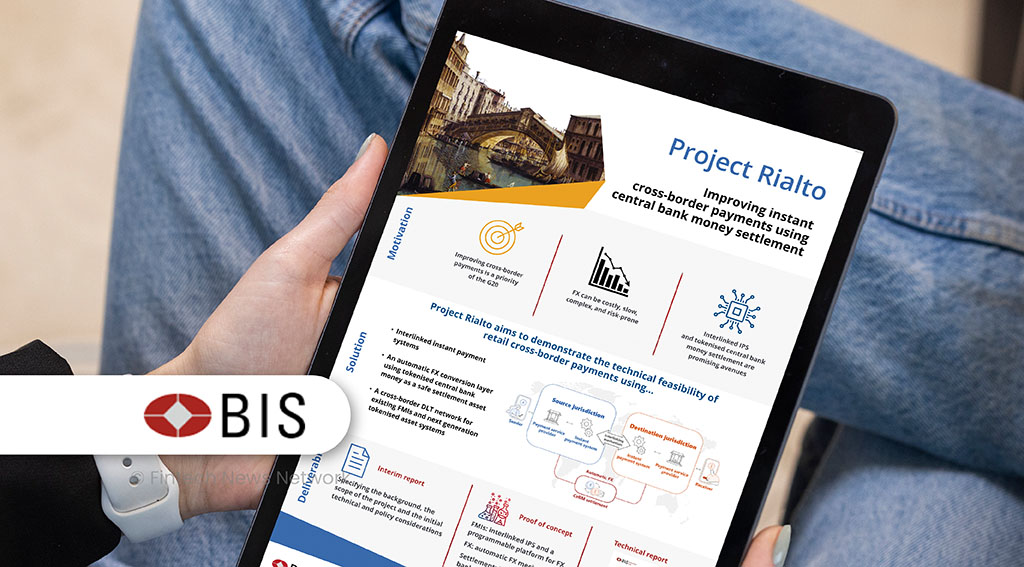
Featured image: Edited by Fintech News Singapore based on an image by pikisuperstar via Freepik and Project Rialto.
