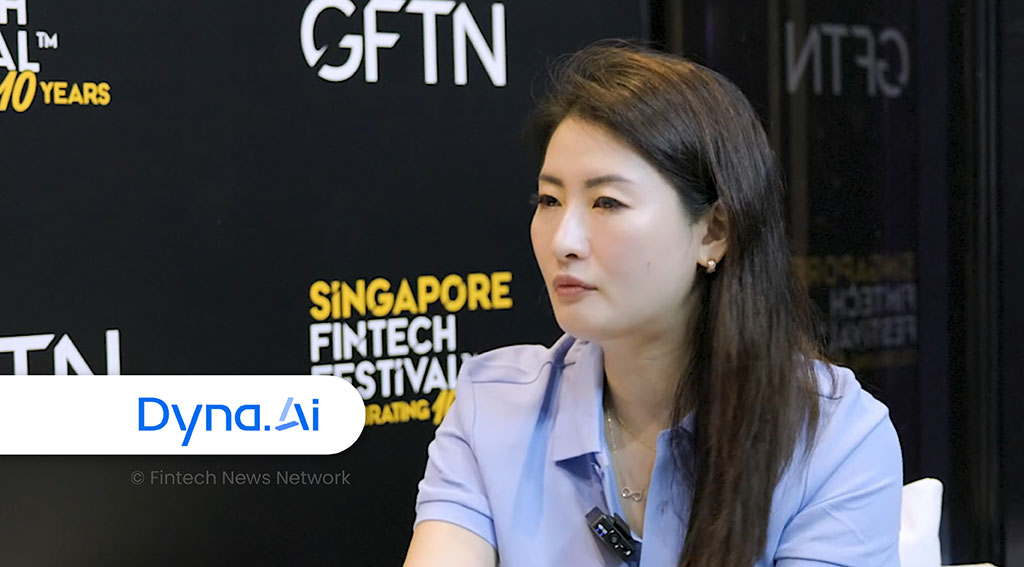
Why AI Keeps Failing in Banks, and What It Takes to Make It Work
Cynthia believes that as agentic AI gains traction, banks are being pushed to rethink not just their technology stacks, but how they manage people, processes, and an emerging AI workforce.
AI may be everywhere in banking conversations, but tangible impact remains harder to pin down.
For Cynthia Siantar, General Manager of Singapore and Hong Kong, Head of Investor Relations at Dyna.Ai, the explanation is far less mysterious than it seems.
Having spent time inside one of Southeast Asia’s largest digital banks before moving into the AI world, she has seen both sides of the equation.
Her conclusion is sharp.
Cynthia Siantar
“Even if the tech works … more often than not, the human systems do not,” she said during a conversation with Fintech News Singapore.
It is a line that neatly captures the core problem facing financial institutions today.
In her view, the issue rarely lies with the technology itself, but in how organisations operate and follow through on change.
Build-Versus-Partner Trap
One of the most common patterns Cynthia has observed is the instinct among large financial institutions to build AI capabilities in-house.
“Especially for big financial institutions, they somehow would rather build than buy or partner, thinking that if they were to build it themselves, they’ll have full control,” she said.
That sense of control is understandable, but it often slows things down, with development dragging out and solutions losing relevance by the time they are ready.
Business users, meanwhile, struggle to see the relevance of what is being built for them.
“I’ve heard the perspective of business teams say they don’t even know what the internal teams are doing, and whatever gets built just isn’t useful enough,” Cynthia noted.
Startups and specialist vendors operate under a different kind of pressure, where solving real problems quickly is not optional but necessary to survive.
Banks, by contrast, often approach AI as a technical build rather than a business tool, and that disconnect continues to widen the gap between experimentation and execution.
Even when an AI solution technically works, it still has to survive the machinery of a large organisation.
Enterprise environments tend to slow things down, as projects move through layers of stakeholders and approvals, often losing momentum before they have a chance to scale.
“If it’s not something that’s visible enough to the management, it may never happen,” Cynthia said. “A lot of projects just get stuck, and eventually they fail.”
There is also a human resistance factor that rarely gets discussed openly.
AI projects can be unsettling, especially when they begin to change how teams work or shift responsibilities across functions, and not everyone is ready to adapt.
“It’s scary,” she said. “They have to change the way they work, but many are comfortable where they are.”
What Successful AI Execution Looks Like in Practice
Despite these challenges, some banks are managing to move beyond pilots and deliver real returns from AI.
From Cynthia’s experience, the difference often comes down to ownership, specifically whether there is a team inside the bank that is willing to take responsibility and carry the initiative forward.
“What I’ve experienced so far is that it really comes down to having the right team from the bank that’s willing to try and take it forward,” she said.
Banks that make AI work tend to have senior leadership driving the effort, creating room for teams to learn and refine as they go.
The same thinking carries into how these banks work with external vendors.
Rather than treating them as transactional suppliers, more effective institutions approach AI as a collaborative effort, refining solutions together as real operational needs become clearer.
“I don’t consider my clients as just clients, they’re partners,” Cynthia said.
The Incumbent Dilemma and Why Digital-Native Banks Move Faster
One of the digital banks in the region also benefits from being a relatively young institution. With minimal legacy systems and fewer entrenched processes, digital-native banks tend to move more comfortably into experimentation, unburdened by the layers of technology and governance that slow larger organisations.
“Minimum legacy,” Cynthia pointed out but, “They’re willing to try,” she continued.
Leadership has played a role as well, with many CEOs and CROs who are strongly AI-focused, often pushing AI beyond short-term initiatives into a more sustained strategic priority for the bank.
“Just being a digital bank is not sexy enough,” she said. “Now you have to be an AI-powered bank.”
Incumbent banks, however, are far from standing still, with many investing heavily in AI and building internal capabilities while also experimenting with tools from hyperscalers such as Microsoft and Google.
Where they tend to struggle is in how those efforts translate into business outcomes.
Discussions inside larger institutions often drift toward technical comparisons and feature-level debates, with teams spending disproportionate time evaluating accuracy rather than whether the solution actually delivers value for the business.
From the perspective of frontline teams, those distinctions matter far less than whether AI helps them work more efficiently or improve results.
A deeper tension sits around ownership and control. Internal teams, particularly in established banks, often want to build and own AI capabilities themselves.
That instinct can turn potential partnerships into competitive exercises, slowing progress in the process.
“The fight isn’t just with hyperscalers,” Cynthia said. “It becomes a fight with the dream of wanting to build it themselves.”
Many banks are still operating in an early phase of AI adoption, where experimentation is encouraged, and outcomes are not yet under intense scrutiny.
But that grace period, Cynthia suggests, will not last forever.
AI Joins the Working World
Looking ahead, Cynthia is pragmatic about where banks should focus next, particularly when it comes to agentic AI.
Given banks’ risk profiles, she encourages starting with internal-facing use cases.
Smarter, compliant copilots that support relationship managers or internal teams allow banks to experiment while ensuring that responsibility for outcomes still sits with the business users, a structure that tends to give compliance teams greater comfort.
That same approach still holds, starting small and learning quickly while staying close to business users to understand what actually drives impact.
Beyond specific use cases, Cynthia sees a broader shift underway. AI is increasingly becoming part of everyday life, with individuals subscribing to personal AI tools to boost productivity.
That familiarity, she believes, will naturally carry over into the workplace.
“AI is becoming our assistant … essentially it is its own AI worker,” she said.
In the future, organisations will not only manage human employees but AI agents as well.
Functions such as HR and IT may evolve to oversee hybrid workforces, balancing people and machines, as familiarity with AI in daily life begins to shape expectations at work.
That future may still feel some distance away for banks struggling to move beyond pilots, but Cynthia’s message is clear.
The constraint is no longer the technology itself, but how institutions organise, take ownership, and follow through on change.
In banking, making AI work is less about chasing the next model and more about fixing the systems around it.
Catch up on more of Cynthia Siantar’s conversation in the full interview below.