Get the hottest Fintech Singapore News once a month in your Inbox
For decades, the world’s financial system has been running on a robust yet highly intricate infrastructure.
Payment rails, settlement systems, regulatory and governance frameworks, and trading infrastructure are all moving parts of the same grid. Together, they enable financial value to move, be held, and be settled across borders, institutions and asset classes.
A new layer is now being integrated into that grid by banks and non-banks alike for digital assets.
Crucially, as McKinsey notes in its A New Era of Fintech report, “the (digital) assets gaining most attention are those that behave, monetise, and integrate like financial infrastructure.”
Against this backdrop, the Financial Grid Fireblocks report offers a global view of where digital asset development stands today, drawing on an expansive 2026 survey of 600+ decision-makers across financial institutions and corporations, including those on digital asset infrastructure in the Asia Pacific.
APAC Leads in Digital Asset Infrastructure Spending
The survey indicates a regional divergence in how financial institutions are approaching digital assets. In the Asia Pacific, financial institutions are way ahead in digital asset adoption, with a pathway that is distinctly different, too.
62% of APAC institutions have already committed budgets for digital asset infrastructure, a number that eclipses North America’s 27%. To put it plainly, for every North American bank putting real money behind digital asset infrastructure, more than two APAC banks are doing the same.
Spending appetite is also more advanced, with nearly eight in 10 APAC institutions allocating more than US$1 million. The regional modal sits between US$1 and US$5 million.
Amy Zhang, Head of APAC at digital asset infrastructure provider Fireblocks, shared,
Amy Zhang
“What stands out most from the data is the combination of speed and conviction. APAC institutions aren’t just exploring: 36% are already in external pilots with clients, more than double the global average (20%).”
That commitment seems to imply that the region’s next wave of production deployments could be larger than anywhere else in the world.
Also, unlike North America, where regulatory clarity remains a key precondition or Europe, where MiCA is increasingly shaping the build agenda, APAC institutions appear to be responding more directly to local market demand.
New customer acquisition and market expansion are the leading strategic drivers for APAC institutions, cited by 46% of respondents, the highest share of any region. This could suggest that digital asset adoption in APAC is less compliance-led and more growth-led in infrastructure decisions.
The regulatory picture is also becoming more constructive. Globally, 96% of financial institutions expect upcoming regulation to be favourable, with frameworks from MAS and HKMA cited as examples for this shift.
APAC’s Digital Asset Build is Taking On a Different Shape
APAC’s infrastructure priorities also suggest that the region has its own distinct digital asset roadmap. Amy commented,
“The most telling signal is where APAC diverges on use case priorities. Every other region globally ranks 24/7 settlement at the top. In APAC, digital asset custody takes that spot, at 84%. Custody is the foundation everything else is built on, and that points to institutions building for the long term, not just running a pilot.”
This distinction is important, given that APAC’s infrastructure priorities point to a different kind of digital asset build.
Tokenised money market funds and tokenised securities each lead the region’s asset mix at 21%, making APAC the only region where capital markets instruments sit at the top.
Own institution stablecoin issuance, by contrast, stands at 6%, the lowest among the regions surveyed in the Financial Grid Fireblocks report.
That capital markets and custody build is also reflected in what APAC institutions want from Financial Market Infrastructures (FMI). Some 55% of the region’s respondents rate clearing as a central counterparty as a critical FMI role, the highest share of any region globally.
The Global Build Is Well Funded, But Production Still Lags
Beyond APAC, the global findings point to a broader market that has made the decision to build, but is still working towards fully converting that commitment into production capability.
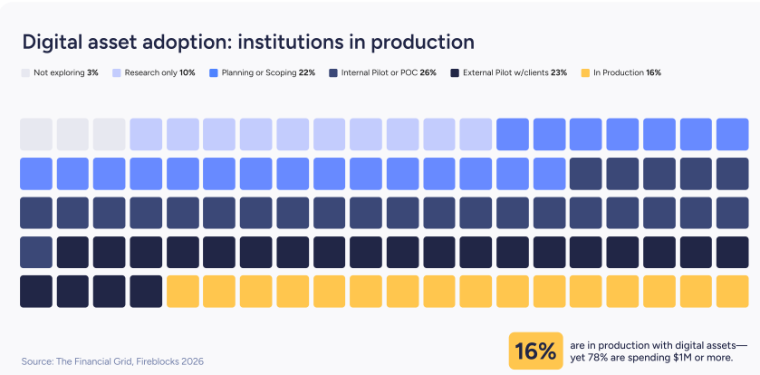
According to the Financial Grid report, 88% of financial institutions have allocated or will allocate budget to digital asset infrastructure in 2026. However, only 16% have reached the production stage.
That gap between investment and readiness indicates that while the decision to build has been made, the market is working on converting that commitment into live, scalable infrastructure.
More than half of financial institutions are spending US$1 million or more on digital asset infrastructure this year, which places them beyond early experimentation, the report indicates.
When operating at that level, budgets are deployed towards vendor selection, architectural decisions, systems integration, staffing, compliance work, and the operational foundations required for production. This is conversion spending, but it does not escape from the lens that production will remain the real test.
The next phase will require hitting the right note on infrastructure decisions, architecture choices, and entry points.
Featured image edited by Fintech News Singapore based on an image by End.ru99 on Magnific