



Tazapay is putting US$36 million behind agentic payments and cross-border stablecoin rails, betting that AI agents will soon be paying for software by transaction.
The Singapore-based payments company closed a Series B extension led by Circle Ventures, with Coinbase Ventures and CMT Digital joining as new backers, taking its total Series B to US$36 million.
The fresh capital is earmarked for licensing, corridor expansion across Asia, Latin America, the Americas, and the Middle East, and infrastructure for AI-driven payments.
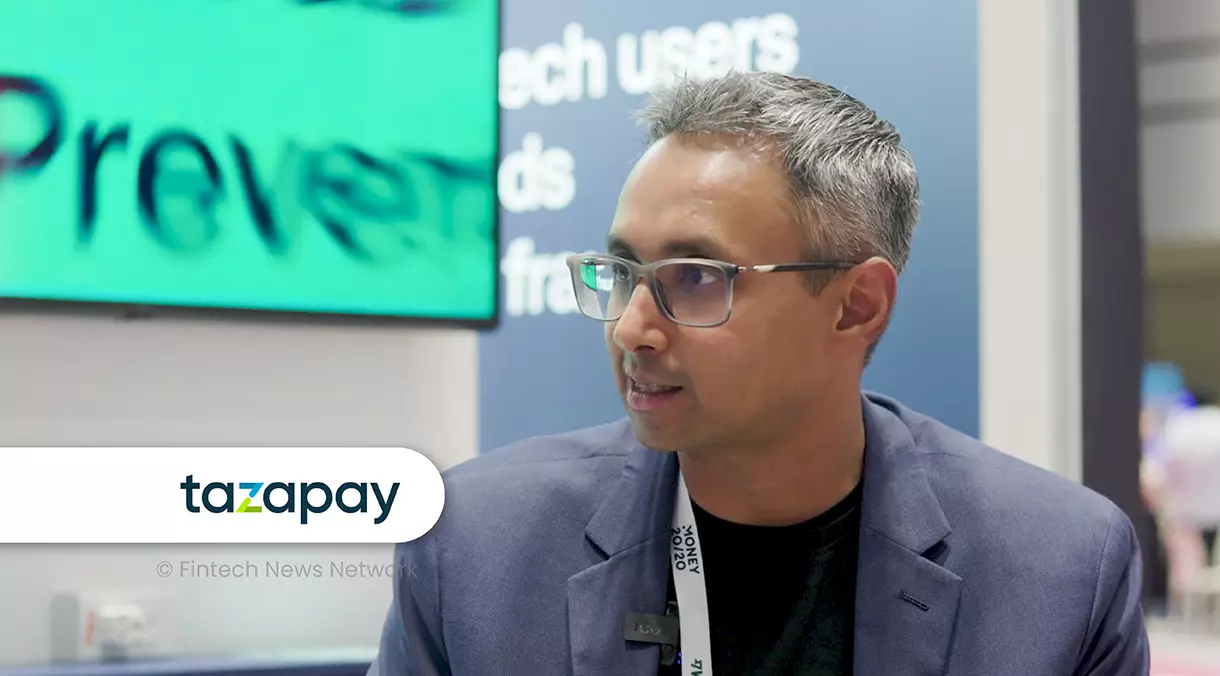
In an interview with Fintech News Network’s Chief Editor Vincent Fong, Chief Product Officer Aayush Singhania unpacks how Tazapay onboards customers across 70+ countries through its partnership with Sumsub, the governance challenge standing between AI agents and unsupervised payments, and what the company is building next.
Why Is So Much Investor Money Flowing into Stablecoins?
In March 2026, four Singapore startups raised a combined US$150 million for stablecoin-related ventures. When asked about why capital is pouring into stablecoins now, Aayush said it mirrored how far domestic payments have already come.
Real-time networks run in 80+ markets, from FAST in Singapore to PromptPay in Thailand and PIX in Brazil. All these networks move volume at scale, yet cross-border payments have kept pace.
Money still travels through correspondent banks, hopping across two or more intermediaries and taking two to three days to land in the beneficiary’s account.

“According to UN estimates, moving $200 across borders still costs 6.2% in 2026,” Aayush shared. “To compound the problem even further, there is $30 trillion stuck in nostro and vostro accounts, which is just dead capital to facilitate settlements.”
Aayush believes that this is where stablecoin comes in; as a game-changer. Stablecoins can be moved 24/7 across the border, is instant and irrevocable, and crucially, they do not require pre-funding.
He explained further,
@fintechnewsnetwork How Stablecoins Solve a $30 Trillion Problem Roughly $30 trillion sits idle in the global banking system just to keep cross-border payments moving. Aayush Singhania, CPO of @tazapay, on how stablecoins free that capital, settling across borders instantly with no pre-funding. fintech banking stablecoins payments
♬ original sound – Fintech News Network – Fintech News Network
Tazapay, for its part, is building the fiat bridge for stablecoins and in doing so, making stablecoins usable to consumers and clients.
“From the user’s perspective, they don’t realise that crypto is involved. The experience layer continues to be in fiat, whereas the magic happens in the money movement with stablecoins as the transport layer. That is what is really driving investor interest,” Aayush said.
The Messy Part of Onboarding Friction Points
Tazapay onboards customers globally, and Aayush shares that the organisation splits this process into two parts.
The first part involves identity verification, and the obstacle here, he explained, is fragmentation. Every market authenticates people differently: in Singapore, a customer might be verified through SingPass, but in India, it may involve an Aadhar card or passport.
Business verification is just as uneven. Some markets maintain databases where a company’s identity can be confirmed directly, while others have no API to reach them.
The challenge for Tazapay is to absorb those different variations of fragmentation and still present a single, unified experience to every client.
To resolve this, Tazapay partnered with Sumsub, which Tazapay a single pane of glass to onboard customers uniformly. Aayush shared,
@fintechnewsnetwork Onboarding Across 70 Countries Is Harder Than It Looks Every market has its own rules for verifying who a customer is, and the complexity is often underappreciated. Aayush Singhania, CPO of Tazapay, on how a partnership with Sumsub simplifies a problem many fintechs hit when they expand. Fintech Banking finance
♬ original sound – Fintech News Network – Fintech News Network
The second check is messier, as Tazapay has to confirm if a client will actually use the platform for the purpose they claimed it is for. Aayush explained,
“To solve this, we do a variety of checks when we onboard a customer. We verify the kind of terms and conditions which are on their platform. Are they licensed to sell those products in the market?”
As these checks were previously tedious and heavily manual in nature, Tazapay has invested heavily into AI-based stacks running in real-time.
“This enables us to onboard any business in minutes instead of days,” he shared.
AI Agents Will Soon Need Their Own Way to Pay
Aayush shared that over the past three to four months, the capability of AI models have moved quickly, and that changes what is possible in payments. He pointed to B2B flows where citing a McKinsey study, almost 60% of payments still require manual intervention.
Agents could soon take these on. Within a year or two, Aayush anticipates that businesses can lean on agents to book travel, manage procurement and more. Once agents do the work though, they would also need to settle the bill.
“When agents start running this, they will need ways to pay, and that’s where agentic payments comes in,” he explained.
Tazapay is approaching the opportunity from two directions at once, building for both the acceptance side, where merchants take payments from agents, and the payer side, where businesses provision and control what their agents can spend.
To learn more about Tazapay and how AI agents are already paying for API calls and data using stablecoins, watch the short video below.
Featured image by Fintech News Singapore
