



If you are picking a forex broker in Australia, the single most useful thing to check first is who regulates it. In Australia that job belongs to ASIC, the Australian Securities and Investments Commission. An ASIC licence does not promise you profits or a good experience, but it does set hard limits on how much risk a broker can hand a retail trader, and those limits change the maths of trading more than any spread or bonus. Here is what the rules actually do, and where they stop.
Who ASIC is and why it matters
ASIC is the government body that oversees financial services and markets in Australia. For forex, the part that matters most is its CFD product intervention order, which came into force in March 2021 and still applies. Forex trading for most retail clients happens through CFDs, or contracts for difference, which are agreements that track a currency pair & price without you owning anything. The order set conditions on how those products can be sold to retail clients.
Why did ASIC step in? Its own reviews found that most retail CFD accounts were losing money, and often losing it fast. These limits were introduced after ASIC found that the majority of retail CFD traders were losing money at unsustainable rates. So the rules are less about helping you win and more about slowing down how quickly you can lose.
The leverage cap is the big one
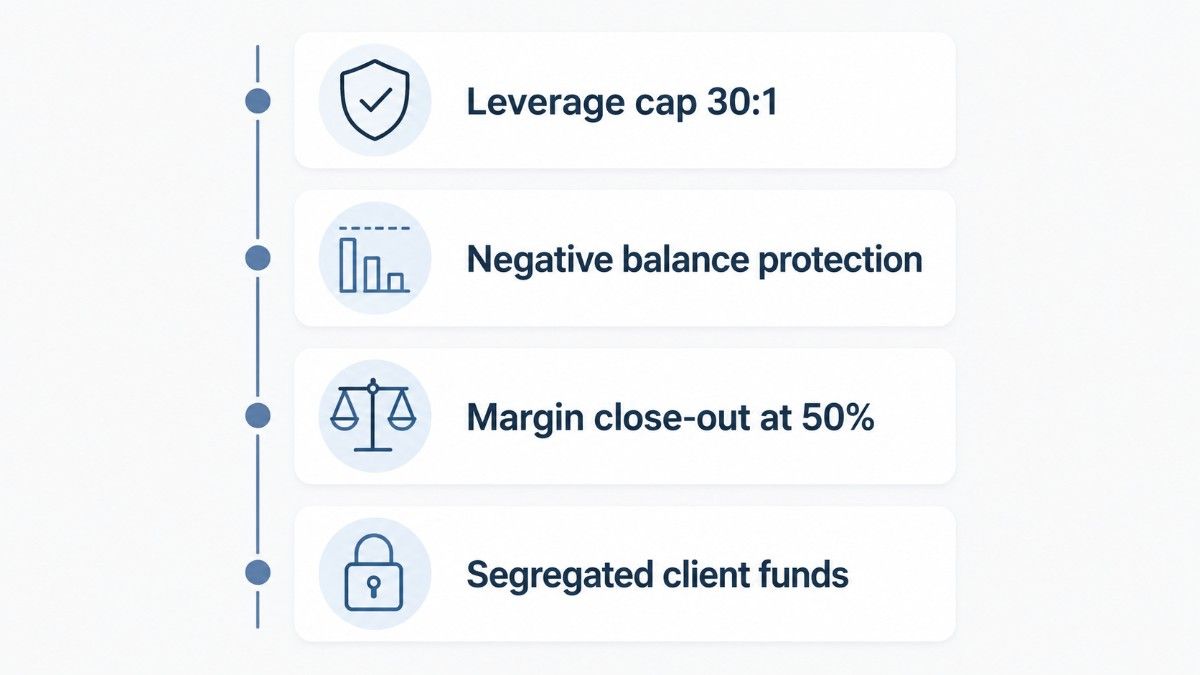
Leverage lets you control a large position with a small deposit. At 30:1, a 1,000 AUD deposit can control a 30,000 AUD position. That cuts both ways: it multiplies gains and losses equally.

Under ASIC’s rules, an Australian broker offering CFDs to retail clients cannot exceed these caps:
| Asset | Maximum retail leverage |
|---|---|
| Major currency pairs | 30:1 |
| Minor pairs, gold, major indices | 20:1 |
| Commodities other than gold | 10:1 |
| Shares | 5:1 |
| Crypto-assets | 2:1 |
Retail leverage is capped at 1:30 for major currency pairs, 1:20 for minor pairs, gold, and major indices, 1:10 for commodities excluding gold and energies, 1:5 for shares, and 1:2 for crypto-assets. You will see offshore brokers advertising 1:400 or 1:500 to Australians. That leverage is real, but it usually runs through an overseas entity under a different regulator, which means the ASIC protections below may not apply to you. That is a trade-off worth understanding before you chase a bigger number.
The protections that come with the cap
Leverage limits get the headlines, but two quieter rules do a lot of the actual protecting.
Negative balance protection means your losses cannot exceed what you put in. If the market gaps hard against you overnight, you can lose your whole deposit, but you will not end up owing the broker money on top. easyMarkets, for example, was one of the early brokers to build this in, and it is now a baseline requirement for ASIC retail accounts rather than a selling point.
The margin close-out rule is the second. If margin levels fall to 50% of the required margin, ASIC brokers must close out their clients’ positions. In plain terms, once your account drops to a set threshold, the broker automatically shuts your losing trades instead of letting them run to zero. It is a circuit breaker, not a safety net you should lean on.
On top of these, ASIC-regulated brokers must keep client money segregated from company funds and hand you a Product Disclosure Statement and a Financial Services Guide before you trade. Those documents are dry, but they are where the real costs and conditions live.
The professional-client loophole
There is a carve-out worth knowing about, because brokers mention it and it confuses a lot of newcomers. The caps above apply to retail clients. A trader who qualifies as a wholesale or professional client can access much higher leverage. Eligible professional clients can access leverage of up to 1:500 on major and minor forex pairs.
Qualifying is not automatic. You generally need to show significant trading volume, a large enough balance, or relevant experience, and reclassifying yourself strips away several of the retail protections described above. For someone new to trading, staying retail is almost always the safer setting, even though it feels more restrictive.
How to check a broker’s status yourself
- Find the AFSL number on the broker’s site, usually in the footer or the legal pages.
- Search that number on ASIC Connect’s professional registers to confirm the entity and that the licence is current.
- Confirm which entity actually onboards Australian clients. Some global brands run several entities, and only the local one carries ASIC oversight.
- Read the risk warning. ASIC-regulated brokers must state how many of their retail accounts lose money, and the figures are sobering.
If a broker cannot produce a valid AFSL and an Australian entity, that is your answer.
A balanced word on risk
None of this makes forex safe. The protections reduce how badly a single bad night can go, but the underlying activity remains high risk, and the loss statistics brokers are forced to publish make that clear. ASIC caps also do not run a compensation fund the way the UK’s scheme does, so a broker failing is a different problem from a trade going wrong. Regulation is a floor, not a guarantee. It tells you a broker is playing by known rules, not that the game is easy or that you will come out ahead.
FAQs
Is forex trading legal in Australia? Yes. It is legal and regulated by ASIC. Brokers offering CFDs to Australian retail clients must hold an AFSL and follow the product intervention rules.
What is the maximum leverage I can get as a retail trader? 30:1 on major currency pairs. Lower caps apply to other assets, down to 2:1 on crypto. Higher leverage exists only through professional-client status or offshore entities.
Does an ASIC licence mean my money is guaranteed? No. It means segregated funds, negative balance protection, and a margin close-out rule apply. It does not guarantee profits, and Australia has no statutory compensation fund for CFD clients.
How do I know a broker is really ASIC-regulated? Find its AFSL number and look it up on ASIC’s public register. Confirm the Australian entity is the one onboarding you, not an overseas branch.
Why do offshore brokers offer so much more leverage? They operate under regulators with looser or no caps. The higher leverage is real, but you usually give up the ASIC retail protections to access it.
Choosing a forex broker in Australia comes down to reading the rules before the marketing. ASIC’s framework caps your leverage, stops your balance going negative, and forces brokers to close losing positions before they run away from you. Those limits can feel like handcuffs when a competitor is waving 1:500 in your face, but they exist because the data on retail losses is bad. Check the AFSL, read the disclosure documents, and treat regulation as the starting point of your decision rather than the whole of it.
Disclaimer: This is an article written by easyMarkets; Fintechnews does not endorse and is not responsible for or liable for any content, accuracy, quality, advertising, products or other materials on this page. Readers should do their own research before taking any actions related to the company. Fintechnews is not responsible, directly or indirectly, for any damage or loss caused or alleged to be caused by or in connection with the use of or reliance on any content, goods or services mentioned in the article.
Please note this is no investment advice.
Featured image by easyMarkets
