



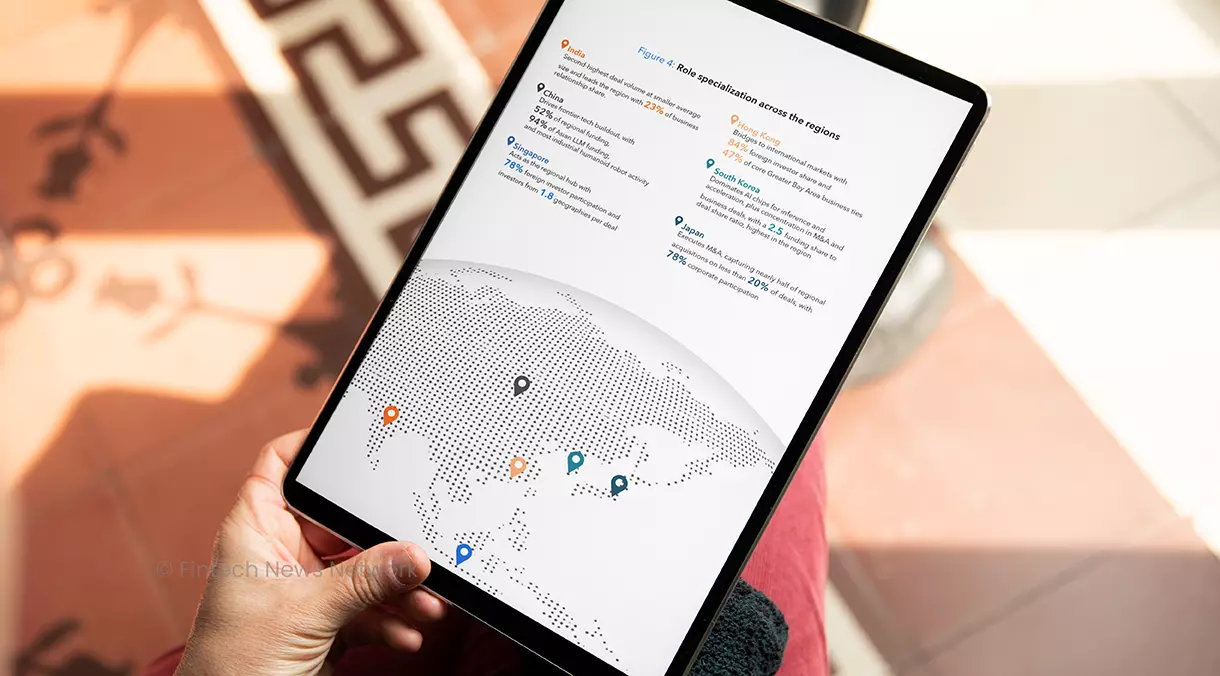
Asia has emerged as a prominent innovation hub, driven by the region’s diverse markets playing unique roles and leveraging their specific expertise to accelerate various stages of the startup lifecycle.
A new research by startup market intelligence and analytics company CB Insights looks at the Asian tech landscape, examining 11 markets and interviewing over 30 senior investors and founders to map how this ecosystem works.
The report emphasizes a network of countries, each specializing in different stages of the startup lifecycle. This open, multi-country innovation model is designed to promote resilience and enable rapid innovation on a large scale.
According to the report, Asia presents unique particularities that come with their specific challenges. In particular, the region provides diverse, often chaotic markets that force companies to build with constraints in mind from day one. Products that survive deployment across these geographies, languages, and regulatory environments are usually more globally adaptable than those designed for a single, homogeneous market.

The report highlights the case of Singapore’s Shopee, which built one of the largest e-commerce platforms in Southeast Asia by tailoring items operations to multiple languages, payment systems, and logistics networks across markets. In 2019, it eventually expanded into Latin America, facilitating over US$100 billion in purchases globally in 2024.
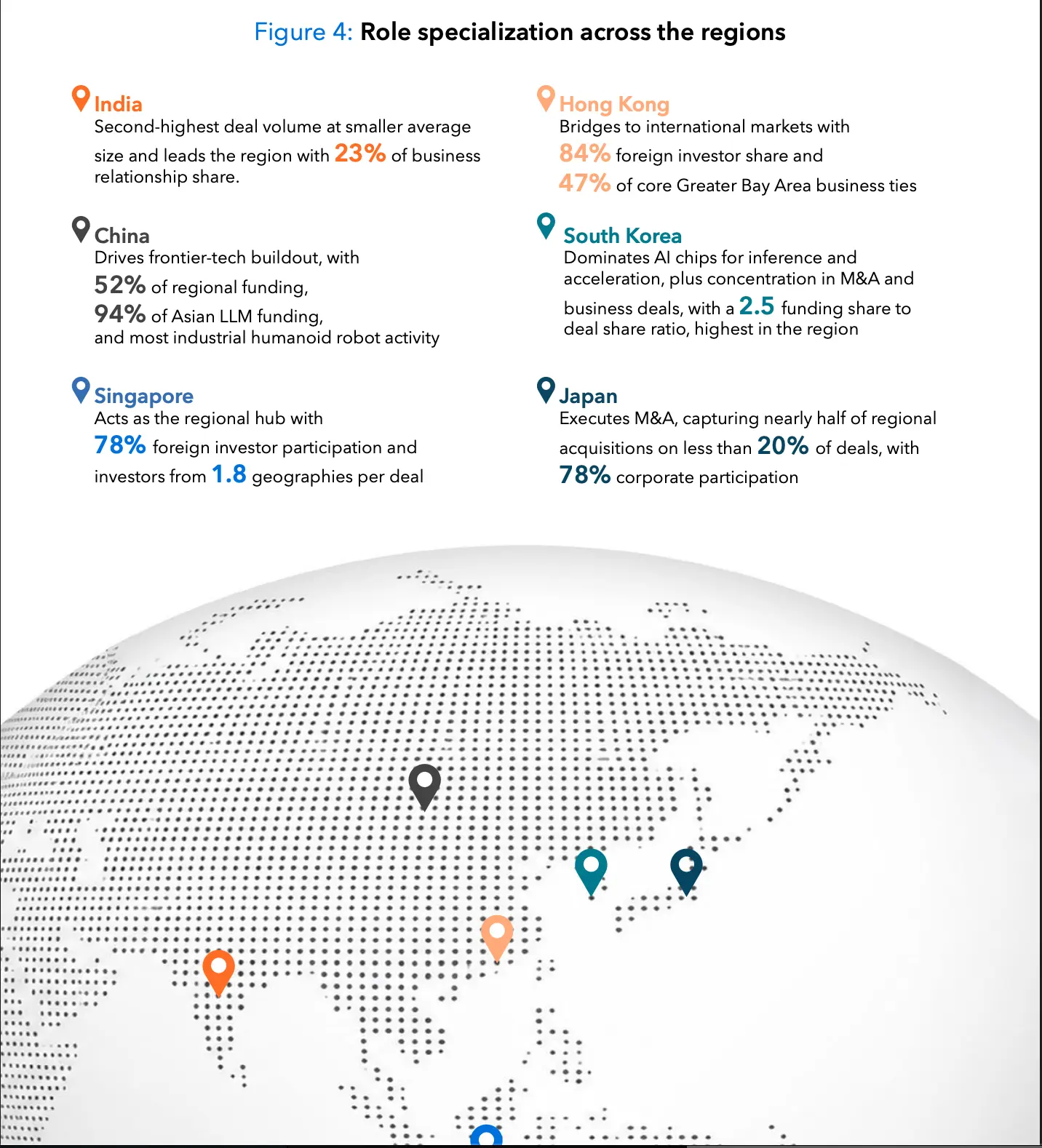
Fragmentation is a defining feature of the Asia tech ecosystem, with each country across the region possessing its own expertise and specialization. For example, China, with its abundant capital for scale, excels in frontier research and builds at scale. The country leads the charge in frontier-tech development, securing 52% of regional funding and 94% of Asia’s large language model (LLM) funding. The country is the epicenter of most industrial humanoid robot activity.
Hong Kong, meanwhile, acts as its global bridge, turning breakthroughs in China into globally investable companies. As the country’s primary international intermediary, Hong Kong accounts for over 60% of total foreign direct investment (FDI) and holds a 47% share of core Greater Bay Area business ties.
India, on the other hand, has become an expert in scaling products in markets where distribution and localization matter most. The country leads the region with 23% of business relationship share, and drives commercialization across large, fragmented markets.
Finally, Singapore effectively functions as a bridge to international capital and facilitates deals within Southeast Asia, anchoring regulatory clarity and channeling venture capital (VC) the region, while Japan steers tech exits and consolidation, capturing nearly half of regional acquisitions on less than 20% of deals, with 78% corporation participation.
Economic outlook
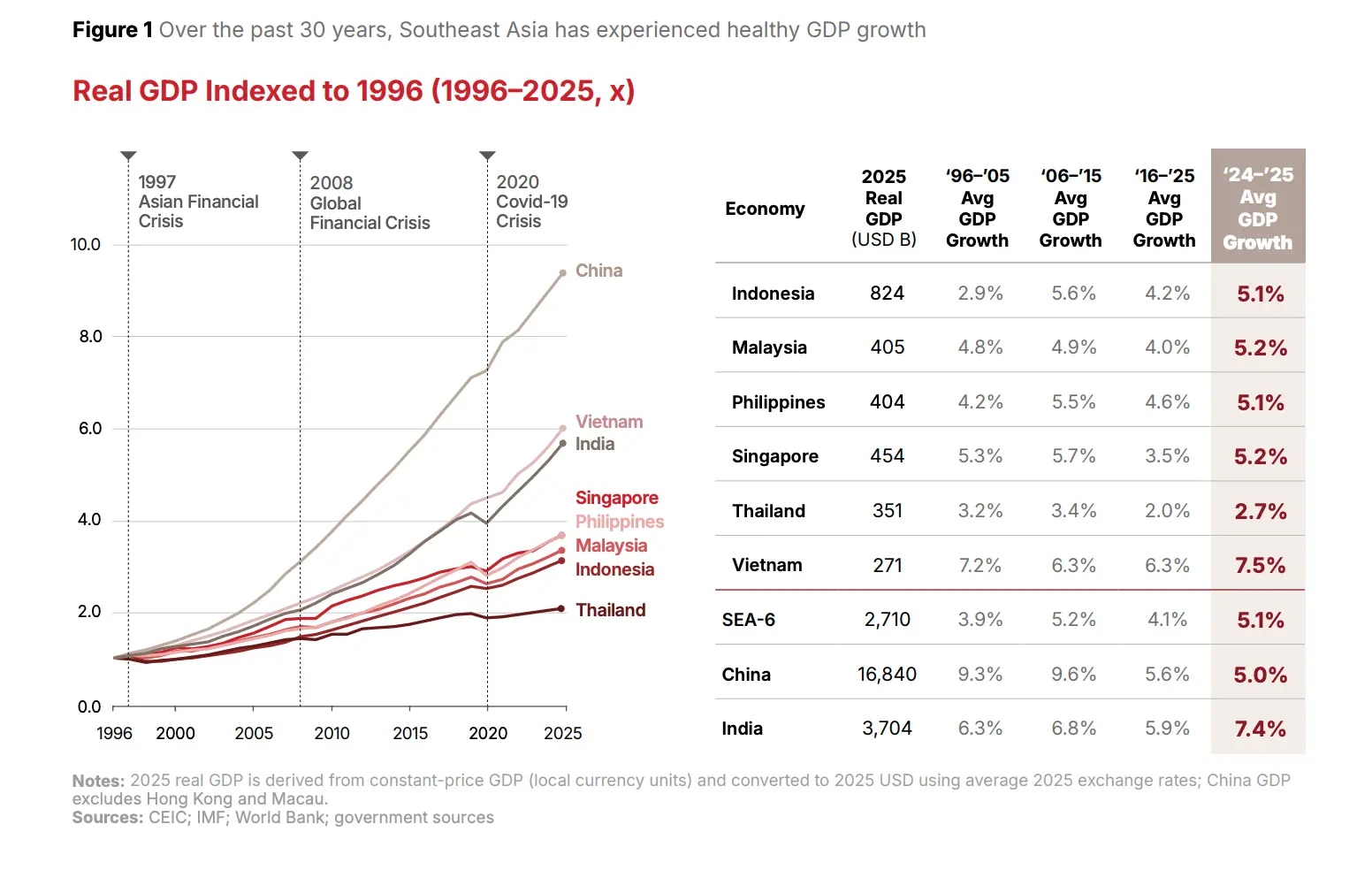
Southeast Asia’s six largest economics (SEA-6), namely Indonesia, Malaysia, the Philippines, Singapore, Thailand, and Vietnam, experienced an impressive annual growth rate of 5.1% in 2024 and 2025, according to a new report by Bain, DBS, and Vriens and Partners. Vietnam continued to lead the region with an average annual growth rate of 7.5%, a trend that’s been consistent since 1996.
Domestic capital formation growth, which reflects changes in investment and productive capacities such as machinery, buildings, and infrastructure, rose 16% annually in SEA-6 between 2015 to 2019 and 2020 to 2024 periods, and by an additional 17% in 2025.
The underlying drivers were country specific, with Vietnam achieving standout growth through export manufacturing recovery and strong public infrastructure investments, while Singapore’s growth was driven by public-led construction and semiconductor expansion, and Indonesia’s reflected continued investment in downstream industries.

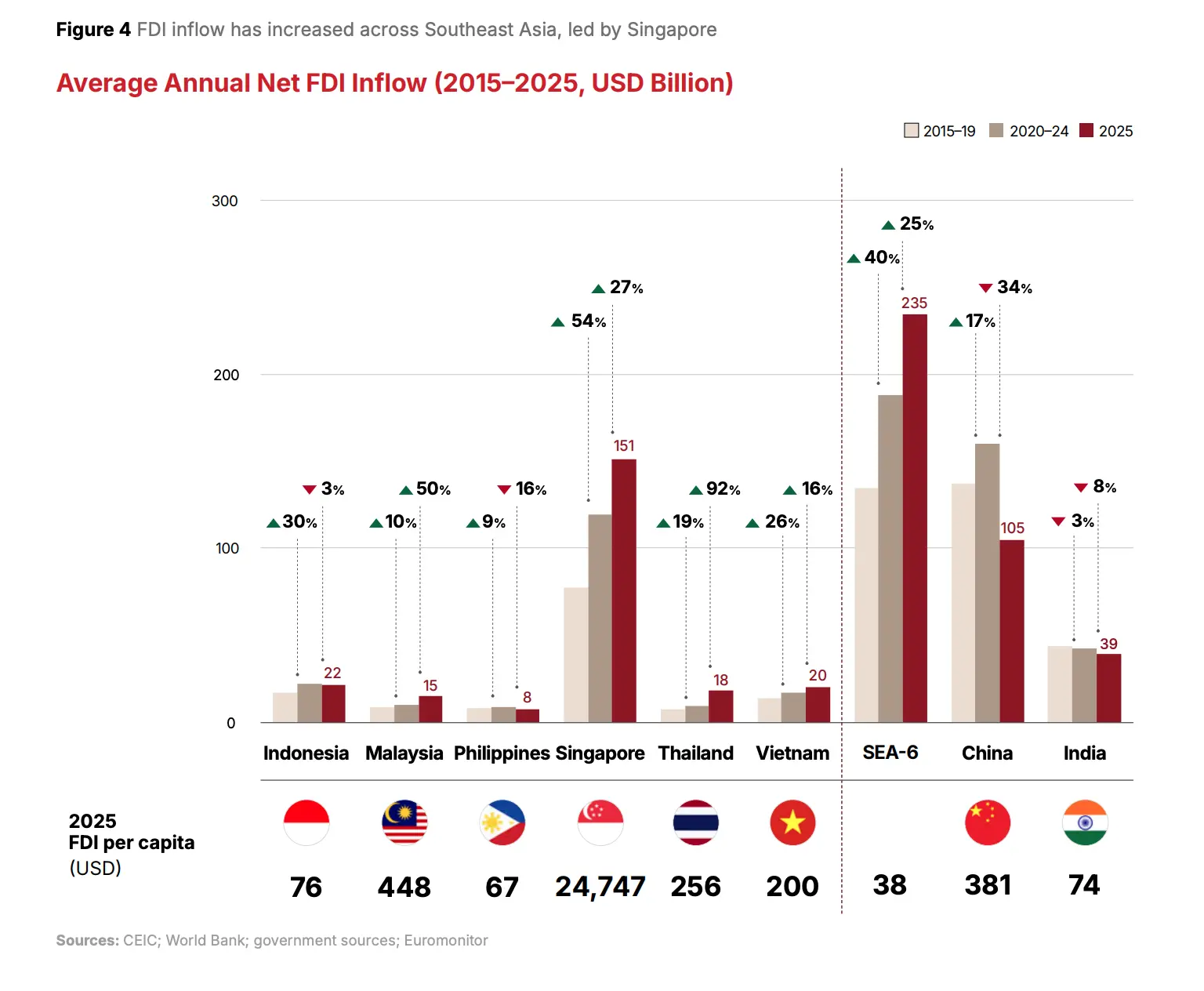
FDI inflows also increased significantly across SEA-6, though investments were concentrated in a few hubs. In 2025, Singapore captured 62.3% of total regional FDI, leveraging its role as a hub for finance, semiconductors, and biomedical manufacturing.
Indonesia and Vietnam were other significant beneficiaries, securing 9.4% and 8.5% of total regional FDI, respectively, in 2025. Thailand, meanwhile, saw FDI inflows improve by a staggering 92% between 2024 and 2025, driven by investments in digital infrastructure and advanced electronics investments.
Finally, Malaysia continued to lag behind, reporting US$15 billion in annual net FDI inflow in 2025, and accounting for 6.4% of total regional FDI. However, its semiconductor and data center commitments could signal a stronger pipeline ahead, the report says.
Data center and cloud computing projects accounted for nearly half of Malaysia’s approved investments in H1 2026, according to the Malaysian Investment Development Authority (MIDA). This reflects a strategic focus on expanding the domestic digital infrastructure.
At the time, MIDA was also reviewing more than 220 investment proposals worth a combined MYR 72.1 billion, with the near-term pipeline concentrated in semiconductors, AI infrastructure, renewable energy and medical devices.
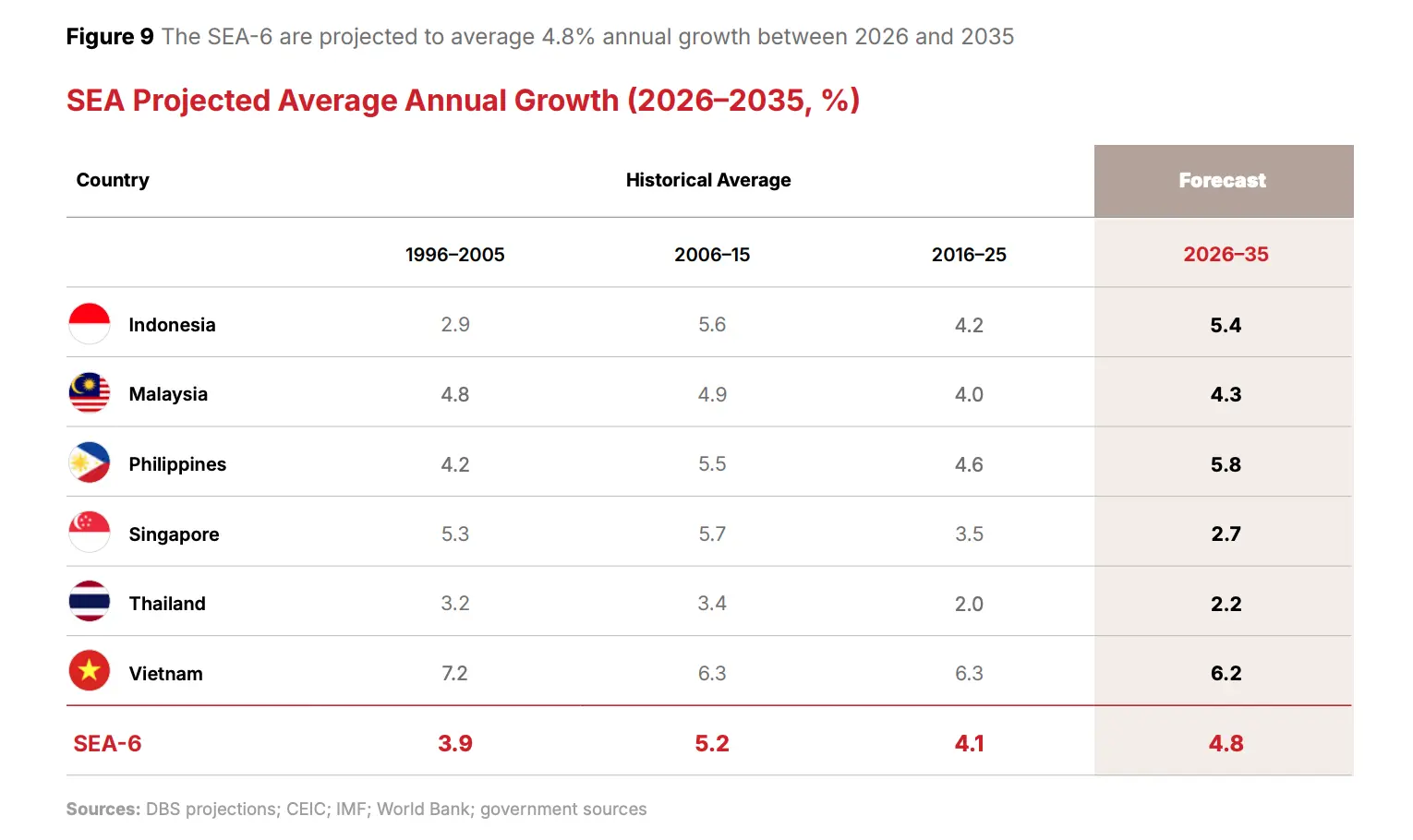
Looking ahead through 2035, SEA-6 is projected to average a significant 4.8% annual growth. Vietnam is expected to retain the regional lead through sustained FDI and productivity gains.
The Philippines and Indonesia are poised to experience substantial accelerated growth. The Philippines is projected to grow at an average annual rate of 5.8% between 2026 and 2035 fueled by a favorable demographic tailwind, consumption, infrastructure investments, and governance reforms. Indonesia, on the other hand, is expected to grow 5.4% annually through boosted domestic consumption and further industrialization of its nickel and electrical vehicle value chains.
Thailand, however, is set to witness the lowest growth rate at 2.2% annually, held back by an aging population and fragmented politics.
Finally, Singapore, a mature economy, is expected to see its growth rate stabilize around 2.7%, leveraging AI-driven productivity gains to offset demographic constraints.
Featured image: Edited by Fintech News Singapore, based on image by magnific via Magnific
