

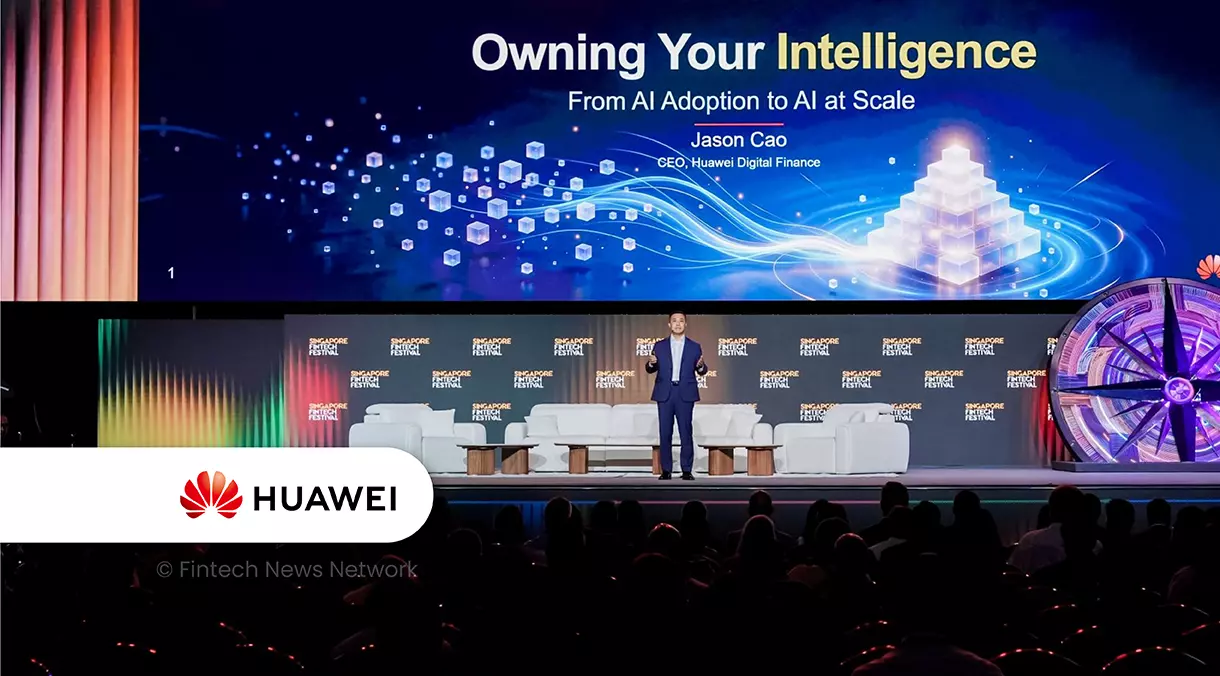
At the Singapore Fintech Festival 2026 (SFF 2026), Huawei discussed how financial institutions can scale AI agents.
The company said banks need greater control over their data, knowledge and business logic as AI moves from pilot projects into production.
Jason Cao, CEO of Huawei Digital Finance, and Alvin Feng, President of Huawei International Financial BU, delivered keynotes at the festival’s Festival Stage and Frontier Stage respectively.
Feng presented Huawei’s Fintelligent AI Solution, which the company launched at HUAWEI CONNECT 2026 in Shanghai in September.

Lessons from China’s AI rollout
Cao shared how Chinese financial institutions have adopted AI across their operations.
Huawei highlighted three areas of focus: continuous application modernisation, hybrid AI infrastructure combining on-premises systems and public cloud, and centralised AI development under an enterprise-wide architecture.
These institutions have integrated AI into core banking processes, including mobile banking, credit and risk management.
Cao said banks must prepare to serve AI agents alongside human customers. As consumers increasingly use their own agents to find information and access services, banks will need to make their offerings accessible to these agents.
Huawei’s Two Super Agents model for banks
Huawei is developing an architecture called “Two Super Agents, Multiple Specialised Agents”.
It consists of a Customer Super Agent and an Employee Super Agent. Specialised agents support functions such as credit, marketing, risk management and wealth management.
The model aims to turn banks’ accumulated expertise into reusable AI capabilities. This includes knowledge in areas such as compliance, credit assessment and risk management.
Cao said these capabilities, developed over many years, are an important source of competitive advantage for financial institutions.
Three factories behind Fintelligent
Feng’s keynote, titled “Owning Your AI, Advancing Agentic Finance”, focused on helping financial institutions move AI projects into production.
He highlighted the need for open architecture, standardised engineering to build agents at scale, and shared assets that teams can reuse across business functions.
Fintelligent runs on Huawei’s open hybrid AI infrastructure and comprises three components.
The Agent Factory provides a central platform for financial institutions to build, deploy, manage and govern AI agents.
Its Agent Marketplace also allows organisations to share and replicate agents across different business units.
The Token Factory uses Huawei’s TokeNexus solution to plan, schedule and optimise token supply. Tokens are the units of content that AI models process.
Huawei said the solution helps institutions manage costs and maintain performance as AI usage increases.
The Data-Knowledge Factory provides AI agents with the information they need through an AI-driven data pipeline and a centralised knowledge pipeline.
At its exhibition area, Huawei also showcased solutions for the insurance, securities and central banking sectors, alongside offerings developed with partners under its RONGHAI Financial Partner Program.
In Singapore, financial institutions remain accountable for managing AI-related risks even when they use technology from external providers.
This is reflected in the Monetary Authority of Singapore’s (MAS)AI risk guidelines.
Huawei said it has 16 years of experience in the financial services industry and serves more than 7,100 financial institutions worldwide, including 54 of the world’s top 100 banks.
Featured image credit: Edited by Fintech News Singapore, based on image by Huawei