



Globally, artificial intelligence (AI) is being adopted at a rapid pace for shopping discovery. But as the technology moves from exploration to execution through AI agents, adoption is becoming more selective, hindered by trust and control concerns, according to a new survey by Alipay+ and S&P Global.
The study, which polled 6,000 consumers across nine markets in Asia, Europe and the US, reveals that AI adoption is strong for travel discovery. In the space, 81.3% of the surveyed consumers are already utilizing AI-powered tools to explore destinations and experiences. Additionally, 73.2% expressed openness to using AI for hotel or flight bookings over the next 12 months. This demonstrates a keen interest in utilizing AI to discover options and offers, as well as to assist in organizing travel plans.
However, the adoption of AI for action is lower, with consumer confidence declining as the technology moves closer to payments and autonomous decision-making. In particular, only 26% of consumers shared interest in using agentic AI for transactions, reflecting skepticism about allowing the technology to make and execute purchases.
The research indicates that this gap between AI discovery and execution stems from trust and control concerns. Privacy concerns regarding AI among travel purchasers are prevalent globally, with 43% of respondents citing them as a significant factor. Additionally, 43% of consumers expressed hesitation to use AI assistants because they prefer to plan their travel independently, while 32% expressed a preference for human advice.

Clear thresholds and controls
Findings from the Alipay+ and S&P Global study align with those of other research. Checkout.com’s Agentic Commerce 2026 report, released in June, surveyed in Q1 2026 400 heads of payments at consumer-facing businesses, and more than 12,000 consumers globally, and found that many consumers are not yet ready to delegate spending.
The research indicates that 24% of consumers expressed a firm refusal to delegate purchases to AI, while 8% remain unsure. 27% trust no organization to operate an AI shopping agent.
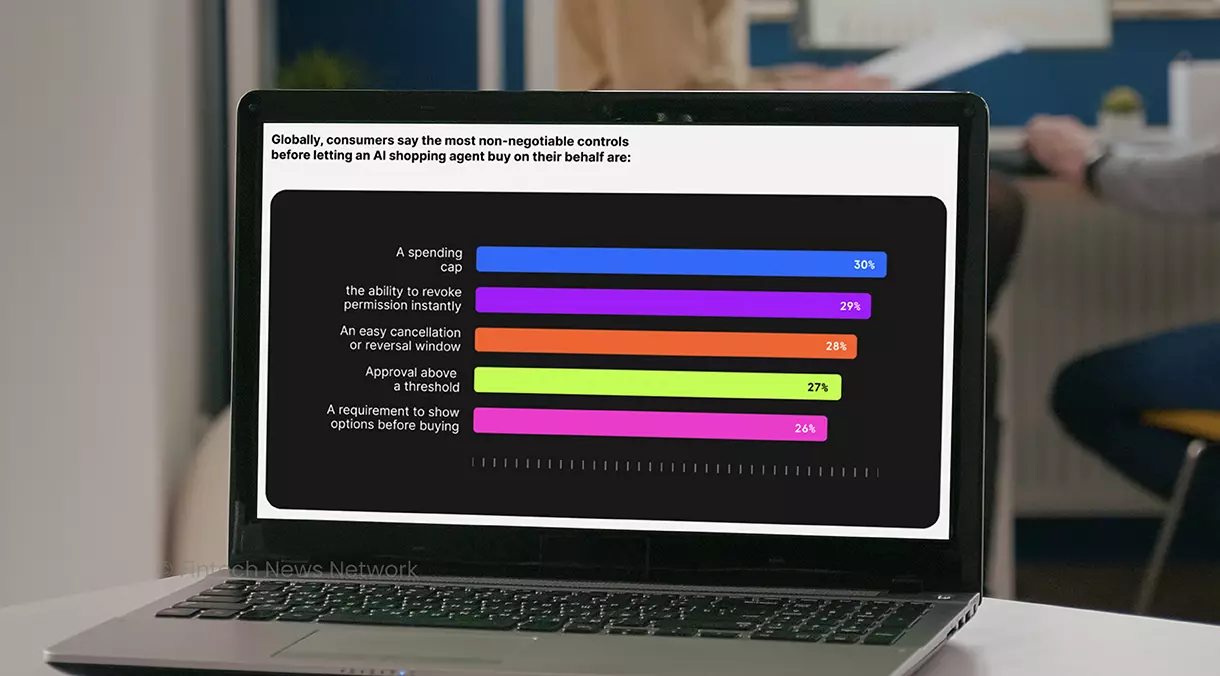
Globally, consumers want transparency and the ability to step in. They identified spending caps (30%), the ability to revoke permission instantly (29%), an easy cancellation or reversal window (28%), approval above a threshold (27%), and a requirement to show options before buying (26%) as the most non-negotiable controls before letting an AI shopping agent buy on their behalf.

Merchants recognize these needs. Notably, 75% of the businesses polled emphasized the significance of providing customers with the real-time ability to revoke permissions for the success of an agentic commerce program.
Consumers also expect clearer boundaries around who should be allowed to use these tools with clear thresholds and strong controls. In particular, 77% believe that individuals must be over 18 to complete purchases using an AI shopping agent.
Interest in agentic commerce builds up
Globally, interest in agentic commerce is increasing, driven by its convenience, the enhanced shopping experience it offers, and the ability to automate routine tasks. Notably, 25% of the consumers surveyed said that saving time is the top motivator for them to use an AI shopping agent. Additionally, 57% said they would let AI switch brands for better value, while 20% want AI to make sure they never miss a better deal.
Currently, only a small percentage of consumers are using AI agents for shopping. Nearly 13% of consumers utilize AI to execute one in 10 of their transactions. 33% expect to reach that point within the next 12 months, and another 13% expect to do so in one to two years.
Merchants are responding to these demands, with 89% of businesses in the UK and the US actively preparing for agentic commerce. In the US, 39% of merchants expect agentic commerce to reach 10% of their online transactions within six to 11 months, a figure that stands at 30% in the UK.
Merchants are also convinced of the size of the shift ahead. 82% of US merchants believe agentic commerce will be the most disruptive force to hit their industry, a figure that stands at 58% for UK merchants.
Agentic commerce in Asia
In Asia-Pacific (APAC), agentic shopping is still in infancy, with around 29% of consumer businesses currently adopting agentic AI, according to Deloitte’s State of the AI research. However, this figure is expected to surge to 76% within two years.
Across the region, industry stakeholders and government agencies are actively collaborating to establish the groundwork for agentic commerce.
Ant International, the global payments and financial-services arm of Ant Group based in Singapore, is collaborating with Mastercard and Visa on agentic commerce, working together on a “know-your-agent” interoperability framework based on shared principles. This framework aims to identify and verify AI agents that can make purchases on behalf of customers, ensuring the safety and interoperability of agentic commerce across various payment networks and AI agents.
In India, the National Payments Corporation of India (NPCI) is preparing to roll out agentic payments on the Unified Payments Interface (UPI), potentially making UPI one of the world’s largest networks with agentic payments, Reuters reported earlier this month.
Agentic payments on UPI would allow AI agents to make small, frequent digital payments without requiring users to approve each transaction, with groceries and other low-value purchases expected to be among the first applications.
The payment authority is also building a registry to verify and monitor AI agents making transactions on UPI, three sources involved in the discussions told Reuters this week. The registry could later on be expanded to cards, bill payments and other payment methods.
McKinsey research estimates that by 2030, agentic commerce could orchestrate US$3 trillion to US$5 trillion globally. This value will be driven by AI agents increasingly influencing discovery, decision-making, and transactions across many product categories.
Featured image: Edited by Fintech News Singapore, based on image by DC Studio via Magnific
