



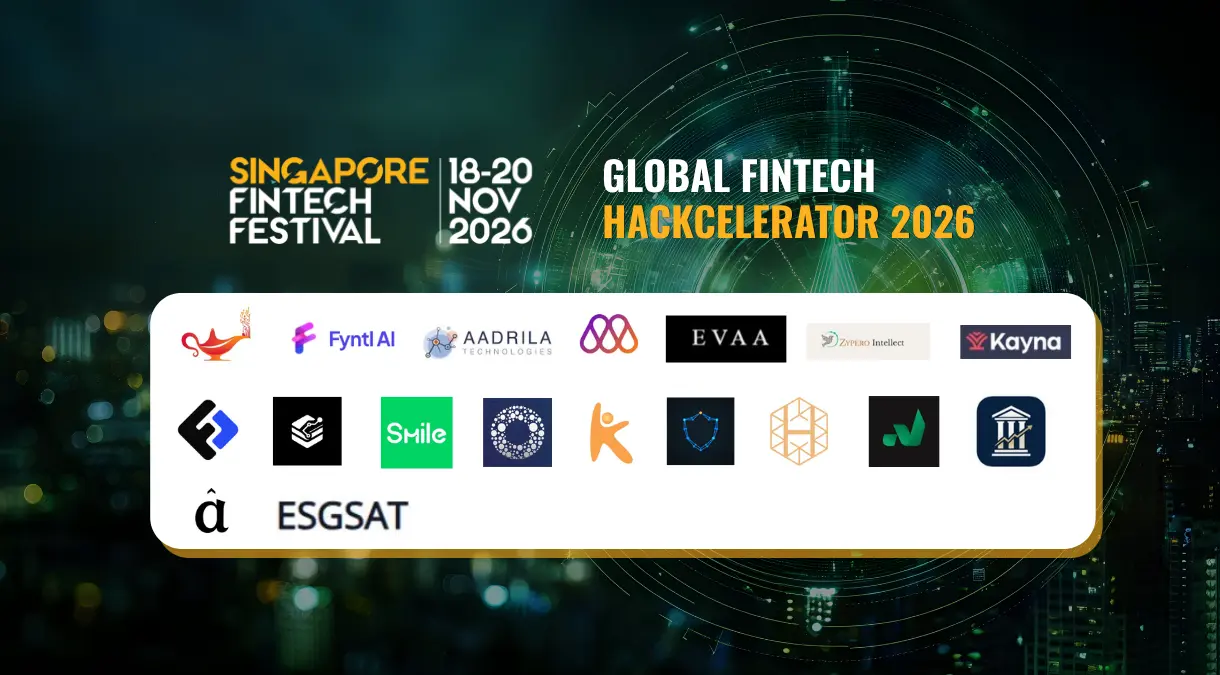
The Monetary Authority of Singapore (MAS) has selected 18 finalists for the Global Fintech Hackcelerator 2026 from 195 applications submitted across 52 jurisdictions.
Now in its 11th edition, the programme is organised by MAS and the Global Finance & Technology Network (GFTN), a not-for-profit organisation established by the regulator.
It connects early-stage fintech startups with financial institutions to develop solutions to specific industry challenges. This year’s Corporate Champions are GXS Bank, Julius Baer and Zurich Insurance.
GXS Bank, Julius Baer and Zurich set three industry challenges
GXS Bank is seeking a risk modelling system that combines credit and fraud assessments. Both areas rely on overlapping data but are typically evaluated separately.

The bank wants a unified framework that can continuously learn and adapt.
Julius Baer’s challenge focuses on using AI to improve digital private banking services for the next generation of high-net-worth clients.
It covers personalised experiences across the customer journey, from onboarding to portfolio advisory.
Meanwhile, Zurich Insurance is looking at how AI can help SMEs better understand their risks and insurance needs.
Its challenge calls for tools that identify coverage gaps in real time and guide businesses towards suitable protection as they expand.
Finalists to compete for S$80,000 prizes in November
The 18 finalists will take part in a virtual programme from October to November, before attending an in-person programme in Singapore from 11 to 13 November 2026.
Participants will receive mentorship, access to investors and masterclasses. They will also have opportunities to explore pilot projects with the Corporate Champions.
Each finalist will present their solution at the Global Fintech Hackcelerator Demo Day on 18 November, during the Singapore Fintech Festival (SFF).
Three winners, one for each challenge, will be announced at the SFF Fintech Excellence Awards 2026 dinner on 19 November. Each will receive S$80,000 in prize money.
Finalists can apply for the GFH Scale-up Grant, which offers follow-on funding to support further development, commercial milestones and establishing a presence in Singapore.
MAS opened applications for this year’s competition in June.
Here Are the 18 Finalists for 2025 Global Fintech Hackcelerator
Aadrila (India)

Team Aadrila combines institutional banking depth with enterprise AI execution. Founders spent a decade inside banks watching credit and fraud teams operate in silos; UnifAI is the direct product of that insight. The team has scaled SaaS across financial services commercially, growing Aadrila to 50+ enterprise clients, bootstrapped and profitable.
Together: domain fluency in risk, and the discipline to ship production-grade AI at scale. OmniRix replaces separate credit and fraud models with a single shared encoder, entity graph and online learner that adapts in real time.
By assessing applicants within their wider network, it detects fraud rings that per-applicant checks miss, approves creditworthy thin-file customers that static models decline, and explains each decision in plain language. The solution runs in shadow mode alongside a bank’s existing infrastructure, so it can be adopted without disruption.
ByteGenie (Singapore)

ByteGenie enables enterprises to automate messy internal workflows by learning explainable business logic from their data, which can be audited, executed without hallucinations, and verified against business rules and constraints.
ByteGenie is a symbolic AI platform that learns explainable business logic from an organisation’s own data. The logic it produces can be audited, executed without hallucinations and verified against business rules and constraints.
This allows complex credit and fraud workflows to be automated while every decision remains transparent and verifiable.
FinBox (India)

FinBox is a B2B credit infrastructure provider that enables enterprises, non-bank financial companies and banks to embed financial services into their ecosystems. Its AI-powered solutions, APIs and data intelligence products help partners launch and scale credit products quickly and responsibly.
FinBox’s DeviceConnect module captures consented behavioural signals, which are combined with bureau data and scored by its Sentinel AI model as one learning system.
Every decision is explainable, and policy changes are simulated on historical data before deployment, so the system improves with each cycle without manual re-tuning.
Mulai.com (Singapore)

The Mulai team is focused on keeping the financial environment safe from crime and fraud, and has continued to grow its base of customers, partners and case studies.
By scoring credit and fraud risk together in real time, the platform breaks down data silos so that thin-file customers can be assessed safely. It delivers high-speed decisions at bank scale, with no-code configuration that gives risk teams the flexibility to adapt their models.
ResponCibleAI (India)

ResponCibleAI is creating the trust layer for enterprise AI:addressing one of the fastestgrowing global markets by enabling organisations to safely operationalise autonomous AI in highly regulated industries.
ResponCibleAI’s Athena models assess a customer’s capacity, identity and intent within one continuously learning model, using geographic data as a live risk signal. In the team’s testing against siloed approaches at the same approval rate, Athena identified a significant share of losses that neither credit nor fraud models had flagged.
Smile API (Singapore)

Smile is the unified identity verification and risk management platform FinTechs and digital banks use to verify identity, assess fraud and credit risk, and monitor customers over time – all from one continuously updated risk profile, delivered through a single API.
Smile API puts credit and fraud risk on one profile. With the customer’s permission, we pull income, employment, identity, device and cross-lender signals into a single record that keeps updating. The two risks are judged together, not separately, and re-scored whenever anything changes.
Banks can approve worthy customers with limited credit history who would otherwise be declined, while catching risky applicants a fragmented system might miss.
EVAA (Singapore)

EVAA builds Tellerbird, an AI operating system for investment banks, funds and family offices. Tellerbird is deployed in production at a Singapore investment bank and a multi-family office, covering client onboarding, agentic co-working and deal and prospect matching, with every outbound action held for human approval and fully audited.
For private banking, Tellerbird allows clients to connect the AI assistant they already use, which the bank then verifies and scopes through a ‘Know Your Agent’ process.
All figures are calculated in code rather than generated by AI, all advice is routed to the relationship manager for approval, and every request is logged, giving digitally native clients an AI-native channel that operates within the bank’s governance controls.
Humancraft AI (Singapore)

Humancraft AI is a solo-founder team in Singapore. Doreen Chee spent 10+ years inside digital banking, delivering digital products and leading digital engagement and UX at Citi, Standard Chartered, DBS and Arab Bank across Asia and the Middle East, and shipping AI into live customer journeys under real bank governance.
She knows the RM’s day and the compliance gates from the inside. Praxis gives digitally native high-net-worth clients an always-on investment committee. It monitors their portfolio, tracks their goals and presents balanced views on each opportunity based on cited evidence, while keeping their banker one message away.
By bringing the research clients already do elsewhere inside the bank, cited and audited, Praxis supports the journey from onboarding to portfolio advice as a decision-support tool rather than an execution platform.
LinqAlpha (Singapore)

LinqAlpha was founded in 2022 by Jacob Choi, Subeen Pang, Jin Kim and Hojun Choi, bringing together former Goldman Sachs analysts and MIT computer science PhDs. The team builds a multiagent AI platform purpose-built for public markets, now used by more than 70 financial institutions including BNP Paribas, Fidelity, Greenlight and Schonfeld.
Headquartered in New York with offices in Korea, Hong Kong and Singapore. LinqAlpha’s AI advisory agent works within the client’s email inbox and a web application, with no new log-in or app required. Clients ask questions in plain language and receive instant, portfoliospecific responses that reflect the bank’s house view and their own profile, while advice-related answers are drafted for relationship manager approval.
Onboarding establishes the client’s investment policy, and each approval further refines how the agent monitors the portfolio.
NestiFi (Ireland)

NestiFi is an AI-powered, white-label family wealth platform for financial institutions. It gives digitally native families one place to save and invest across generations, combining collaborative contributions, personalised AI guidance, financial education and institutional analytics.
NestiFi gives digitally native families one place to save and invest across generations, combining collaborative contributions, personalised AI guidance and financial education.
For private banks, its family intelligence layer identifies nextgeneration opportunities and turns permissioned family signals into auditable, relationshipmanager-ready actions, helping banks build relationships with heirs before wealth is transferred.
Pantheon Research (Singapore)

Pantheon Research is an institutional-grade crossasset command center transforming complex market noise into actionable execution intelligence.
Powered by quantitative frameworks, we deliver data-driven insights and narrative scanning across Global Macro, Equities (US, CN, HK, SG), Crypto, and FICC.
By synthesising structural fundamentals and dynamic risk-regime models, Pantheon arms sophisticated allocators with the precise context and risk-budgeting needed to navigate global liquidity.
Pantheon Research is a live, governed AI investment-intelligence platform for cross-asset portfolios. It combines deterministic investment frameworks, canonical market data, multi-model AI, signal delivery, agent workflows and forward validation to turn market noise into explainable investment intelligence.
Zypero Intellect (Singapore)

Zypero Intellect builds governed AI decisionsupport software for financial institutions, combining agentic AI with deterministic controls, institution-owned policies, traceable decisions and mandatory human oversight across multilingual, jurisdiction-specific deployments.
Zypero’s Wealth Advisory Studio gives advisers a single governed record from onboarding to portfolio advice for digitally native clients.
It maps beneficial ownership and verifies source-of-wealth claims against evidence, then turns client discovery into a risk-scored, adviser-approved portfolio in minutes. AI prepares each step, rules constrain it, and human advisers make the final decision.
ComplyStack (India)

Jay Dembani leads the team, bringing 18+ years in enterprise B2B SaaS, most recently as Head of Products at HyperVerge, where he scaled platform ARR from $10M to $24M and grew the product org from 3 to 35 PMs. He previously co-chaired the RegTech Committee at the FinTech Convergence Council of India (2023-2024).
He’s joined by two engineers, each with 4-5 years of hands-on experience in AI and ML, who bring the hands-on build capability to complement his product and compliance domain expertise.
Zurich Edge Risk Copilot by ComplyStack is an AI peril-scoring layer for Zurich Edge Assist, giving agents an explainable, market-specific coveragegap score during SME conversations. One configdriven engine covers India, Malaysia, and Indonesia, scoring cyber, property, supply chain, and flood risk per market. A licensed agent always delivers the recommendation.
Fyntl AI (India)

Fyntl AI was founded by two co-founders with backgrounds in engineering and AI, including experience building infrastructure at Infosys Limited and developing AI algorithms at IIT Kanpur.
The team has built and scaled products used by millions of users and combines enterprise-scale engineering, applied AI, and product execution to build intelligent financial infrastructure for businesses and financial institutions.
Fyntl RiskTwin helps SMEs continuously tracks meaningful changes, compares emerging risks with existing protection and highlights potential gaps, then guides the SME to the right next step, including review by an expert or insurer where needed.
GapShield AI (United States)

ESGSAT US unites elite geospatial AI scientists, ESG risk analysts, and veteran reinsurance underwriters. We fuse real-time satellite intelligence with deep insurance acumen to build dynamic SME risk twins.
GapShield AI creates a continuously learning risk digital twin of each business, combining real-time geospatial intelligence, supply chain graph analytics and AI-powered policy parsing to quantify coverage gaps in monetary terms rather than technical language, helping SMEs and insurers act on them.
Kayna (Ireland)

Kayna closes the SMB protection gap. They give vertical SaaS platforms the rails to embed insurance where SMEs already work, without holding risk or displacing the broker.
Kayna’s AI Policy Analyser reads policy wordings, not certificates, exposing underinsurance before a claim does.
Kayna gives vertical SaaS platforms the infrastructure to embed insurance where SMEs already work, without holding risk or displacing the broker. Its AI Policy Analyser reads the actual policy wording, rather than certificates of insurance, against live platform data to expose underinsurance before a claim does.
Because Kayna is embedded in the software SMEs already use, coverage gaps can be closed in the same workflow in which they are found.
PROSPERO (Indonesia)

Prospero’s founders pair deep domain expertise with strong engineering. CEO Bobby Putra spent 15 years in enterprise risk at banks and insurers (AIA, Bank of India, BTPN). Together they have taken Prospero live at five financial institutions.
SME RiskLens is an AI layer built on PROSPERO’s bank-grade risk engine. It turns a small business’s data into a plain-language risk profile and detects gaps in its insurance coverage.
Through Indonesia’s 83,000-cooperative programme, it provides insurers with a structured pre-underwriting signal and an embedded channel to reach SMEs and close their protection gaps.
RoboInsure Ai (United Kingdom)

Robo-Insure AI is led by Michail “Mike” Chopra and Nicholas Stewart Taylor, with 50+ years’ combined insurance, MGA formation, distribution and product strategy experience, AI, and Insurtech.
Robo-Insure AI reads SME policies clause by clause, maps them against how the business operates today, and turns hidden coverage gaps into options SMEs can act on. RoboInsure AI has built an AI agent that reads SME insurance policies clause by clause and maps them against how the business operates today.
As businesses adopt more automation, AI agents and robotics, it identifies where existing cover no longer fits, spots these gaps before a claim arises, and helps SMEs find policies that close them.
Featured image credit: Edited by Fintech News Singapore, based on image by plugstudio666 via Magnific
