Get the hottest Fintech Singapore News once a month in your Inbox
Singapore leads Southeast Asia in digital wealth adoption, according to the latest e-Conomy SEA 2026 report by Google, Temasek, and Bain & Company. Leading digital wealth platforms are used each month by 9% of Singapore’s internet users, nearly three times the share in the next-ranked market, Malaysia.
The report attributes the lead to Singapore’s affluent and financially literate consumer base, deep capital markets, and mature digital financial ecosystem.
Markets like Vietnam and the Philippines both recorded declines over the period, which the report says could likely be a short-term shift in user engagement as opposed to a “structural retreat from digital investing.”
The report also indicated that Singapore comes first in AI adoption, with 70% of its working population (3.2 million) being GenAI users. One out of three AI users here shared that they use AI every day, driving 7.7 billion in annual AI queries.
Digital Lending Leads Near-Term Growth in Singapore
Singapore’s digital loan book is forecasted to reach US$39 billion in 2026, up 18% from US$33 billion in 2025. This is reportedly faster than digital payments, where the gross transaction value is projected to rise by 7% to US$166 billion in 2026, and digital insurance, where premiums are forecasted to grow 12% to US$0.60 billion.
Over the longer term, the e-Conomy SEA report projects for Singapore’s digital lending book to reach US$92 billion by 2035, running at a CAGR of 10%.
Digital insurance is forecasted to grow fastest over that same period, at a 14% CAGR to hit US$1.91 billion, while digital payments are projected to grow at a 4% CAGR to US$242 billion.
AI Is a Widely Used Research Tool for E-Commerce
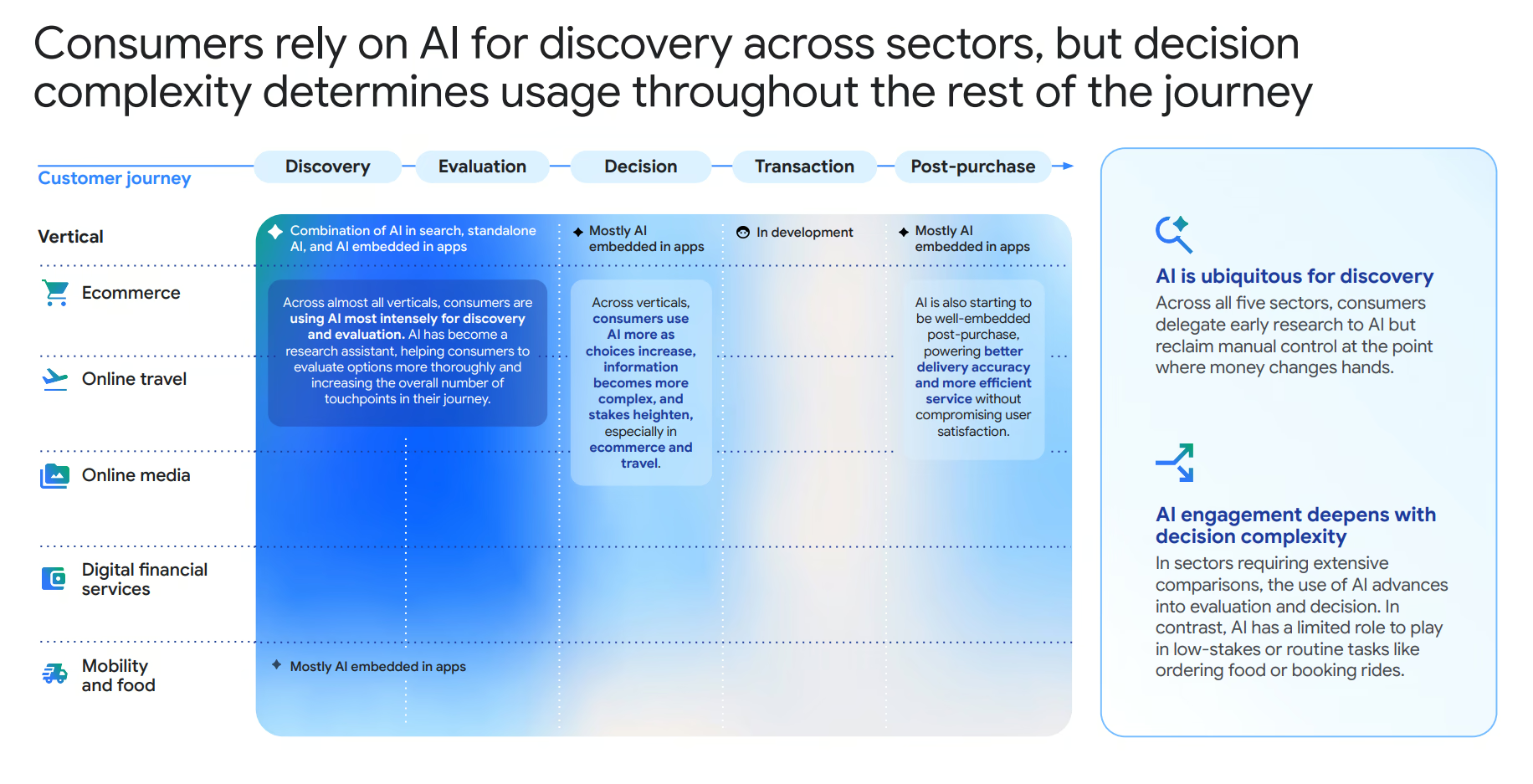
Consumers across the markets use AI mostly for discovery and evaluation, but revert to manual control where money changes hands, according to the report. It lists AI-assisted transactions as still in development, with AI after purchase mostly embedded in existing apps.
In digital financial services, 45% of AI users cited saving time as a top reason for using AI, followed by personalised support (31%) and round-the-clock convenience (28%).
The report also indicated that AI engagement deepens as decisions become more complex, and that it could potentially play a limited role in low-stakes or routine tasks such as booking rides.
Ecommerce platforms are already showing steps toward where the handover is happening. Lazada’s AI shopping assistant, Lizzie, reached around 3 million daily active users during a sales campaign. Meanwhile, Shopee’s AI chatbots are said to manage about 80% of queries, cutting cost per contact by 30% YoY while keeping satisfaction levels steady.
While trust in AI for online shopping is high, the report noted that 93% of AI users in the region’s markets trust AI as a shopping assistant to some degree.
50% trust it but verify its recommendations, and another 29% trust it only for basic information. Only 3% would trust it to take action on their behalf. Sellers, who mostly rely on AI built into platforms today, to start adding more self-led AI tools to maximise margins.
Nitin Gajria, the Managing Director for Southeast Asia and South Asia Frontier Markets at Google, shared the bigger picture on agentic commerce,
Nitin Gajria
“As people move from basic queries to trusting AI with more complex tasks, Southeast Asia has a unique window to lead the world in agentic commerce. Unlocking that full potential will require clear governance, transparent capabilities, and an unwavering commitment to responsible AI deployment across the whole ecosystem.”
Featured image edited by Fintech News Singapore based on an image by Google