


A flash sale, a last-minute gift, or just wanting to hold onto your cash for the month. That’s the stark reality today for certain consumers, and also when four magic words at checkout hit differently: Buy Now, Pay Later.
And in Thailand, more people are saying yes to these instalments, because they’d rather stay liquid, earn points, or manage spending on their own terms (and at zero-to-low rates).
Notably, by 2030, Thailand’s BNPL market is expected to hit US$6.6 billion. This indicates that the market is ripe for the picking. However, given the abundance of BNPL providers to choose from, it now comes down to selecting the best option that suits your needs.

Source: Research and Markets
Regardless of whether you’re browsing through to decide which BNPL fits your purchase or lifestyle or just curious about who’s leading the charge in Thailand’s booming pay-later market, this guide lays it all out for you.
Last updated: 7 January 2026
What is BNPL?
Buy Now, Pay Later (BNPL) is a short-term financing option that allows consumers to split the cost of a purchase into smaller, scheduled payments, typically over 3 to 12 months. In most cases, the first payment is made upfront, with the remaining instalments automatically charged on a monthly basis.
Many BNPL providers offer zero-interest plans for shorter tenures, though fees may apply for longer terms or missed payments. BNPL is usually embedded directly at checkout, both online and in-store, and facilitated by their own platforms or alternatively third-party fintech platforms, banks, or e-wallet providers.
Unlike traditional credit cards, BNPL typically doesn’t require a full credit check, making it more accessible to younger users or those without strong credit histories.
A Snapshot of the Top BNPLs in Thailand
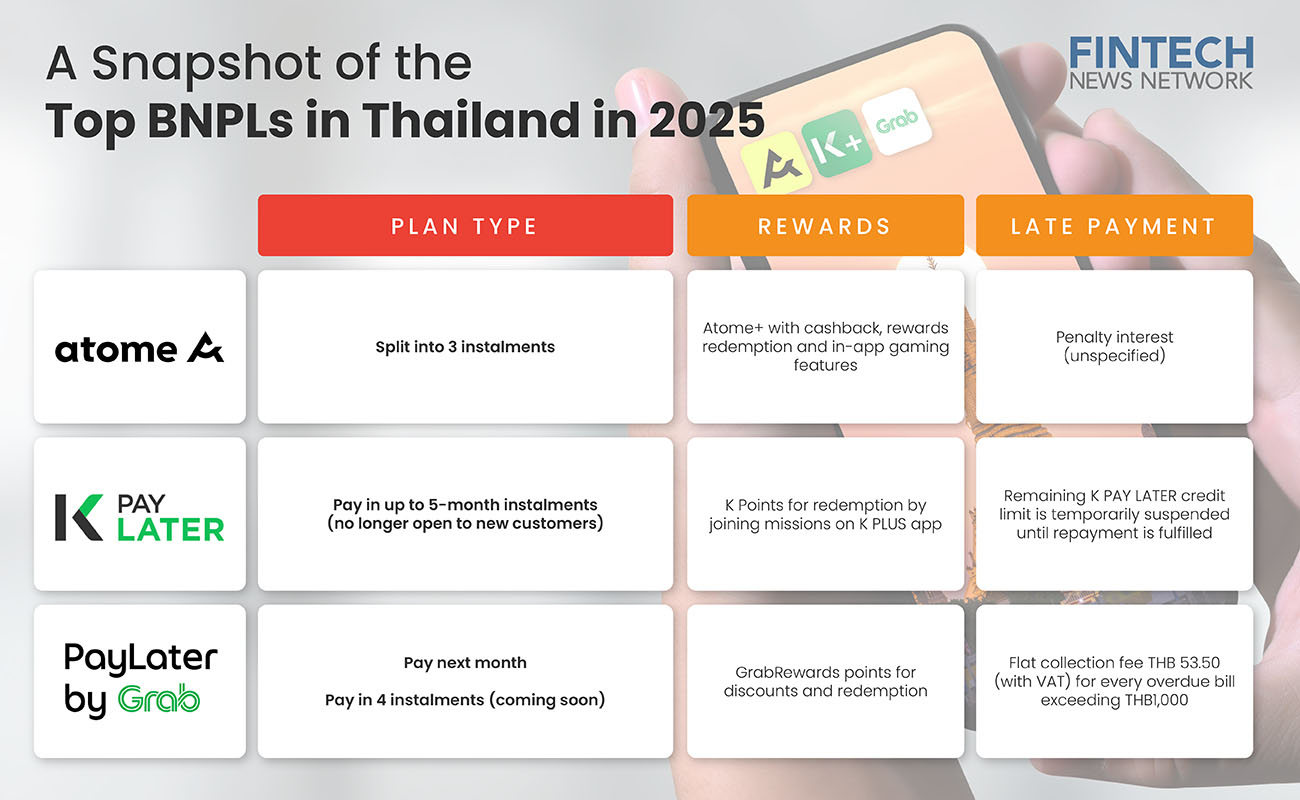
Top 3 BNPL Providers in Thailand in 2026
Key players in Thailand’s BNPL space are Atome, K PAY LATER, and PayLater by Grab.
Atome

Atome positions itself as a BNPL service in Thailand that lets consumers split their purchases into three interest-free payments. The first payment is made at the time of purchase, followed by two additional instalments spaced 30 days apart.
Shoppers can use Atome wherever its QR code is displayed or by browsing the merchant directory on its website or mobile app. Atome is also available as a payment option at selected online checkouts.
Interestingly, Atome can be used even by non-residents, as long as a Thailand-issued credit or debit card is linked to the Atome app during account setup. However, purchases must be made in Thai baht.
Notably, Atome states that its service is free to use as long as repayments are made on time. However, it does not publicly disclose the exact late payment fees on its website, and it is possibly available on its Atome Thailand app instead. Atome does, however, share that the penalty interest charge will not snowball.
K PAY LATER by KBank

K PAY LATER is a BNPL solution from Kasikornbank (KBank) which offers instalment payments at a limit of THB20,000, including for electricity, gas, restaurants, and supermarkets across Thailand.
To use the service, consumers would need to use the K Plus app and ensure that they make their repayments via K Plus by the last day of the month.
K PAY LATER offers repayment terms of 1, 3, or 5 months, and transactions can be made between 3 a.m. and 9 p.m. daily. If a repayment is missed, the remaining credit limit is temporarily suspended until the overdue amount is cleared. Once repayment is made, the service is automatically reactivated.
PayLater by Grab

PayLater by Grab in Thailand will soon let users split purchases into four interest-free payments, which will be available exclusively soon with Grab’s online merchant partners. At the moment, you can choose to pay the full amount by the 7th of the following month, but only for transactions made within Grab services.
You’ll continue earning GrabRewards points with every PayLater transaction. But what happens if you miss a payment?
According to Grab’s website, your PayLater account will be temporarily suspended until the overdue amount is cleared. A collection fee of THB 50 (inclusive of VAT at THB 53.50) will be charged for each overdue bill that exceeds THB 1,000.
PayLater also offers strong security benefits, including 24/7 fraud detection and biometric protection such as fingerprint scanning on Android and Face ID on iOS.
How to Use BNPL in Thailand
Using BNPL in Thailand is simple. Here’s how it works:
#1 Shop at a partner store or app
Whether online or in-store, select a merchant that supports your BNPL provider.
#2 Choose the BNPL option at checkout
Options include Atome, K Pay Later, Pay Next, or SPayLater.
#3 Complete a quick verification
You may need to provide ID, payment method, or link your account.
#4 Pay the first instalment
Similar to its BNPL counterparts in other markets, most Thai providers deduct the first payment instantly, with the rest billed monthly.
#5 Track your repayments
Use the provider’s app to stay on top of your balances and repayments, ensuring you don’t miss or delay a payment to avoid account suspensions or late payment charges.
What’s Next for BNPL in Thailand?
As BNPL adoption accelerates across Thailand, the market may be entering a critical phase of maturity. In terms of responsible lending, the Bank of Thailand has already taken concrete steps, including its new notification on responsible lending, which came into effect in January 2024.
According to Global Compliance News, the new notification sets out comprehensive rules comprising clear obligations before a user takes on debt, during the repayment period, and even in the event of default or legal recovery.
Now, although BNPLs are not yet regulated under a dedicated framework, notably, the notification applies to digital personal loans as well as nano-finance under supervision. Collectively referring to these and a few more segments as service providers, the notification requires them to offer lending products responsibly and ethically.
As competition intensifies and the application to the notification continues, BNPL service providers that balance innovation with accountability will shape the future of BNPL in Thailand.
Frequently Asked Questions (FAQs)
Is BNPL regulated in Thailand?
BNPL is not yet governed by a dedicated regulatory framework in Thailand. However, the Bank of Thailand has issued broader responsible lending guidelines, effective from January 2024, that apply to digital personal loans and nano-finance providers, including those offering BNPL-like services.
Are there any fees or interest charges when using BNPL in Thailand?
BNPL in Thailand often includes zero-interest instalment options, especially for short tenures (3 or 4 months). However, longer repayment periods or delayed payments may incur processing fees or monthly charges.
What happens if I miss a BNPL repayment in Thailand?
Missing a BNPL payment can lead to late fees, account suspension, or temporary blocking of future purchases.