Get the hottest Fintech Singapore News once a month in your Inbox
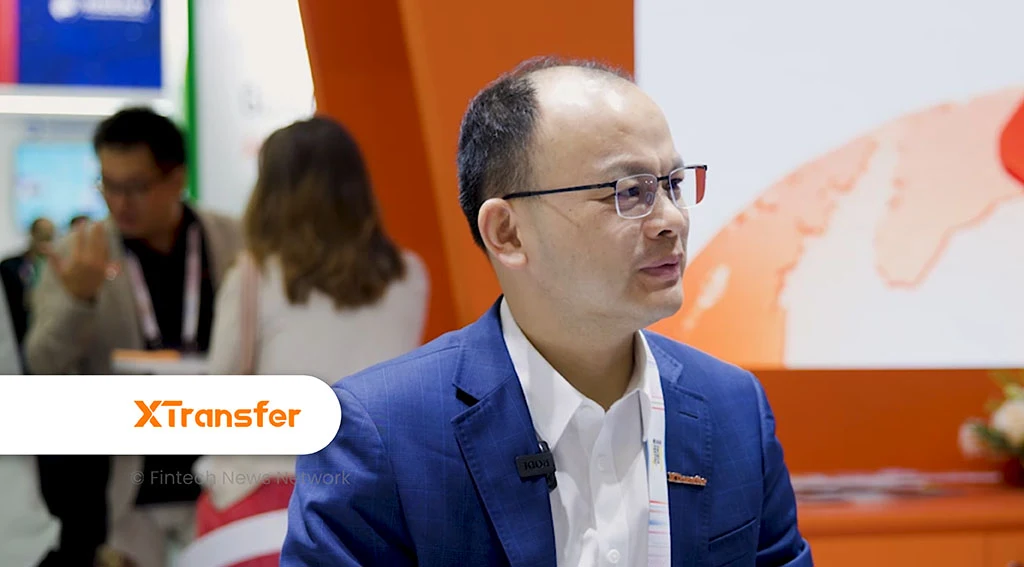
Bill Deng, Founder and CEO of XTransfer, watched multinational corporations move billions across borders with relative ease, while SMEs were left navigating a maze of fragmented ledgers, opaque fees, and the ever-present risk of having accounts frozen without warning.
That imbalance, Deng argues, was reinforced by the industry’s growing reliance on de-risking. This was a compliance-driven retreat that pushed smaller businesses to the fringes of the formal financial system, as they were deemed not very profitable yet high in risk exposure.
And for many SMEs, a single flagged transaction could mean days without access to working capital, payroll disruptions, or even bankruptcy. Deng believes the root of the problem was never SMEs, but the outdated tools used to assess them.
Now processing over US$12 billion in transactions each month for more than 800,000 enterprises globally, XTransfer is building an alternative financial infrastructure catered to cross-border trade at scale.
From Fragmented Ledgers to a Common Language
Traditional cross-border payments still operate like a relay race between private ledgers. Funds move between sending banks, correspondent banks and finally to the receiving bank, with each step requiring reconciliation between ledgers that were never designed to work seamlessly together. As Deng explains,
Bill Deng
“The ledgers have to ‘talk’ to one another, so the interoperability is not smooth. The other thing is that each player has a different database about AML. AML is all about data, which they can’t share directly.”
Deng views stablecoins as a structural solution to this fragmentation. By moving trade onto a “common ledger” (blockchain), the industry can bypass the chain of private ledgers entirely, eliminating many of the reconciliation and settlement delays that plague traditional banking.
At the same time, new infrastructure players are addressing the compliance bottleneck. Startups such as Notabene are developing ways for stablecoin issuers and receivers to securely exchange KYC information, allowing compliance data to travel alongside value.
Deng is optimistic about stablecoins, sharing,
“In the next three years, when every stablecoin company will be regulated, they will become the only way to convert to fiat currency. They will also apply all AML-related work in a new way. This will bring in a lot of new corridors, new bridges, and a lot of benefits to the customers.”
X-NET, The AI-Powered Bridge
While blockchain may define the future, the immediate pain point for SMEs remains compliance friction today.
Deng traces the origins of XTransfer back to 2017, when banks increasingly withdrew services from SMEs because the cost of manual AML checks outweighed the commercial upside.
“It was an existential crisis for some of them (SMEs). So we decided that there needs to be a platform that makes money movement easier.”
That platform became X-NET.
Designed as a scheme-like layer between banks and businesses, X-NET sits between senders and receivers to perform two core functions: simplifying money movement and automating compliance. The secret to its speed? AI-supported automation.
“We digitalised and automated everything about AML from the beginning with the power of AI. As most of the information is unstructured, the large language model was masterful in converting the data into structured ones, which was very helpful.”
By automating onboarding, transaction monitoring, and risk analysis, XTransfer has reduced compliance costs to less than 5% of what traditional banks typically spend. Just as importantly, the automation dramatically improves speed and consistency.
What once took weeks, such as account openings, can now happen in hours. With a quick speed to market, XTransfer’s efficiency allows an exporter in Shanghai to be onboarded in 24 hours, providing them with a local bank account in countries like Singapore quickly.
Making Cross-Border Feel Local
The ambition behind X-NET is simple but far-reaching: to make a cross-border transaction feel like a domestic one. In the past, a Chinese exporter selling to Singapore would wait days for a USD wire transfer.
Today, they can offer their buyer a way to pay in Singapore Dollars (SGD), which XTransfer receives and clears in minutes.
This strategy is expanding rapidly. Deng recently announced major partnerships with KBank, Maybank, and is looking into the top 30 countries to build their local bank partnerships in.
“These bank partners in local markets will be able to help us collect money locally and convert it into Chinese yuan or USD. We’ll be able to sweep all the funds into our treasury hub, and if our clients need us to send it (funds) to Vietnam or China, we can do it in minutes.”
In 2025 alone, Deng shared that the company secured over 100 new bank partnerships.
The Race for Validity in an AI Era
As the industry moves into 2026, the conversation around SME cross-border payments is shifting. What XTransfer is ultimately competing on is credibility.
The ability to prove that a transaction represents real trade, real goods, and real economic activity. By using AI to verify the genuineness of trade, from analysing website data and logistics trails to scanning digital footprints, the platform is helping SMEs build something they have historically lacked: a financial identity banks can trust.
The bigger implication is structural. As platforms like X-NET succeed, the traditional hierarchy of global finance begins to flatten.
A small exporter in a developing market no longer has to be treated as inherently higher risk simply because of size or geography. They can be assessed, priced, and trusted based on data.
That is one shift underway, which is best understood in Deng’s own words.
To hear Bill Deng explain how his experience in cross-border payments shaped XTransfer’s approach to stablecoins, AI-driven compliance and more with our Chief Editor Vincent Fong, watch the full conversation in the YouTube video below: