




The condition of career stagnation in Singapore has its own peculiarities, caused by the nature of the country’s business environment, which in 50-60 years has gone from being a poor port with no resources to one of the richest nations in the world.
Therefore, first and foremost, the specific nature of how businesses operate forces us to reject the usual rules and replace the mechanisms inherent in other international business hubs with new ones that will provide a constant effect of growth here. To develop as a global talent on a completely new scale, you need to adapt to Singapore’s requirements and rethink your attitude towards your career. Let’s consider what exactly can become a barrier to such achievements.
Every motivated professional holds on to their ambitions and makes plans. However, sometimes the logic behind these ambitions turns out to be wrong and not supported by the rules of the game in the changing world of business.
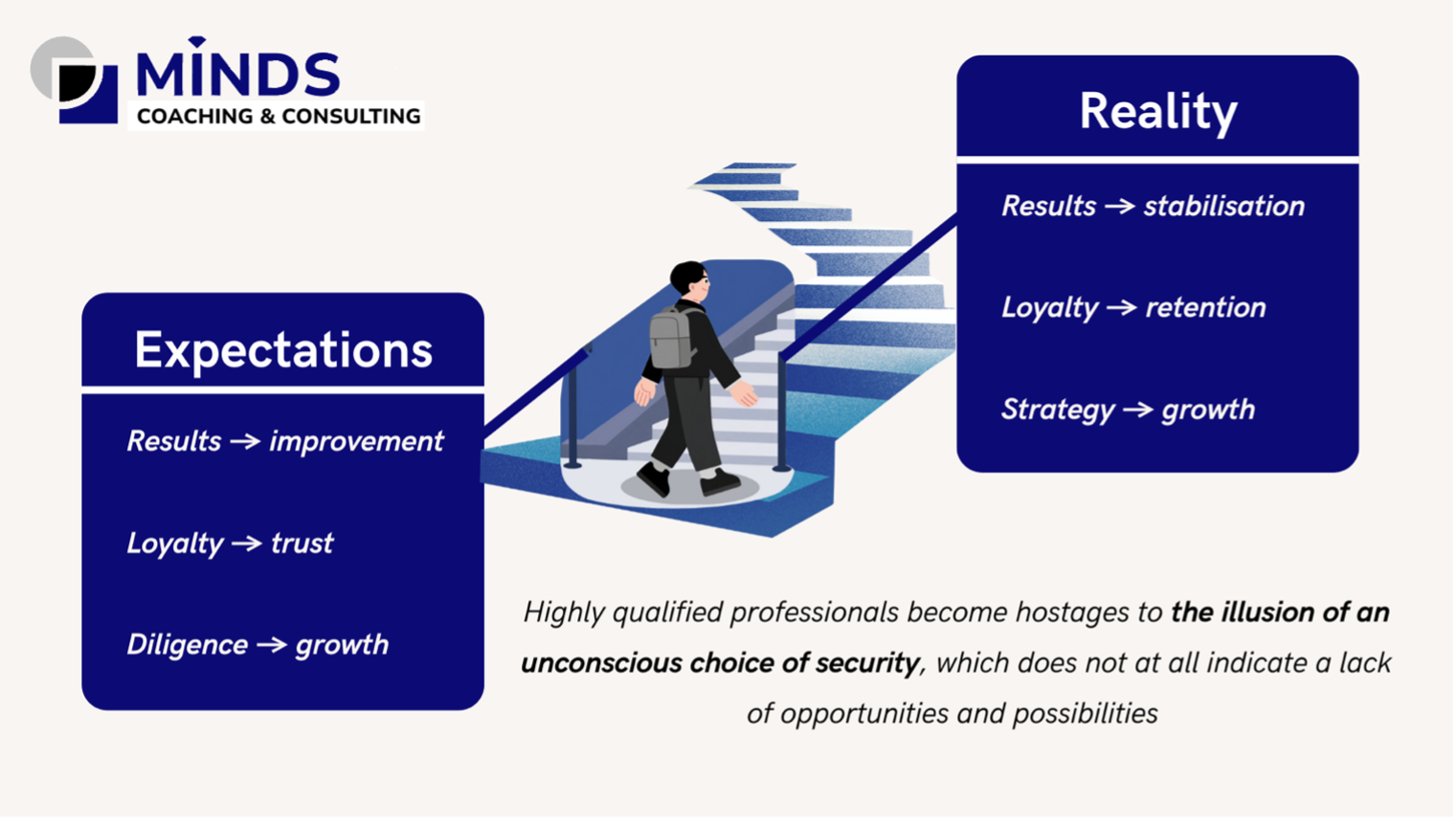
For example, when the desire to earn more is accompanied by a refusal to grow professionally, make more complex decisions, and take on more responsibility. This means that highly qualified professionals become hostages to the illusion of an unconscious choice of security, which does not at all indicate a lack of opportunities and possibilities in the market. However, note that this mindset is not about success in Singapore.

A similar scenario is thinking along the lines of ‘qualifications = money,’ which very often lures specialists into a trap of inaction. Income growth is a separate skill that includes negotiation, positioning, and strategic role selection. The main focus is on learning to manage your own economic trajectory. Your long-term reputation depends on active yet measured steps, so you need to make yourself known to be a visible professional, but also calculate the possible effects of your actions.
In cases where the solution to the problem lies not in changing the environment but in working through your own blocks and biases, professional career coaching can be a reliable tool. Let’s lift the veil on this issue from a coaching perspective and delve into the possible causes of this phenomenon.
Why do you feel less successful than you really are, while others manage to see your achievements? A typical mechanism that was established a long time ago comes into play. It seems logical – you need to look up to the best role models. And that would be fine, but our psyche is such that, although it motivates us, it also makes us feel left behind.
By changing just one small aspect of your own perception, you can get rid of the negative component of this process. Comparing your success with others is not negative in itself, as long as you do not use it as proof of your ‘failure.’ Convince yourself that someone else’s success does not in any way reflect on your achievements and qualities, but only sets a new benchmark that you can reach or even surpass.
What are the real mistakes in our work strategy in practice? The biggest enemy of active professional growth is the paradox when specialists do everything right from the point of view of the system they are used to and which has reliably delivered results in the past.
At first glance, it seems that it will be possible to ‘break through’ the career plateau by achieving even higher productivity so that the system responds with a promotion. In the highly competitive context this often has the opposite effect. If you are highly effective here and now, why would they take you away from where you are extremely valuable? From a coach’s point of view, lack of effort is not the reason, because if the logic of the role does not change, there is no reason for growth.
Clients often live with the belief that minimal effort is enough for their stable results to be noticed. However, if a specialist does not declare their ambitions, does not formulate a clear request, and does not show how exactly their growth solves business tasks, the management systems simply see no reason to change anything. Therefore, it is not external random processes, but your initiative that is the decisive factor and will contribute to new opportunities.
One of the qualities of a professional is the ability to clearly explain who they are beyond their current set of tasks. You must be able to formulate a strategic career narrative. In Singapore, those who clearly fit into the long-term logic of the business move up the career ladder.
One of the most dangerous mistakes is living with short career horizons. Singapore as a globally recognized top-tier, highly competitive, and pro-business hub creates ideal conditions for your comfort zone: high incomes, security, predictability, where one can think in terms of contracts, years, or current projects. But your focus should be on future prospects and new opportunities that will open up thanks to your current achievements. The main danger of a short-term strategy is that stability gradually turns into a trap. Opportunities never disappear on their own, specialists simply stop looking for them.
The smallest but most important step you need to take is to acknowledge that there is a problem. If you do this, you will have the opportunity to change your working life for the better. Moving from the theory of solving the identified problem to practice, it is important to understand what career coaching services cover and how a coach can help you change the trajectory of your development. Coaching at this point is not about motivation, but about managing your trajectory. If effectiveness no longer translates into growth, the question is no longer ‘to work or not to work,’ but whether you are ready to think strategically different.
Featured image by mrsiraphol on Freepik
