



With their data-rich and language-heavy operations, financial services businesses are uniquely positioned to capitalize on the development of artificial intelligence (AI), a capability they have been pursuing for years.
According to a World Economic Forum report in collaboration with Accenture, 32-39% of the work performed across capital markets, insurance and banking businesses has high potential to be fully automated through generative AI (genAI), and 34-37% holds high augmentation potential.
PwC estimates that embracing AI could improve a bank’s efficiency ratio by 15 points through revenue boost by matching the right customers with the right messages, and cost transformation via intelligence automation and agile operations.
Specifically, AI can double customer retention rates by proactively predicting and engaging with customers where they spend most of their time, and offering lifestyle-based financial planning.

PwC also projects up to a 30% increase in lead conversion rates through autonomous lead generation and targeting, improved relationship management, and adaptive, AI-driven marketing, alongside a 50% boost in productivity and speed through human and AI collaboration.
It expects up to a 25% improvement in decision-making speed and accuracy driven by modular data pipelines and context management, and a 35% enhancement in proactive risk management using AI compared to traditional methods.

Driven by these potential gains, AI in financial services is surging. In 2023, financial services firms spent US$35 billion on AI. That figure is projected to reach US$97 billion by 2027, and US$368 billion by 2032, according to Statista.
As AI becomes increasingly integrated into banking, this curated selection of whitepapers, reports, and interviews examines the rapidly evolving landscape. These resources aim to equip industry stakeholders with the essential intelligence needed to transition from experimental AI pilots to production-ready, revenue-generating systems, sharing insights, case studies, and guidelines for succeeding in this new era of AI-powered financial services.
The Digital-First Bank’s Guide to AI in 2026 – Oradian

Released earlier this year by core banking platform Oradian, this whitepaper aims to serve as a comprehensive guide for financial institutions, digital banks, and lending organizations considering implementing AI in their operations.
The paper outlines key applications transforming digital banking, including risk scoring, fraud prevention, chatbots, and automation, while also offering strategic advice on responsible implementation. It also addresses critical technical considerations, including integrating AI with core banking systems and maintaining regulatory compliance across different jurisdictions.
Most importantly, the whitepaper emphasizes that a strong data layer is the groundwork for AI deployment, and provides an AI readiness checklist to help institutions assess their preparedness for value-driven implementation. It also offers strategic guidelines for deploying AI effectively and responsibly.
From Pilots to Production: How Banks Turn AI into Revenue – Dyna.Ai, GXS Partners and Smartkarma
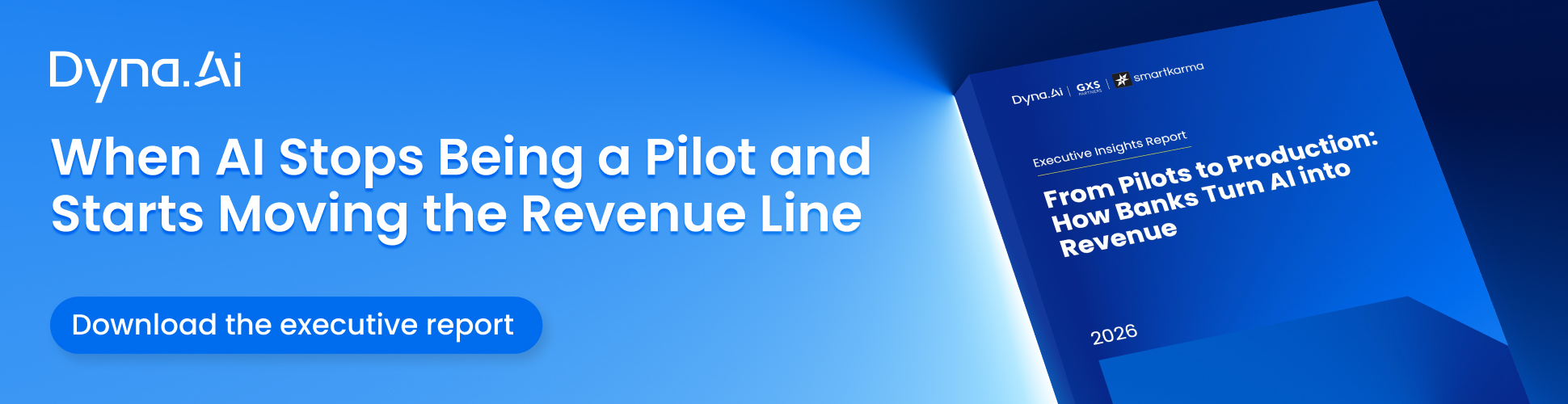
Released in February by Dyna.Ai, in partnership with GXS Partners and Smartkarma, this executive insights report explores how banks and insurers are turning AI into new revenue.
The paper blends primary interviews across Southeast Asia, Latin America, and the Middle East and Africa with market data to highlight where the growth opportunities lie, what operational challenges slow scaling, and how leading institutions move from pilots to revenue impact.
The report offers a playbook centered on strategic alignment, data and model foundations, fast-track use cases, modular scaling, and embed governance and trust. It also showcases real-world, revenue-generating use cases, including AI-driven inclusion lending and micro-credit, hyper-personalized wealth engagement, and AI-accelerated merchant acquisition and payments monetization.
Beyond the Bot: Agentic AI’s Evolving Role in Financial Services – Fintech Fireside Asia

Hosted by the Fintech News Network in October 2025, this webinar featured top executives from Boost, AWS, Ryt Bank, and WeLab Bank exploring the transition from AI systems that merely think, to agentic AI systems that can autonomously act on behalf of users.
The discussion examined how the technology is reshaping the banking and financial sectors, covering key themes including the transformation of financial services through new capabilities, live deployments and early results, the impact of agentic AI on customer experience, lead generation, and problem solving, and the critical challenges of agentic AI adoption, including reliability, data privacy, and customer trust.
The experts also discussed practical use cases, such as loan onboarding, automated underwriting processes, and seamless customer interactions, and explore Boost’s AI journey from AI-based lending to the Boba chatbot and new agentic AI in financial services.
Why 95% of AI Pilots Fail in Banking and How Banks Can Get ROI – Fintech Fireside Asia

In this interview conducted in April 2026 by the Fintech News Network, Cynthia Siantar, General Manager of Singapore and Hong Kong, Head of Investor Relations, Dyna.Ai, discusses why banks often struggle to move from AI experimentation to real execution. She attributes many project failures to complex human organizational systems, including excessive layers of decision-makers, prolonged alignment meetings, and internal resistance to changing established workflows.
Siantar shares a case study where Dyna.Ai worked with a digital bank to automate outbound voice calls for debt collection. She emphasizes that the key to scaling AI is to start small with measurable outcomes, secure executive visibility, and treat AI agents as a new category of workers that organizations must learn to manage.
Are Banks Thinking Big Enough About AI? | Philippines AI CxO Roundtable – Fintech Fireside Asia

Hosted jointly by the Fintech News Network and OneConnect Financial Technology in September 2025 in Manila, this roundtable brought together banking C-level executives from the Philippines representing West Banking Corporation, UNO Bank, RCBC, GoTyme Bank, Security Bank, Tonik, Netbank, and the Philippine National Bank to explore the strategic implementation of AI in banking.
These experts debated whether current efforts are sufficiently transformative or merely incremental improvements to internal efficiency. They also shared real world use cases on how their institutions are leveraging AI, highlighting applications for internal productivity, fraud detection, and compliance reporting, such as automating report processing for anti-money laundering (AML) filings.
These experts also explored challenges regarding AI implementation, delving into issues related to legacy systems, and the difficulty of harmonizing fragmented data silos.
How to Build an AI First Bank | Malaysia Banking CxO Roundtable – Fintech Fireside Asia

Moderated by the Fintech News Network in August 2025 in Kuala Lumpur, this roundtable welcomed top leaders from Malaysia’s digital and incumbent banks, including GXBank, Ryt Bank, AEON Bank, Boost, CIMB and Standard Chartered Bank, to discuss how they’re applying AI across every layer of operations.
The panelists explored the strategic requirements for building an AI-first bank, and shared examples of AI deployment within their organizations. They discussed consumer-facing innovations, including personal financial management tools that leverage machine learning for budgeting and financial insights, as well as back-office transformations, such as reducing request-for-proposal processing time from weeks to days, and automating compliance due diligence workflows.
Featured image: Edited by Fintech News Singapore, based on image by user21016237 via Freepik
