



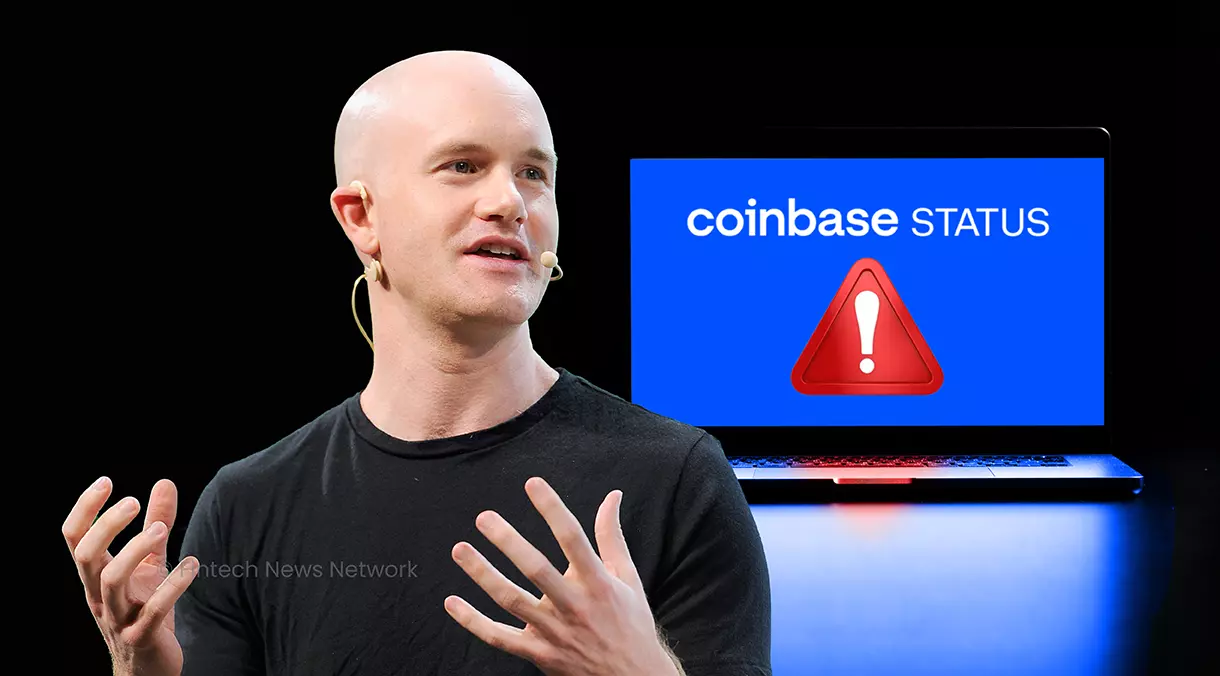
It is a very unfortunate week to talk about speed, but Coinbase had quite the week.
First, the crypto exchange told employees it was cutting about 14% of its workforce as part of a plan to become “faster and more AI-native”.
CEO Brian Armstrong said AI had changed how work gets done, with engineers now shipping in days what used to take teams weeks, while non-technical teams were also beginning to ship production code.
Then, just days later, Coinbase went offline for around seven hours.

You do not need to be Einstein to see the comedy in that.
To be clear, Coinbase said the disruption was not linked some internal AI experiment gone wrong. So no, this is not a neat story where Coinbase reduced headcount, handed the keys to AI and immediately paid the price.
That would be too convenient, and probably wrong. But the timing? The timing did half the article for us.
The AI-Native Memo Meets Reality
Armstrong’s memo was written in the familiar language of modern tech restructuring. Coinbase needed to reduce layers, move faster, automate more work and put AI closer to the centre of how the company operates.
The company also said it was operating in a “weaker crypto market” and needed to “adjust its cost structure”, which is not especially surprising.
Crypto is cyclical, and Coinbase has been through several rounds of adjustment before.
But when you strip away the polished wording, Coinbase’s message was basically, “AI lets fewer people do more, so why do we need more people?”
There may be some truth to that in certain areas.
Microsoft Research found that developers using GitHub Copilot completed a controlled coding task 55.8% faster than those without it, while McKinsey has found that generative AI can speed up certain software development tasks, especially documentation and code generation.
AI can help humans in some cases mostly by making internal workflows less painful. And nobody is calling AI as just a hype.
The problem, however, begins when AI becomes a neat explanation for cutting human capacity, especially in businesses where operational resilience matters.
Moving fast sounds convincing in a memo, but it sounds less convincing during an outage, especially when customers simply want the platform to just work.
When Lean Starts Looking Thin
The Coinbase outage was more than a minor inconvenience because trading disruptions hit differently on a crypto exchange.
Timing matters, and crypto markets do not pause politely while a cloud provider cools down.
Once users cannot transact, uptime quickly turns into a trust issue. People can forgive an outage. Maybe.
But they for sure are less likely to be generous when it lands right after a company talks about cutting hundreds of roles, just because AI can make teams more productive.
At that time, one must wonder whether “lean and fast” sounds slightly different when the platform is unavailable. Coinbase pointed to an AWS-related issue.
Reuters reported that a temperature spike at a Northern Virginia data centre disrupted Coinbase’s services, forcing AWS to bring additional cooling capacity online before it could safely restore the systems.
That makes it unfair to blame Coinbase’s layoffs for the outage. Customers, however, do not usually care which layer of the stack overheated.
They opened Coinbase, trusted Coinbase and experienced the outage through Coinbase, which means the pressure still lands on the company even when the problem starts elsewhere.
Someone still has to respond and troubleshoot, while reassuring users and making sure the disruption does not spiral into a bigger reputational mess.
That work is not as exciting as AI-native pods or one-person teams, and it rarely gets celebrated in a CEO memo.
But in financial services, the boring operational layer is often what separates a manageable incident from a trust problem.
The AI Layoff Story Is Getting Harder to Sell
AI has become a very convenient way for tech and fintech companies to talk about smaller teams without making it sound like ordinary cost-cutting, and Coinbase is hardly the only one leaning on that language.
Block had its own version of this story, with Jack Dorsey saying the company would cut thousands of roles while pointing to AI, efficiency and a need to make the business more functional.
Block had also grown aggressively during the pandemic, so the story was never as simple as “AI came in, people went out,” even if the headline made it easy to read that way.
Many of these announcements can make AI sound like a clean solution where fewer people somehow means faster work and better execution. It sounds tidy on paper, though real life has a habit of making things less tidy.
Klarna showed how complicated this can become. The company had promoted its AI assistant as doing the work of around 700 customer service agents, only to later acknowledge that service quality still needed human support in some situations.
So yes, AI could handle a lot, but apparently not everything customers actually needed.
Coinbase’s outage then landed right in the middle of this wider debate.
Reports tied the incident to AWS, which makes the obvious punchline tempting but not entirely fair.
Still, a seven-hour outage will naturally raise questions when it follows so closely after Coinbase told everyone it wanted to become leaner, faster and more AI-native.
There is no denying that AI can help companies move faster, but when something breaks, customers don’t necessarily look for an AI-native operating model. They look for someone to fix the problem.
Be Careful With What You Optimise For
None of this means companies should avoid AI. That would be silly.
But AI should not become a magic word that makes every headcount cut sound visionary.
Becoming more efficient is not the same as becoming thinner, and moving faster is not much use if a company loses the depth it needs when things go wrong.
Coinbase may still become the lean, fast, AI-native company their CEO, Brian Armstrong, described.
But for one very awkward day, it looked more like a company that had just told everyone it was built for speed, only to be reminded that the future can still overheat in a data centre.
And honestly?
You cannot write better timing than that.
Featured image: Edited by Fintech News Singapore based on images by pvproductions and ilin_sergey via Magnific and TechCrunch via Wikimedia Commons.
