



Asset managers globally are accelerating their adoption of tokenization, eyeing new revenue streams and operational improvements. According to research by Calastone, a global funds network, almost three quarters of asset managers polled in the study have initiated at least one tokenization project, laying the groundwork for substantial growth in the coming years. The proportion of asset managers distributing tokenized funds, projected to reach 13% in 2026, is expected to surge to 28% by 2030.
Tokenized funds are investment vehicles where shares are converted into digital tokens on a blockchain network. They offer asset managers several strategic advantages, primarily centered around operational efficiency and expanded market access.
By converting fund shares into digital tokens, managers can automate many back-office processes such as settlement, custody, and distribution of dividends, significantly reducing administrative costs and settlement times.
The technology also enables fractional ownership, allowing managers to lower minimum investment thresholds and attract a broader base of retail investors who were previously excluded by high entry barriers.

Finally, tokenization enhances liquidity for traditionally illiquid assets like real estate or private equity, introducing secondary markets where these tokens can be traded 24/7.
Early adopters are also seeing improvements. Among asset managers who have already launched a tokenized fund, 65% report that the experience offers benefits over the traditional model, with access to new customers and automation being amongst the most commonly cited advantages.
Through 2029, Calastone estimates that assets under management (AUM) for tokenized funds will grow to US$235 billion, marking a 58x increase from US$4 billion in 2024. This estimates remain conservative compared to others, with a PwC report earlier this year projecting AUM of US$715 billion by 2030.
Strategic partnerships
To achieve these targets, asset managers are prioritizing working with third parties to facilitate the distribution of tokenized funds and accelerate time-to-market. Technology partners are the top priority for 70% of managers as a Day 1 requirement, followed by wallet custody providers and blockchain foundations, each cited by 51% of respondents.

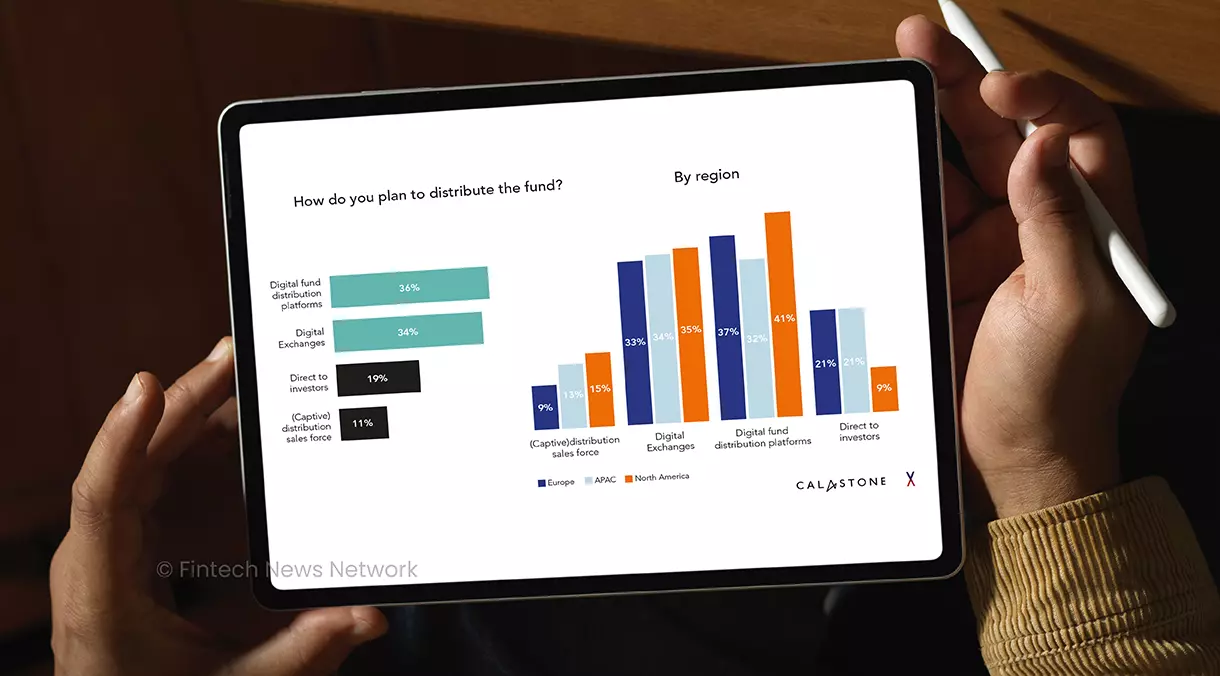
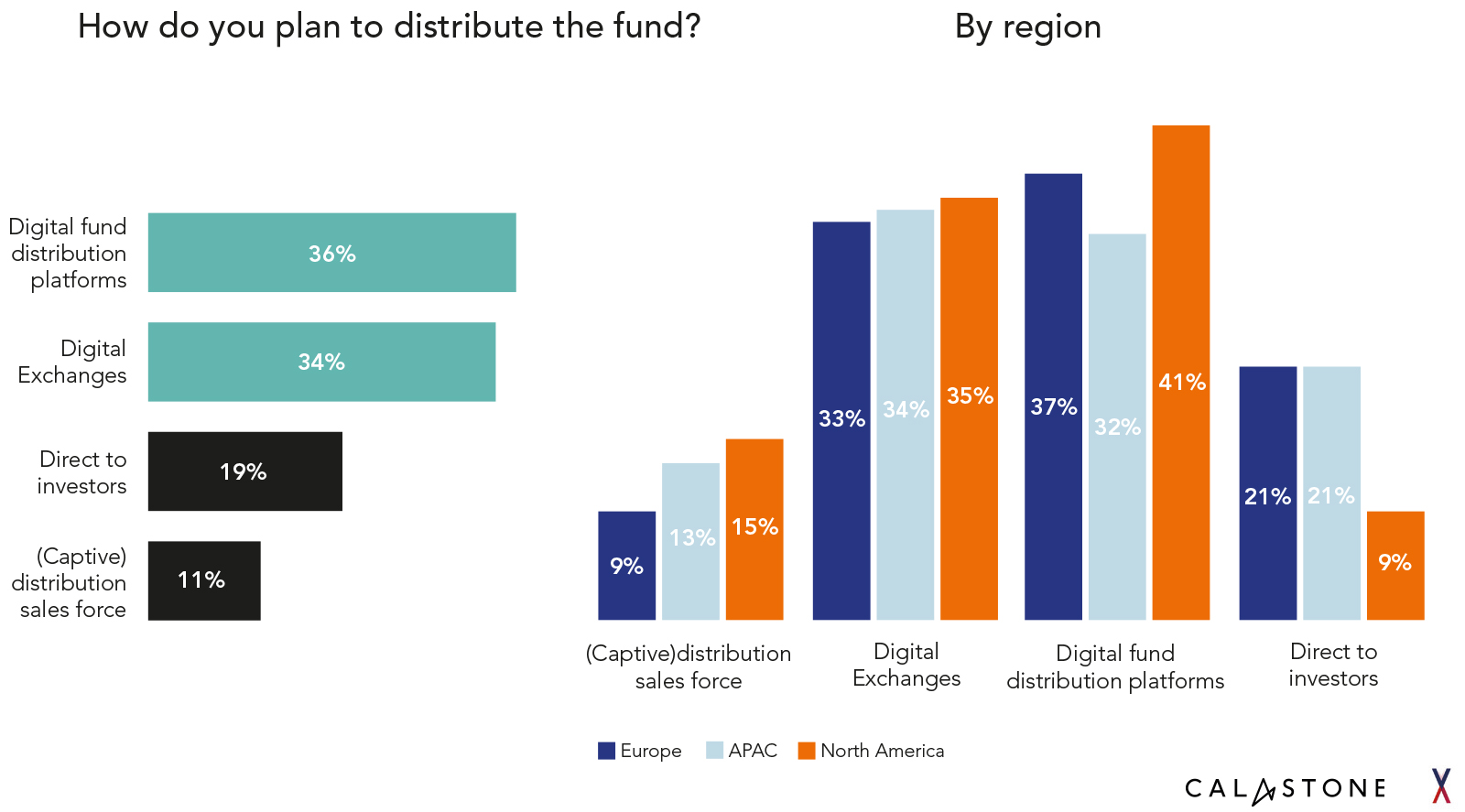
Distribution strategies also reflect this reliance on external expertise. 70% of asset managers plan to distribute through intermediaries, with 36% preferring digital fund distribution platforms and 34% digital exchanges.
In contrast, just 19% intend to go direct to investors and 11% plan to rely on a captive distribution sales force.
These findings suggest a preference for partnering with established experts to accelerate time-to-market by leveraging existing infrastructure and ecosystems.
Money market funds as the favored product category
Looking at products, money market funds (MMFs) were found to the clearest near-term use case. These instruments combine the core features of a traditional cash product, including low risk, liquid, and yield-bearing, with the additional benefits of direct integration with digital wallets, improved transparency, and the ability to purchase using stablecoins.
For decentralized finance (DeFi) players, tokenized MMFs are viewed as beneficial for treasury management, with eight out of ten platforms surveyed by Calastone endorsing their utility, and three-quarters considering them critical for client retention.

Besides money market funds, private markets rank equally high in the Calastone research. These offer a complementary opportunity, particularly as tokenization begins to address long-standing challenges around access, liquidity and transparency in less accessible asset classes.
The APAC landscape
Within this global context, the Asia-Pacific (APAC) region stands out for its unique challenges and opportunities.
While the lack of compelling business case or return on investment blocks progress for 44% of global respondents, and limits it for 41%, the single largest blocker for APAC respondents is the challenge of building an ecosystem around tokenized solutions. A staggering 86% of APAC respondents cited this as a blocker, compared to a global average of 34%.
Integration across blockchain networks is also more acute in APAC, with 57% of asset managers in the region viewing interoperability across chains as a blocking issue, compared to 28% for their counterparts in Europe or North America.
These findings suggest that the primary concern in APAC is not around product development, but rather ensuring that products can operate within a fragmented and still-evolving ecosystem.
However, APAC demonstrates distinct advantages, including a higher acceptance of non-bank stablecoins compared to their European and North American counterparts, and a greater willingness to incorporate a broader range of blockchain-native payment mechanisms alongside them.
Additionally, traditional constraints such as legacy system integration as well as privacy and security concerns are less acute in APAC than in other regions.

2026 developments
In 2026, the tokenized funds landscape continued to expand with institutional scaling, interoperability between traditional finance (TradFi) and DeFi, and regulatory normalization.
In April 2026, crypto trading platform OKX launched a joint framework with BlackRock and Standard Chartered to integrate BlackRock’s BUIDL tokenized short-term treasury fund into collateral workflows, marking the first time a globally systemically important bank (G-SIB) has acted as custodian in such an arrangement.
The framework enables OKX clients to hold collateral in regulated, off exchange custody while trading on the same integrated venue, combining the efficiency of crypto trading with the security standards of traditional finance institutions.
On the regulatory front, the US Securities and Exchange Commission (SEC) issued a joint statement in January on tokenized securities clarifying the treatment of tokenized securities. The regulator formally confirmed that tokenized securities fall within the definition of a “security” under federal securities laws, thus subjecting them to existing regulatory frameworks.
Featured image: Edited by Fintech News Singapore, based on image by thanyakij-12 via Magnific
