



In Asia-Pacific (APAC), digital cross-border money movement is on the rise, with digital channels now underpinning most international money movement across the region.
A 2026 research by Visa, which surveyed in Q1 2026 more than 45,000 remittance senders and receivers across 20 markets globally, including Singapore, the Philippines, India, Japan, Mainland China, and Australia, found that digital channels are the most used method for international transfers. Across the region, India leads, with digital channels accounting for 86% of remittances, followed by Singapore at 82%, and the Philippines at 72%.
This top three ranking remains consistent with last year’s survey results but shows a significant increase in the adoption of digital channels. Between 2025 and 2026, the use of digital means for remittances grew by 19 points in India, by 43 points in Singapore, and by 16 points in the Philippines. This reflects surging adoption of digital remittances across APAC.
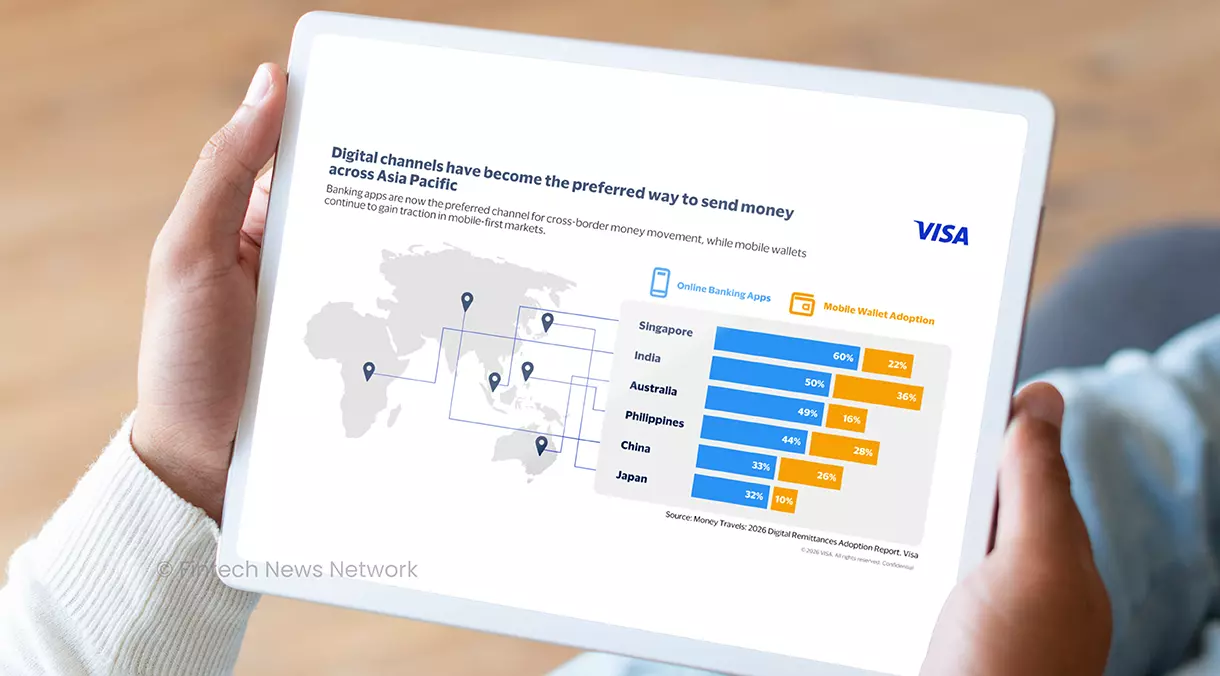
In particular, online banking applications have emerged as the most commonly used transfer method in 2026, with usage ranging from 60% in Singapore down to 32% in Japan.

Mobile wallets are also gaining significant traction, becoming a major remittance channel in several APAC countries in 2026. In India, mobile wallets were used by 36% of consumers, the highest rate in APAC, followed by 28% in the Philippines and 27% in China. However, Japan stands out in the region, recording a significantly lower mobile wallet usage rate at 10% of remittances.
Japan boasts the lowest adoption of digital remittances in APAC at just 42%. Most consumers there are wary of digital tools, with 32% of consumers still preferring to send money internationally through a physical bank branch, more than any other transfer method.

Growing openness to stablecoins
Across APAC, awareness of stablecoins is high, exceeding global averages. However, it varies substantially between markets, with awareness reaching 66% in India compared with just 28% in Japan.
Over the past years, APAC has emerged as the world’s largest regional hub for identified stablecoin payment activity. Since 2022, the region has consistently led the global market, holding a share of volume ranging from approximately 45% to 60%, according to CoinDesk research. APAC now accounts for 51.2% of this volume.

At the issuer layer, global USD stablecoins remain the primary focus of APAC activity, with USDT dominating crypto-native liquidity across many markets. However, regional stablecoins have also started emerging over the past years.
In Singapore, StraitsX’s XSGD, XUSD, and XIDR demonstrate the city state’s role as a stablecoin issuance and payments hub, while JPYSC, issued by SBI Shinsei Trust Bank and distributed exclusively through SBI VC Trade, reflect Japan’s bank-anchored approach to yen-denominated stablecoins.
In Australia, AUDD provides an AUD example within the country’s financial-services perimeter, while HKD initiatives such as HKDR reflect Hong Kong’s transition from sandbox experimentation toward an active licensing regime.

Despite growing awareness of stablecoins among APAC consumers, the Visa study revealed that the broader public and mainstream understanding of the technology remains limited. In India, only 45% of consumers correctly identified stablecoins as assets typically designed to stay close to a traditional currency, while 33% mistakenly believed their value fluctuates like Bitcoin.
While the adoption of stablecoins has yet to reach mainstream acceptance, the study suggests that education has the potential to dramatically accelerate usage. Nearly 80% of consumers in India and more than half in Australia said they would use stablecoins once informed about their benefits.
Fees, fraud and trust issues hinder digital adoption
Across APAC, fees remain the most persistent source of friction in cross-border payments. Although online banking apps are now the dominant transfer method in most countries, fees are the number-one complaint in every APAC country outside China, cited by 26-38% of consumers.
Trust-related concerns also continue to influence channel choice, particularly among consumers who have not fully adopted digital transfers. In Japan, for example, 27% of consumers prefer the social interaction of a physical agent, while concerns about money arriving safely remain a leading barrier to digital adoption.
Fraud is also a significant concern across the region. Scam exposure is among the highest globally in APAC, with 27% of remitters across the region reporting some form of fraud experience. Notably, 40% of Indian and 29% of Filipino remitters reported having experienced a scam, representing among the highest fraud exposure rates globally.
Concerns about AI-enabled fraud is also prevalent in APAC. In particular, 62% Filipinos are highly concerned about AI-enabled scams and deepfakes being used to impersonate family members or facilitate financial scams. This concern is even higher in India, at 53%, Singapore, at 49%, and Japan, at 44%.

Across APAC, consumer fraud has emerged as a critical risk. A 2026 study by LSEG Risk Intelligence, which polled 7,000 consumers across the region, found that almost six in ten adults in APAC had been exposed to scams directly or indirectly in the past two years. Around one in four consumers reported being personally targeted, and of those, 42% lost money.
Australia reported the highest levels of concern and targeting, while China showed lower perceived risk but the highest loss rate among those targeted. In contrast, Japan, where consumers are the most skeptical and wary to digital tools, had relatively low exposure but high anxiety about fraud.
In Singapore, younger adults were particularly exposed to financial losses, with 25-34-year-olds reporting the highest personal loss rate among surveyed age groups.
Featured image: Edited by Fintech News Singapore, based on image by magnific via Magnific
