Get the hottest Fintech Singapore News once a month in your Inbox
At a closed-door roundtable at the GFTN Insights Forum during the Singapore Fintech Festival 2025, one participant, who runs a banking operations platform, described the challenge of human fatigue. The team had put AI agents to work on suspicious activity reports, with a human in the loop reviewing each submission before it went to the regulator.
Working together, the AI and its human reviewers cut processing time from six hours to five minutes. But things started to change shortly after. The participant shared,
“We got to a point where our operators were not reviewing submissions properly because they were so convinced of the reliability of the agentic output. We now have to deliberately insert mistakes so that reviewers stay sharp.”
It’s easy to see how something like this can happen. When AI becomes that fast and good, the human check starts to feel like a formality, and people are lulled into trusting its decisions.
Institutions are still working out how to govern that trust. Until they do, it will be a struggle to move AI agents beyond the pilot, and the numbers bear this out:
According to KPMG, 99% of companies plan to put agents into production, yet only 11% have done so.
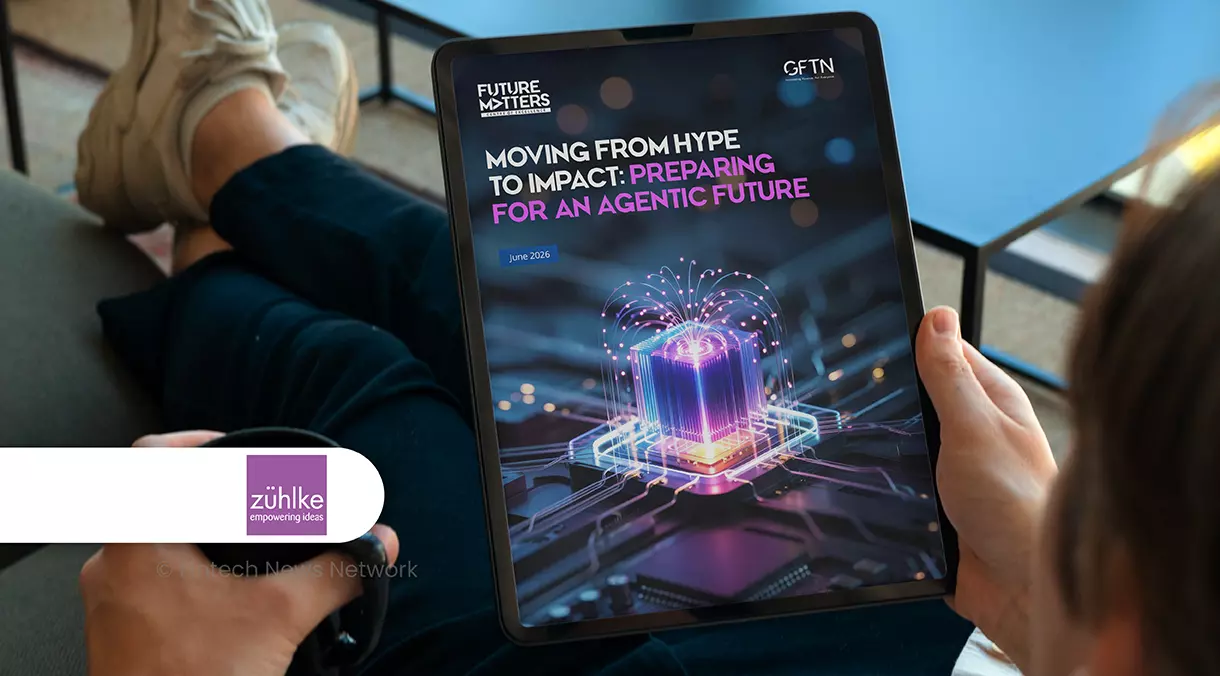
The GFTN report, produced in partnership with Zühlke, “Moving from Hype to Impact: Preparing for an Agentic Future,” distilled timely insights from the roundtable on scaling agentic AI, which included senior leaders of global banks, regulators, and technology firms as participants.
A Human Reviewer Is Only One Part of the Answer
Requiring a person to approve an AI-generated submission sounds reassuring. Findings from the GFTN report, however, reveal that meaningful oversight still needs deliberate design, including periodic audits and active measures to keep the human reviewer engaged.
It also recognises that checking every output manually may not be a practical affair, especially in time-sensitive settings like real-time transaction monitoring.
Banks would therefore need to decide where human judgement matters the most.
Thorsten Neumann, the Head of AI and Research at Standard Chartered, shared how trust underpins all of the bank’s efforts in AI, across client experiences, operational automation and more.
Thorsten Neumann
“The appropriate level of human oversight is ensuring consistent accuracy at acceptable levels of consistency (in terms of eval metrics), which must remain within our defined risk appetite and balance the tradeoffs of accuracy, performance, and cost.”
An investment banker from the roundtable described another approach, a “reflection architecture” involving a writer-model/reviewer-model pairing, which they said achieved 70-80% quality output compared with 20% from a single zero-shot prompt.
Ultimately, banks will always need to establish when a result warrants closer scrutiny, and who has the authority to intervene. The responsibility is now even greater, with the Monetary Authority of Singapore’s (MAS) recently announced supervisory expectations on responsible AI adopted by financial institutions on 7 October 2026.
When Banks Cannot Easily Access Their Own Data for AI
Before a bank can give an AI agent access to its information, it may first have to pay someone to retrieve it.
Financial institutions end up paying substantial fees to professional services firms, the report noted, simply to extract data from enterprise software they already own. This dependence on providers is a consequence of vendor lock-in. A participant from the regtech space explained:
“When you talk about vendor lock-in, you’re talking about how hard it is for financial services to get their own data out of their own systems. That should simply not be happening.”
For agentic AI, that dependence can limit how much useful work a system can perform. Agents need clean, accessible, and well-governed data to function reliably, which may often be drawn from several systems across a bank.
Without the presence of API-native infrastructure and interoperable data standards, organisations are forced to build isolated use cases that raise costs, slow down delivery, and prevent value from compounding across the bank’s ecosystem.
“The (GFTN) roundtable identified data accessibility as the single most cited regulatory constraint to AI adoption. One central bank’s survey data showed that 33% of regulated firms identify challenges in data regulation as an active barrier.”
The report urges banks to treat API-native infrastructure as a foundation for agentic AI deployment by establishing clear data portability and interoperability standards.
It could possibly even address more of the barriers to responsible AI adoption than technology-specific rules ever could.
Governance in Agentic AI Must Be Woven In From the Start
Source: Insights Forum 2025 by GFTN (Global Finance & Technology Network Limited)
More autonomy brings in more risk, and every AI strategy team needs to treat risk as a core mission.
The banking industry has, granted, long been wired to optimise for outcomes, but agentic AI cannot be handled like conventional software. Agentic systems need scrutiny at every step of the way, not just at the end.
The former outcome-focused approach may hold up in isolated, low-stakes applications. In multi-agent systems with real-world consequences, it becomes a liability. As one roundtable speaker put it,
“The failures we saw in multi-agent systems were not due to weak models. They were due to coordination breakdown — communication gaps, memory drift, cascading errors where a small mistake leaps across agents.”
The participants identified the lack of “compliance by design” thinking as a critical structural gap. Agentic development needs governance to sit at the heart of its processes, with traceability, audit trails, and kill-switch mechanisms built in from the very first line of code.
Neumann pointed to how Standard Chartered expects to handle this as the number of agents grows:
“As we project that the agents will scale from the first solutions today to many hundreds and thousands, the only manageable way is by establishing a bankwide agent control plane and management by metrics that ensure the AI remains within acceptable performance range(s),” Neumann said.
So far, AI has fit reasonably well within existing risk management frameworks like third-party risk rules.
But as the more autonomous end of the spectrum brings self-evolving models, agent-to-agent delegation, and cross-jurisdiction data flows, those very frameworks will need to evolve in tandem too.
Can Banks Keep Up With the AI They Deploy?
Agentic AI is already capable enough to support many financial use cases. The harder task at hand is whether financial institutions, regulators, and technology partners can build the ideal institutional layer that helps agentic AI unlock its true potential.
Steps which these organisations can take include focusing on data interoperability, designing with governance in mind from the get-go, and even investing in executive AI literacy.
“AI does not transform organisations on its own. It amplifies what is already there: in talent, governance, and technology delivery. The financial institutions that will lead in the AI era are those bringing together experts, effective governance, and continuously adapting and deploying technology at speed,” Neumann explained.
Transformation partners like Zühlke can help banks take one step further.
The challenge is not simply building AI solutions faster, Zühlke shares, but ensuring the wider organisation can support them in production. That means assessing the readiness of data platforms, data governance, AI governance and underlying technology, while developing business and technical capabilities together.
The focus shifts from accelerating individual tasks to improving the quality and flow of work across the entire delivery process, while people remain accountable for intent and validation.
Accelerating one part of delivery without addressing weaknesses elsewhere can simply move the bottleneck downstream.
The pace of adoption will therefore depend on how confidently banks can take responsibility for the systems they put to work.