



In India, access to banking and payments, alongside participation in formal investment products, is expanding rapidly, driven by fintech advances. Even with these gains, insurance uptake still lags behind, widening the protection gap compared with global standards.
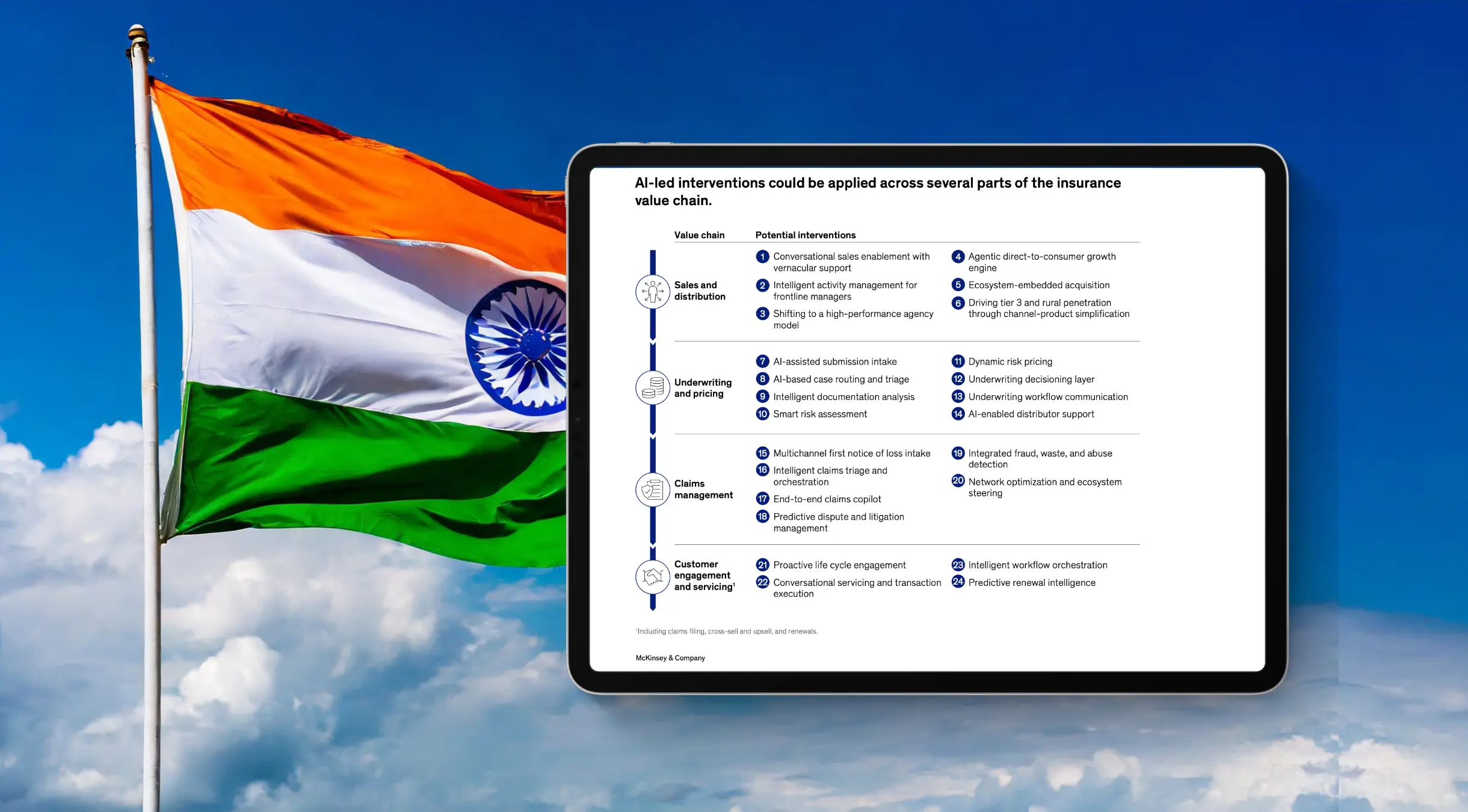
In this context, artificial intelligence (AI) has the potential to reshape India’s insurance sector, easing productivity limits, rising costs, manual work, and customer experience issues, and transforming functions including sales and distribution, underwriting, claims, and customer engagement, according to a new report by McKinsey and Company.

AI in insurance sales and distribution
In sales and distribution, frontline distribution remains fragmented, relying on multiple applications, and significant dependence on supervisors for product knowledge, sales support, and customer servicing. These challenges are often amplified in tier 2, tier 3, and rural markets, where digital adoption and language barriers can further constrain advisor effectiveness.
To address these constraints, insurers can leverage conversational, voice-first, and vernacular-enabled engagement models that cut adoption friction, let advisors interact naturally through voice, and bring product guidance, sales support, and frontline workflows into a single intuitive interaction layer.

For frontline leadership, AI can be used to track advisor activity, productivity trends, pipeline movement, renewals, earnings progression, and KPI gaps to show real-time visibility into frontline performance. This allows managers to identify underperformance early, prioritize coaching actions, improve follow-through, and focus attention on the activities most likely to improve outcomes.
AI in underwriting
Underwriting is another potential area for AI-led transformation across the insurance value chain. A possible future state is a unified underwriting workflow in which intake, enrichment, risk assessment, pricing, approvals, quote generation, and policy issuance are orchestrated through a common workflow, enabling underwriters to focus on judgment, broker and customer engagement, exception handling, and portfolio steering.
In the initial assisted-underwriting stage, AI could augment the underwriter’s workflow by providing recommendations, risk insights, and decision support while humans retain final authority over individual cases, McKinsey says.
As capabilities mature, underwriting may evolve toward a human-in-the-loop model. In this model, AI could support decisioning responsibility for lower-complexity cases within predefined guardrails while human intervention would be reserved for exceptions, potentially improving turnaround times while maintaining oversight.
The final progression could involve more autonomous underwriting where AI would manage underwriting and pricing for routine cases. Human oversight would shift to portfolio-level governance focused on aggregate risk exposure, pricing adequacy, underwriting performance, and regulatory compliance.

AI in claims management
In claims management, AI-led transformation may involve a future state in which intake, triage, assessment, fraud detection, settlement, recovery, litigation management, and network steering operate through a common workflow. Information gathering, decision support, and operational coordination may occur in near real-time, enabling claims professionals to focus on complex judgment, customer advocacy, dispute resolution, and indemnity optimization.
In particular, an AI-powered decisioning layer can automate claim assessment, prioritization, routing, and escalation, potentially reducing reliance on manual reviews and inconsistent decision-making. An intelligent claims triage engine may analyze structured and unstructured claim information; evaluate coverage, severity, fraud indicators, litigation potential, recovery opportunities, and operational complexity; and route each claim to the most appropriate pathway.

Furthermore, an end-to-end claims copilot can support a shift in claims handling from document processing toward decision support and exception management by automating much of the foundational work and supporting liability assessment. Handlers can receive a structured claim package comprising coverage assessments, liability recommendations, reserve guidance, fraud indicators, recovery opportunities, and prioritized next best actions.
AI in insurance customer engagement and servicing
In customer engagement and servicing, AI can shift these roles from reactive, transaction-based interactions into an AI-enabled engagement ecosystem that supports proactive assistance, personalized interactions, and seamless omnichannel experiences throughout the customer life cycle.
McKinsey expects customer engagement to evolve through five stages, beginning with manual servicing and progressing toward highly personalized, AI-enabled engagement.

In particular, AI can be used to support more continuous life cycle engagement by combining customer behavior, affordability, policy history, servicing interactions, and life stage events to inform personalized financial recommendations and next-best actions. These interactions can extend beyond policy servicing to include protection reviews, financial wellness guidance, renewal reminders, and personalized cross-sell opportunities, potentially supporting stronger customer relationships throughout the policy life cycle.
AI can also enable a unified servicing model that combines conversational customer engagement with intelligent agent assistance. In this model, customers could initiate and complete routine servicing requests, including policy inquiries, endorsements, claims updates, customer information changes, and renewals, through a single conversational interface across voice and digital channels.
Simultaneously, AI-enabled servicing copilots can offer representatives with customer context, knowledge retrieval, objection handling, real-time guidance, post-call summarization, and next-best-action recommendations. This would potentially allow representatives to focus on complex customer interactions while supporting routine servicing, documentation, and follow-up activities.
Insurance lags behind
Between fiscal years 2017 and 2025, the number of in-force individual life insurance policies in India remained essentially flat, at around 330 million. Meanwhile, the number of health insurance policies increased by just 5.8% annually from 33 million to 54 million. These figure reflect how the insurance sector has so far remained the only major financial service in India that has not fully shared in the nation’s financial inclusion.
Overall insurance penetration currently stands at 3.7% of GDP with life insurance at 2.7% and non-life at 1%, according to India’s Press Information Bureau. In comparison, the Allianz Global Insurance Report 2026 places the global rate at 7.2%.

At the same time, the domestic insurance sector faces stagnant profits and rising costs. According to McKinsey analysis, individual new business premium (NBP) grew at approximately 14% compound annual growth rate (CAGR) over fiscal years 2022 to 2025, accompanied by an 8% increase in policy volumes.
This growth came at a significantly higher cost, with total operating expenses increasing at around 20% CAGR during the same period. Employee-related expenses alone grew by approximately 16% across six leading private life insurers, reflecting the rising cost of acquiring and servicing business.

Pressure on distribution economics appears in productivity measures too. Productivity across the top five private life insurers has remained broadly flat over the past years, with aggregate NBP per unit of employee expense declining by approximately 2% per annum between fiscal years 2022 and 2026.

India is home to a sizable insurtech ecosystem comprising about 150 players. According to a 2025 report by the Boston Consulting Group (BCG), this industry was valued at a combined US$15.8 billion last year, with revenues reaching US$900 million in 2024, marking a tenfold increase from 2019 levels.
Featured image: Edited by Fintech News Singapore, based on image by mabrouksamira25 via Magnific
