




Artificial intelligence (AI) agents will not take over the financial industry all at once. Instead, the technology will first handle simple, repetitive tasks with clear rules, before moving into more complex financial decisions and autonomous capital movement, according to a new report by the United Overseas Bank (UOB).
The report, released in October 2026, draws insights from eight respondents spanning the payments, infrastructure, and digital asset stack. They represent organizations including Bluwhale, Eigenteam, Kasu Finance, NetMind.AI, OKX, Polyhedra Network, Transak, and Velo Labs.
These experts explored the future of agentic finance and shared their views on the future of agentic AI in the finance sector, and why addressing identity, accountability, interoperability and governance issues will be critical for institutional adoption.
Adoption of agentic finance expected timeline
According to the experts, adoption of AI agents in the financial sector will follow a gradual and uneven path rather than a single industry-wide transformation. Over the next three years, they expect bounded autonomous finance to expand first in areas where outcomes are measurable, mandates can be tightly defined, and accountability is clear.

Machine-to-machine payments are widely seen as the leading area for near-term large-scale deployments of agentic finance. This is because payments for computing resources, data services, APIs and other digital inputs are highly structured, repetitive and governed by clearly defined rules, making them well suited to autonomous execution. These transactions also tend to involve lower risk and clearer transaction parameters than many retail financial activities.
Over time, many respondents expect these machine-native payments to become embedded within digital platforms and applications, operating largely in the background rather than as a visible payment category.
Enterprise workflows such as treasury, procurement and reconciliation are expected to be the next deployment wave, potentially emerging by 2027. Treasury management, procurement, invoice processing, reconciliation and recurring cross-border payments already operate within established governance and control frameworks.
As organizations become more comfortable delegating routine operational decisions to AI agents, these workflows are likely to provide a practical pathway for scaling bounded autonomy within financial institutions and large enterprises, the experts said.
Consumer adoption of AI agents is likely to develop slowly through tightly bounded, low-risk financial activities, possibly starting as early as 2029.
While respondents generally agree that agents will increasingly assist consumers in managing routine financial activities, there is less consensus on the speed of adoption. This is because questions surrounding liability, dispute resolution and customer trust remain more challenging when financial decisions directly affect individuals.
For this reason, respondents expect early consumer use cases to focus on tightly bounded activities such as budgeting, cash-flow management and predefined savings or investment mandates, where permissions are explicit and easily withdrawn.
Finally, autonomous credit decisioning is set emerge as the further prospect because of liability, governance and loss-allocation considerations, with adoption potentially beginning around 2031.
Across the submissions, respondents consistently distinguished between executing financial decisions and making them. Although AI is expected to play a growing role in underwriting, risk assessment and portfolio monitoring, institutions remain cautious about delegating loss-bearing decisions to autonomous systems.

Three remaining challenges to agentic payments
The respondents broadly agree on the barriers to adopting agentic payments, with three key issues remaining unsettled. All sit at the intersection of technology, governance, and institutional accountability.
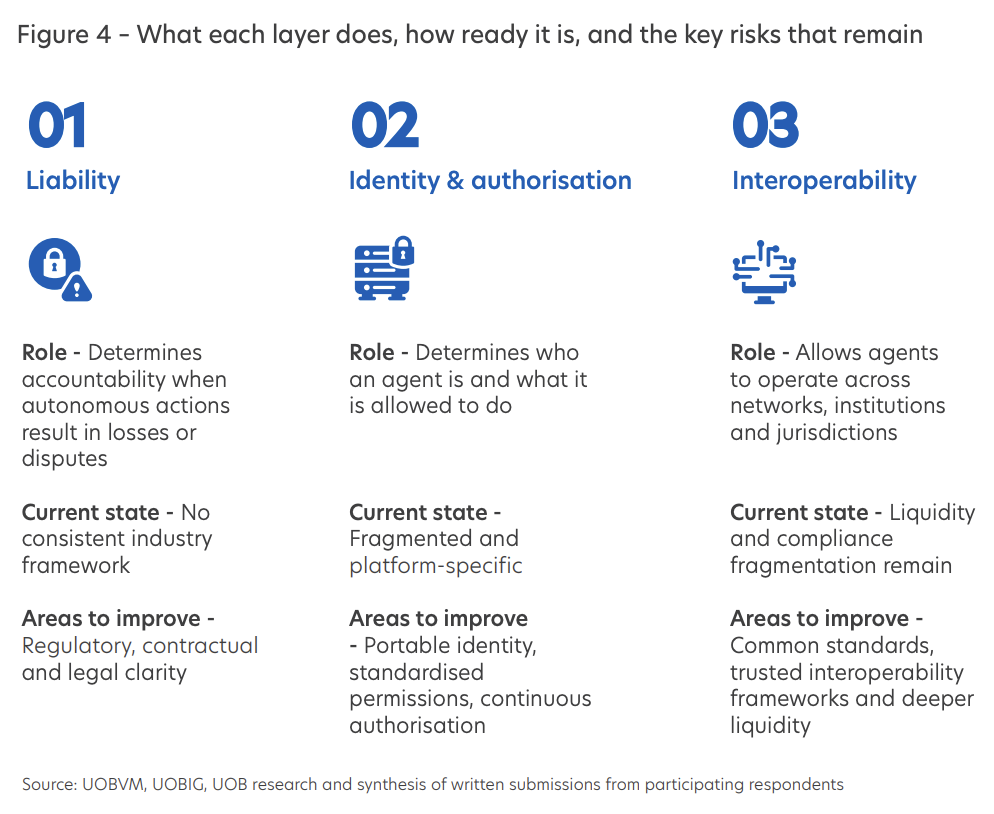
The first challenge is liability, which remains unresolved because technology can identify actions but cannot determine who ultimately bears responsibility for losses.
When an autonomous agent initiates a payment that causes financial loss, responsibility is not always clear. Liability could potentially sit with the user who delegated authority, the institution that approved the mandate, the software provider that designed the agent, the wallet or payment provider that executed the transaction, or some combination of the above.
The second unresolved challenge concerns agent identity. Financial institutions have decades of experience verifying human customers and legal entities. However, they do not yet have a broadly accepted framework for verifying autonomous software acting across multiple institutions, platforms, and jurisdictions.
With no common standard yet in place, any agentic payment deployments remain confined to controlled environments and closed ecosystems. This limits widespread adoption and efficiency.
Finally, the third challenge involves interoperability. This issue extends beyond technical connectivity into liquidity, compliance, regulation and settlement certainty. Agents may operate seamlessly within individual systems, but institutional workflows rarely remain inside a single network. Value must move across different payment rails, jurisdictions, asset classes, compliance frameworks and liquidity pools.
Liquidity fragmentation is a notable concern. An agent may identify an optimal route, but the route is only useful if counterparties, assets and liquidity are available at the moment execution is required. Similarly, settlement finality may appear straightforward to a human operator but can be considerably more difficult for an autonomous system to evaluate across multiple networks.
AI adoption in Southeast Asia
Across Southeast Asia, AI is increasingly embedded into the digital consumer journey and major sectors. In e-commerce, 69% of shoppers now use AI to compare complex purchases like electronics, while 93% of consumers trust AI in their purchasing journeys, according to the 2026 e-Conomy SEA report.
In online travel, generative AI (genAI) platforms are capturing 26% of planning journeys compared to 23% for social media, becoming the preferred way for consumers to evaluate multiple options, reduce the friction across the full planning journey, and generate personalized, custom itineraries.
In digital financial services, AI supports customer acquisition, credit assessment and fraud detection. The technology is now helping providers reach first-time or unbanked borrowers, detect fraud in real time, and expand lending and wealth management offerings to existing payment users.
As confidence in AI grows, 75% of consumers in Southeast Asia are willing to let AI agents autonomously find the best prices and complete purchases on their behalf. This shift reflects pragmatic optimism, with 62% reporting greater trust in AI tools today than a year ago.
Featured image: Edited by Fintech News Singapore, based on image by sitthiphong via Magnific
