

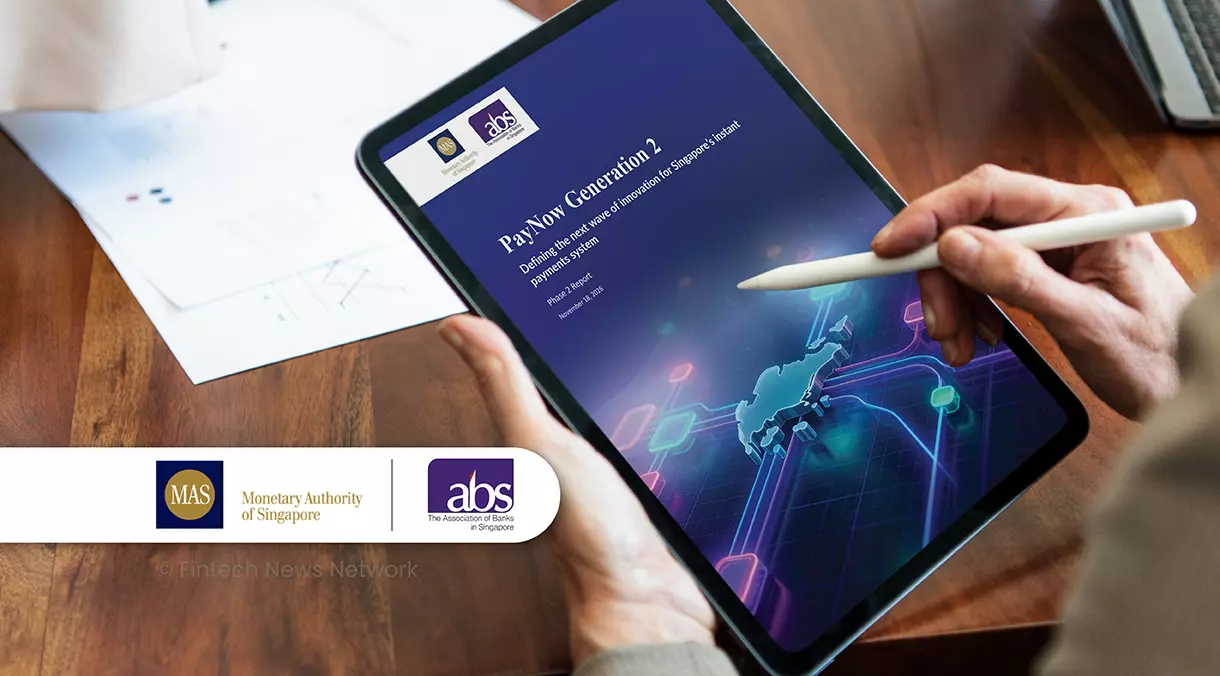
The Monetary Authority of Singapore (MAS) and the Association of Banks in Singapore (ABS) published the PayNow Gen2 roadmap for 2026 to 2028, released during the Singapore Fintech Festival 2026.
The PayNow Gen2 Phase 2 report sets out seven enhancements for a scheme that already reaches more than nine in ten adults in Singapore.
MAS will lead delivery with the Singapore Payments Network (SPaN), the not-for-profit body set up by MAS and ABS, as well as the payments industry. They will work on fitting the payment standards, scheme rules, operating arrangements and the safeguards necessary to deliver the seven PayNow Gen2 enhancements.
But what’s the full story about the PayNow Gen2 Roadmap, and why it came to be?

Where PayNow Stood Before Gen2
PayNow enters its Gen2 phase with its robust adoption already in place. Figures from the PayNow Generation 2 Phase 1 study showed that more than 90% of the adult population registered on PayNow, with around 11 million registrations.
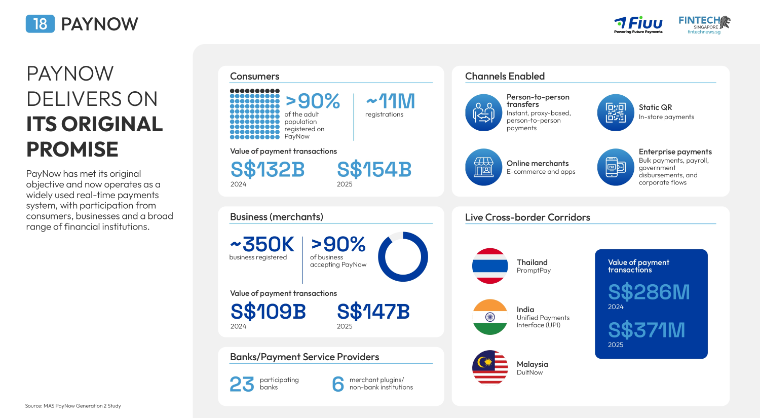
Consumer payment value rose from S$132 billion in 2024 to S$154 billion in 2025, while business payment value grew from S$109 billion to S$147 billion.
Around 350,000 businesses are registered, and the scheme counts 23 participating banks plus six merchant plugins and non-bank institutions.
Across borders, PayNow’s live corridors with Thailand’s PromptPay, India’s Unified Payments Interface (UPI) and Malaysia’s DuitNow carried S$371 million in 2025, up from S$286 million in 2024.
Released in June 2026, Phase 1 of the study identified four possible areas of upgrade for its next phase, focusing on Singapore residents and visiting tourists, merchants and businesses, government agencies, and wider businesses and consumers.

What the Second Phase of the Study adds to PayNow Gen2
After Phase 1 flagged critical capability gaps between PayNow’s existing capabilities and those of leading payment markets, Phase 2 turns towards closing those shortfalls.
Phase 2 expands these into seven, grouped under three priorities: seamless, safe and inclusive payments, globally interoperable payments, and enabling Singapore’s future economy.

How Will PayNow Gen2 Enhance Digital Payments Further?
Phase 2 builds on three focus areas developed in Phase 1, with seven upgrades and a staged rollout plan.
The PayNow Gen2 aims to enable the following: inclusive QR apps, QR interoperability via SGQR+ switch, deep-linking, micropayments or FAST-LITE, high-value and high-volume payments, PayNow P2M scheme rules, and finally, smarter business payments.

What’s Happening in 2026?
Two enhancements are already reaching users in different stages of development.
Inclusive QR apps
According to the report, inclusive QR apps are currently available, with features that focus on Singapore residents and inbound visitors. New options are also being made available for Singapore residents, which would make it possible to “support greater independence in everyday payments with appropriate family oversight.”
For example, the enhanced NETS app offers sponsored wallets with spending limits. It is designed for residents who are financially dependent, like seniors and young adults who may rely on a caregiver or parent for their spending.
Select visitor payment options are also available for inbound travellers, like Wise and the enhanced NETS app, allowing these visitors to make PayNow QR payments at certain merchants.
“76% of tourists surveyed indicated they would be more likely to trust a Singapore Government-backed app, the PayNow Gen2 Phase 2 report shared.”
Of the 87 inbound tourists surveyed by MAS BIRU, 78% said cards were their primary payment mode in Singapore, and the report notes that internationally issued cards already provide convenient access across much of the country.
Phase 1 of deep-linking
Deep-linking, which takes a customer straight to their banking app at checkout for government or e-commerce payments, is live in selected journeys.
For example, OCBC customers can now pay directly with PayNow when checking out on Lazada, and make payments to the Central Provident Fund Board (CPFB) in OCBC’s mobile banking app.
Ant International also said it was the first to implement PayNow deep-linking for e-commerce via Lazada, seeing ~9% higher payment success rates.
2C2P by Antom is also working alongside GovTech Singapore to explore PayNow deep-linking capabilities through GovWallet, a payment platform that supports digital government services.
What’s Coming in 2027
The report describes 2027 as the year to build foundations and begin initial adoption.
Phase 2 of deep-linking
The focus will be on developing common industry standards so that journeys from online checkouts into participating banking or payment apps can become more direct and consistent.
In late 2027, a central deep-linking facility is targeted for pre-release.
Phase 1-2 of QR Interoperability through SGQR+ Switch
A limited rollout will link an initial group of participating QR schemes and test live transactions. This will set the groundwork for interoperability between PayNow and NETS QR, followed next by regional connectivity.
Micropayments/FAST-LITE
A payments simulator will be built to support Micropayments/FAST-LITE development. It will assess whether a possible lower-cost, higher-frequency payment rail is viable.
Phase 1 of high-value and high-volume payments
A limited, initial rail trial of higher-value PayNow payments will commence, starting with the first government agency in late 2027.
Phase 1 of smarter business payments
More detailed PayNow payment data is targeted for introduction from end-2027, giving banks and payment providers a way to build services that help businesses and government agencies match payments to invoices and handle reconciliation automatically.
Next Up in 2028
2028 is all about expanding the capabilities even more across the four segments: users, merchants, government agencies, and payment networks.
Phase 3 of deep-linking
Following its targeted pre-release in late 2027, the central deep-linking facility is planned to go live in stages from early 2028.
Phase 3 of QR interoperability via SGQR+ switch
SGQR+ will first extend across local networks, including PayNow and NETS. Over time, regional connections will broaden the payment options for visitors in Singapore and for Singaporeans overseas.
Wider participation would benefit merchants and SMEs, as they would be able to accept payments from a bigger pool of local customers and visitors using the QR setup they already have.
Phase 2 of high-value and high-volume payments
In this phase, higher-value PayNow payments will be extended to more government agencies.
PayNow P2M Scheme Rules
This initiative aims to enable clearer arrangements for handling disputes, refunds, scams, and fraud, as well as consistency. Broader P2M scheme rules will be phased across 2028.
Phase 2 of smarter business payments
This phase is the beginning of when services using richer PayNow payment information can be offered. Work on tokenised payment credentials and other future business-payment capabilities will continue on a separate track.
Future Payment Rails Blueprint in 2027
MAS will lead work on a Future Payment Rails Blueprint beginning in 2027, setting out how Singapore’s payment rails should evolve beyond Gen2.
The Blueprint centres on a multi-rail, multi-functional, and multi-service payments architecture. It aims to reduce operating costs, speed up time-to-market, increase the resilience of the national payment rails, and accelerate the pace of innovation.
Featured image edited by Fintech News Singapore based on an image by rawpixel.com on Magnific