



Despite growing investments in artificial intelligence (AI), most financial institutions still struggle to translate their AI initiatives into measurable business value.
According to a new report by consulting firm Quinlan and Associates, 95% of traditional financial institutions are actively exploring or have already adopted AI solutions for business operation. However, a concerning 71% of these institutions are facing challenges in achieving clear returns on investment (ROI) from these investments.
The report identifies three main barriers hindering this progress. First, organizations often rush to deploy AI tools without a well-defined strategy, selecting AI solutions before identifying the specific business problems, workflows, and desired outcomes they should address.
Quinlan and Associates warns that while this rush to deploy AI can generate visible momentum and media attention, initiatives launched without a strategic design often fail to enhance underlying business performance.

Another prominent reason for the lack of value and ROI from AI initiatives is the tendency to treat risk as an afterthought.
As solutions based on large language models (LLMs) ingest increasingly sensitive data and assume greater autonomy, risk must be embedded early to avoid control gaps, costly remediation, and project cancellation, Quinlan and Associates advises.
The report reveals that a concerning number of AI initiatives are ultimately canceled. Only 56.6% of AI initiatives are successfully deployed. Among those deployed, only 21.1% achieve their objectives fully, while 35.5% achieve them partially.

Finally, another key reason behind the lack of AI value and ROI is that existing models are not equipped to effectively govern, implement, and scale AI. Oftentimes, AI is deployed as a solution looking for a problem, resulting in workflows being reshaped around AI rather than being designed specifically to meet workflow requirements. Consequently, these workflows are frequently ill-equipped to leverage AI capabilities.
Furthermore, AI capabilities can be delegated to different functions, resulting in teams assembling their own agents. This leads in fragmented deployment, duplicate efforts, and limited interoperability.
Another issue arises from inconsistent evaluation processes and unclear quality benchmarks. Current business operating models often lack standardized workflows, human review checkpoints, and use case specific key performance indicators (KPIs) to assess and validate AI outputs.
Finally, existing training and change management efforts do not often evolve in tandem with changing employee roles. This means that staff may lack the necessary skills and confidence to use AI roles effectively, leading to underutilization of these tools across organizations, and limiting ROI.
Findings from the Quinlan and Associates research align with those of other studies. A 2025 study by Boston Consulting Group (BCG) of more than 1,250 firms worldwide found that only 5% of the organizations polled have actually achieved AI value at scale.
Conversely, at the other end of the spectrum, 60% reported achieving no material value at all, noting minimal revenue and cost gains despite substantial investment. Another 35%, or 13 points more than in 2024, were scaling up their efforts and seeing some returns, but many of them admitted that they were not moving far enough or fast enough.
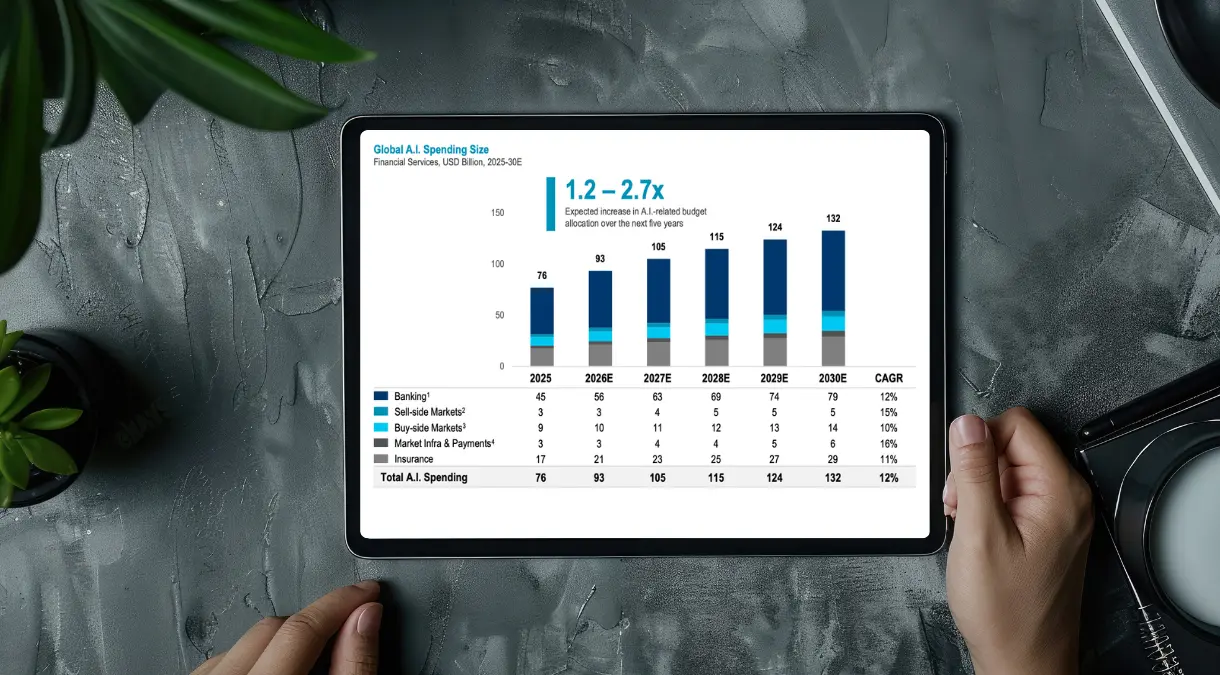
Global AI spending in financial services
In 2025, the global financial services industry invested US$75 billion in AI-related initiatives. This figure is projected to reach US$132 billion by 2030, growing 12% annually, according to Quinlan and Associates’ estimates.

Currently, AI is mostly deployed in assistive use cases, such as chatbots that handle customer queries through text or voice, and copilots, which are AI assistants embedded within business applications that enable professionals use to better perform daily tasks with enterprise context.

AI agents and agentic systems, on the other hand, have yet to achieve widespread adoption, despite high intent. According to a Nvidia survey conducted in Q3 2025, 42% of the over 800 industry professionals polled were either using or assessing agentic AI. Within that number, 49%, or 21% of the total survey respondents, said that agents had already been deployed within their organizations. Another 41%, or 18% of the total survey, said that AI agents would be deployed within the next year.
56% of those using or assessing agentic AI cited knowledge management and retrieval as the top overall use cases for AI agents. This is followed by internal process optimization at 52% and customer support automation at 43%.

Featured image: Edited by Fintech News Singapore, based on image by ttonaorh via Magnific
