



Around the world, central banks are expanding their focus on artificial intelligence (AI) from experimentation to readiness.
According to a new study by the Irving Fisher Committee on Central Bank Statistics (IFC), a forum for central bank economists, statisticians, and data professionals under the Bank for International Settlements (BIS), these institutions increasingly view themselves as AI-ready, supported by higher priority in their agendas, plans for organizational and data readiness, and wider AI applications.
The research, based on a 2026 survey of 65 IFC jurisdictions, found that more central banks have added AI to their strategic plans since 2024. In 2026, nearly two-thirds placed AI in their goals, up from less than half in 2024. This change is reflected in formal discussions of AI and machine learning (ML) within half of the organizations.

The report also highlights a clear rise in the share of production-grade initiatives deployed over the past years. Specifically, more than two-thirds of AI projects were in production in 2026, compared with about half two years earlier. The fraction of use cases under development has remained relatively unchanged at less than one third of the total, while the number of respondents not using AI or ML has failed to almost zero, further reflecting the widespread AI adoption.


Data and AI governance readiness
In line with the growing relevance of AI, central banks also reported quickly advancing their readiness to use the technology by strengthening their organizational preparation. Specifically, over two-thirds of the respondents had either already established or were drafting such organizational strategies in 2026, with less than 10% not planning to do so.
Organizations also indicated significant progress in data AI readiness and in managing information assets supporting the use of AI. In practice, almost two-thirds of central banks reported that they had already implemented or were planning to implement such strategies, often as part of broader modernization programs.

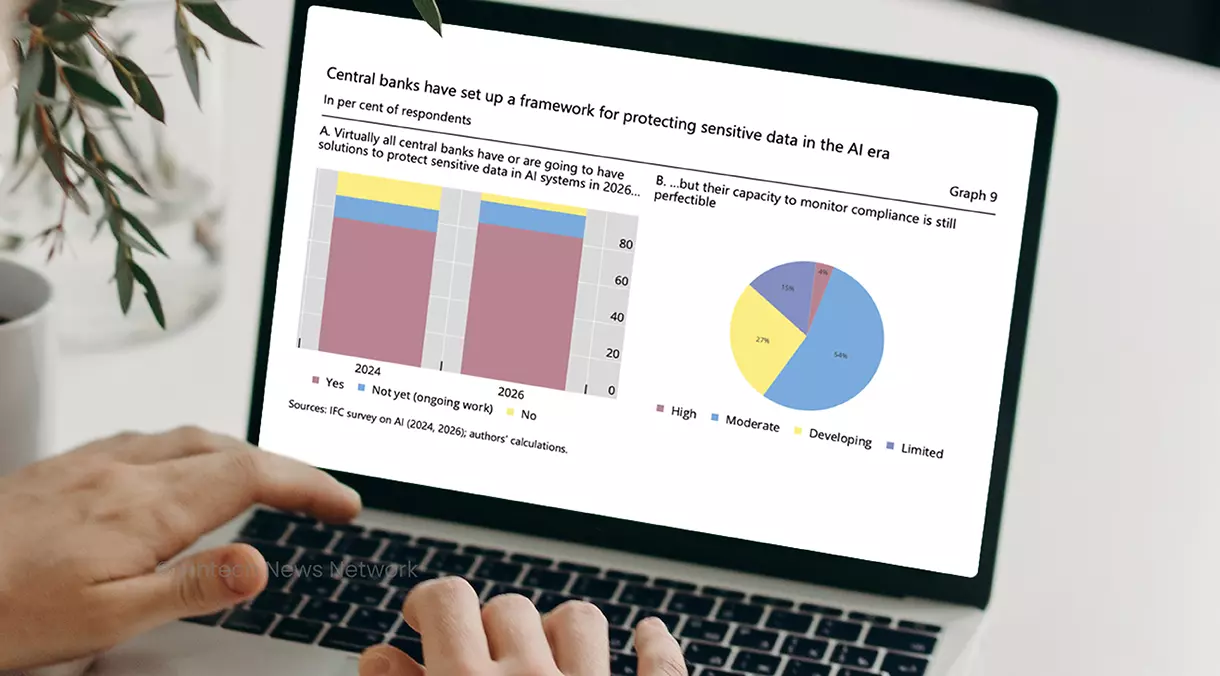
Central banks are also making significant headway in AI governance. Virtually all of the respondents in 2026 had or were going to have solutions to strengthen their capacity to monitor and, where possible, mitigate AI-related risks, especially to protect sensitive information. Yet, about half indicated that their capacity to monitor compliance remained moderate, while a large minority reported that it is still under development or limited, showing that work still needs to continue.

Expanding AI use to support efficiency
The study also found that central banks are adopting AI more widely, moving beyond early uses like search, coding, and translation, towards general-purpose solutions that improve efficiency.
A notable development is the deployment of productivity copilots, which are increasingly integrated into routine operations in many organizations. In 2026, these were used extensively by half of the central banks surveyed.Narrow models, which cover tailored use cases such as forecasting or sentiment analysis applications, are also catching up, with about 25% utilizing them broadly.

Looking ahead, central banks expect AI to transform many of their existing workflows, particularly those related to cross-cutting activities such as coding, IT as well as data analytics. Over 60% expect a high impact on coding and IT, while about 55% foresee a strong effect on analytics.

Use of AI among regulators
AI is increasingly being adopted by financial regulators and public authorities. In Asia, the Monetary Authority of Singapore (MAS) and the Hong Kong Monetary Authority (HKMA) are deploying AI for off-site monitoring and anomaly detection. The Bank of Thailand applies AI to support prudential supervision, including analyzing board meeting minutes of supervised financial institutions to assess regulatory compliance.
Meanwhile, the Securities Commission Malaysia uses AI tools to monitor the adoption of corporate governance best practices and the quality of disclosures of listed companies on the Malaysia Stock Exchange as part of its ongoing conduct supervision.
In the Philippines, the Bangko Sentral ng Pilipinas (BSP) rolled out the Advance Suptech Engine for Risk-based Compliance (ASTERisC) in 2023. ASTERisC is a unified regulatory and supervisory technology solution that streamlines and automated regulatory supervision, reporting, and compliance assessment of banking, financial services, and insurance institutions’ cybersecurity risk management systems and processes. The platform incorporates cloud-based data analytics, automated processing, and monitoring technologies alongside broader regulatory tech frameworks.
Featured image: Edited by Fintech News Singapore, based on image by saurabh Jainth via Magnific
