




A digital bank architect, a Mastercard engineer and a personal finance app founder are among 10 women the Singapore Fintech Association (SFA) has recognised for their work in AI.
SFA opened nominations to the public and profiled the winners in its Women Leaders in AI report.
Four judges assessed nominees on the impact of their work, leadership, innovation, responsible and inclusive AI, and contributions to their communities.
The Financial Alliance for Women and the Women Entrepreneurs Finance Initiative supported the campaign. The list is not ranked.

Who Made SFA’s Women Leaders in AI List?
1. Yier Cao, Google Cloud

Cao helped build and launch digital banks and fintech businesses across Asia before becoming Google Cloud’s Principal Architect for Financial Services.
She now advises banks across Asia-Pacific on deploying AI agents with safeguards and builds systems that use multiple agents.
Prior to joining Google Cloud, she and three teammates built a voice and vision prototype at a Google DeepMind hackathon to help people living with dementia recall memories.
She also co-founded Mimosa AI and helped launch workshops where people with no coding experience build their own AI agents.
“What fascinates me is that we are all inside this giant experiment we call the agentic AI era. It is reshaping how we work, how we connect with each other, and how we engage with the world.
Human agency has to stay at the center of it. In financial services, we call that accountability. More broadly, it means people defining how change happens, not just reacting to it.”
2. Shery Chan, Standard Chartered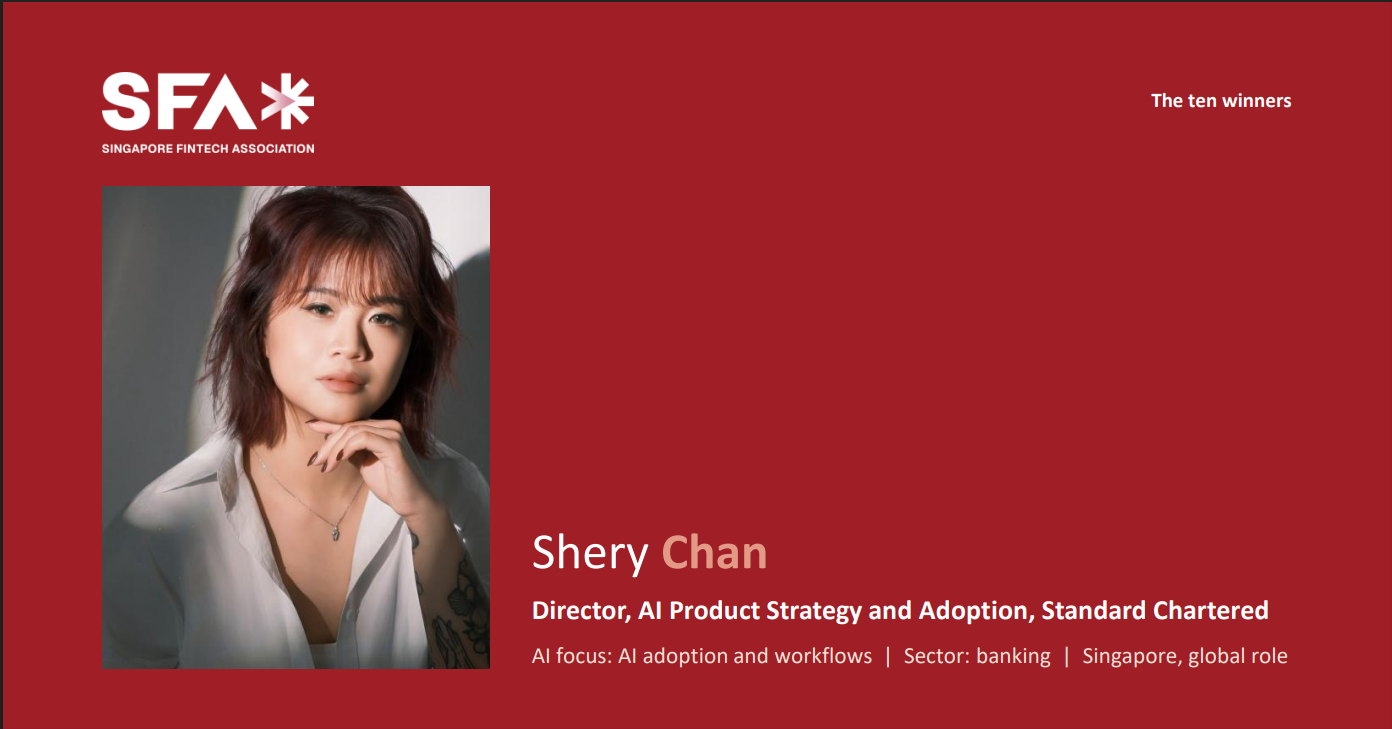
Shery trained as a designer. After taking an introductory AI workshop in 2025, she built a prototype to help financial crime teams spot and act on risks sooner.
That work helped her move into Standard Chartered’s central AI team.
As Director of AI Product Strategy and Adoption, she works across the bank’s 54 markets.
She helps teams assess whether an AI project solves a real problem, whether staff will use it and where people need to keep control.
Outside the bank, she founded Innovation Design Club and runs sessions that help beginners build their first AI prototypes.
“It’s almost always a human problem, not an AI one. The scarce ingredient is perspective and discernment – women have it in spades, and it’s time we took the reins.”
3. Dr Brindha Jeyaraman, Aethryx
Dr Brindha helped companies design and deploy AI systems as Principal Architect for AI at Google Cloud before founding Aethryx.
She worked on AI policy and risk at the Monetary Authority of Singapore (MAS) and later led AI governance at UOB.
Her doctoral research at Singapore Management University explored how AI could help predict corporate credit risk.
At Aethryx, she built AssureTrust to check what data and tools an AI agent can access, what it can do and when a person must approve an action.
The platform also records what the agent did and which controls were applied.
“I want AI governance to become part of how systems are built and operated, with clear authority, meaningful human oversight and evidence people can understand.”
4. Sherry Jiang, Peek, 65labs and Code with AI
Sherry co-founded Peek and serves as CEO. The AI personal finance app helps younger users understand where their money goes and start building wealth.
She also co-founded Code with AI, which has taught more than 1,000 people to build and launch apps.
Some participants have built tools for their own classrooms. At 65labs, Sherry helped grow a community of more than 5,000 builders and bring AI Engineer Singapore to the city.
“AI has made it possible for almost anyone to build software. What matters now is making sure more people actually get the chance to try.”
5. Dr Ayesha Khanna, Addo AI
Dr Ayesha is the Co-Founder and CEO of Addo AI, where she helps companies and governments put AI into use across their organisations.
She serves on the board of Johnson Controls and previously served on boards at industrial software company Aveva and Saudi technology company NEOM Tonomus.
Through her charity 21C Girls, she taught hundreds of girls in Singapore the basics of AI over a decade.
She now offers scholarships through Amplify for mid-career women to develop practical AI skills.
“What separates AI ambition from AI value is execution. Visionary leaders treat AI as an operating model that delivers returns on ambitious initiatives, responsibly.”
6. Annabelle Lin Peishan, Nextvestment
Annabelle spent two decades in financial services and enterprise technology, including roles at Google, Citibank and EY.
As Co-Founder and Chief Revenue Officer of wealthtech firm Nextvestment, she closed six deals with financial institutions in two years, according to the report.
She pitched Portugal’s Bison Bank at Web Summit in Lisbon and helped turn that meeting into a partnership that led to the launch of Bison Insight in September 2026.
She also worked on Nextvestment’s partnership with Phillip Securities, which uses the company’s AI tool for financial guidance in its POEMSGPT platform.
“People should understand the basis of an answer, its limitations, and who is accountable when it is wrong.”
7. Wan Ting Poh, Mastercard
Poh leads Mastercard’s AI Foundations team, which builds tools for use across the company.
Her team replaced separate cardholder models with a shared system that supports more than 400 deep learning models in production across five regions.
The report says it cut the time needed to bring a new card issuer on board from about three months to four hours.
Her team tests AI systems for safety and fairness before and after launch.
Poh also co-leads Mastercard’s work in the MAS BuildFin.AI Payments Working Group, which looks at how the industry can use AI agents safely.
“What has always excited me about AI is its potential to solve real problems and make a meaningful difference. I believe the true measure of AI is not how sophisticated the technology becomes, but the impact it creates.
That means being thoughtful about how we apply it, responsible in how we build it, and ensuring that trust is at the heart of everything we do. To me, responsible AI isn’t a constraint on innovation. It’s what makes meaningful, lasting progress possible.”
8. Bhavana Ravindran, EarlyBird AI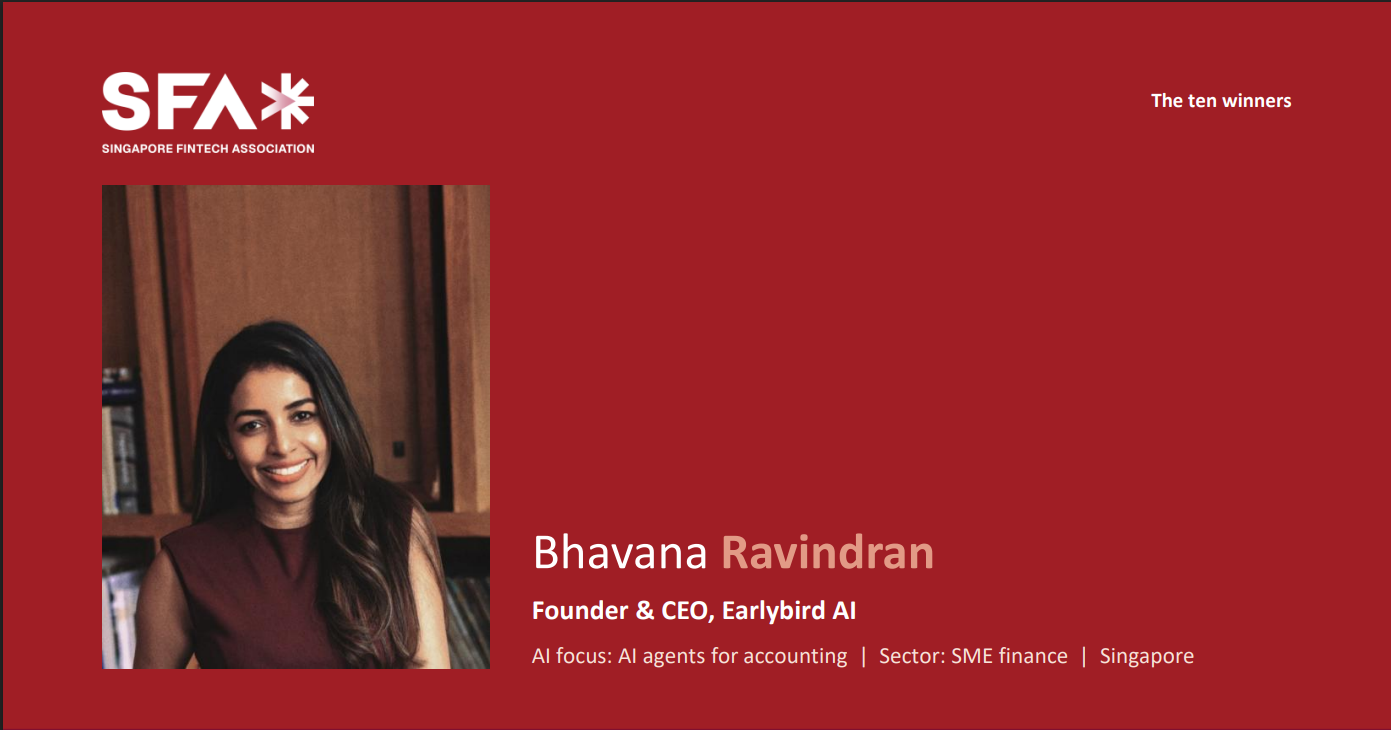
Bhavana spent a decade building payments infrastructure with major banks and Visa before founding EarlyBird AI in 2024.
The company helps businesses such as restaurants and clinics match payments across point-of-sale systems, payment gateways and bank accounts as they come in.
A qualified accountant reviews every exception, and each entry records where it came from and who approved it.
EarlyBird also put its software through independent testing under the Infocomm Media Development Authority’s AI Assurance Programme.
“The future finance team manages exceptions, not transactions. At EarlyBird, AI does the matching at machine speed, and accountants make the judgement calls a machine shouldn’t. That frees people for the work that needs them.
Women leaders can make that balance the standard: reward teams for getting it right, not just for using AI, and keep asking who checks the output, who is accountable, and whether it actually works.”
9. Daini Wang, ANEXT Bank
Daini is an AI Solutions Architect at ANEXT Bank, a digital wholesale bank that serves SMEs.
She helped develop AI-assisted transaction monitoring that reduced the anti-money laundering team’s transaction analysis time by 60 percent, according to the report.
An internal AI agent she worked on answers thousands of staff questions each month.
Daini also uses AI to help screen negative news during customer onboarding while leaving final decisions to analysts.
When the credit risk team wanted to use voice-to-text software, she tested how it handled English, Mandarin and Singlish.
“AI is a structural amplifier. It magnifies how an organisation already works.”
10. Jennifer Zhang, AchieveGo.AI
Jennifer co-founded WIZ.AI in Singapore in 2019 to build voice software that could handle the way people speak across Southeast Asia, including Singlish and Taglish.
During her six years as founding CEO, the company grew from three people to about 300 across 17 countries and served banks and insurers.
Her latest company, AchieveGo.AI, is using AI agents in the day-to-day operations of a clinic chain and working towards its first autonomous store.
The company uses what it learns in those settings to train and test agents. People still set the rules and sign off on key decisions.
“The autonomous economy won’t be built in a demo. It will be built in the clinics and shops people depend on every day, one operation at a time.
I’m building the infrastructure for that: real-world environments where AI agents prove themselves, under rules that people set.”

Featured image: Edited by Fintech News Singapore, based on image by stokhunt via Magnific
