Ant International’s CEO Says the Four-Party Payment Model Needs to Evolve
Yang shared that the settlement infrastructure must evolve as A2A payments gain ground and as merchants begin running entire transactions on tokenisation.
Get the hottest Fintech Singapore News once a month in your Inbox
The traditional economy has long relied on a clear split of responsibilities across four parties, also referred to as the four-party payment model of the issuer, acquirer, network, and regulator. But with CBDCs, blockchain, and Web3 currencies going mainstream, will the acquirer and network still be needed?
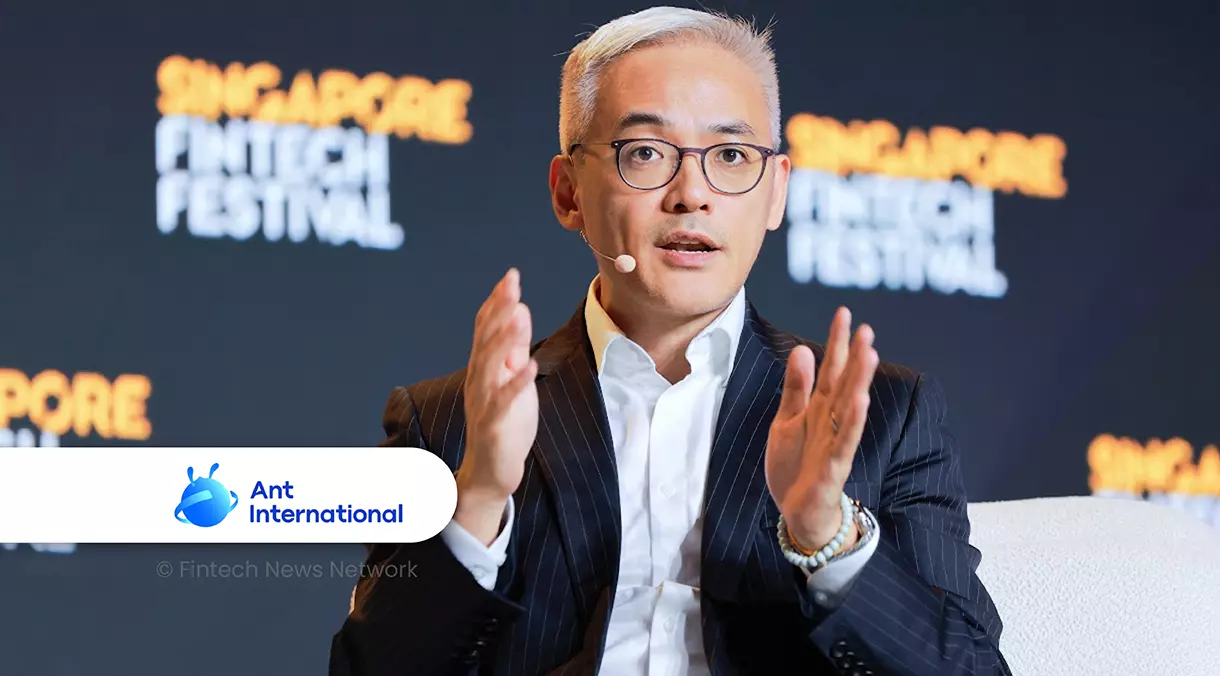
According to Ant International’s CEO, Peng Yang (YP), the settlement infrastructure would need to evolve beyond that very model.
Yang shared his insights during a panel titled From Digital to Intelligent: Who Will Build the Next Financial System? alongside Javier Pérez-Tasso, the CEO of SWIFT, and Surendra Rosha, the Co-Chief Executive, Asia and Middle East, of HSBC.
Arjun Vir Singh, Partner and Global Head of Fintech at Arthur D. Little, moderated the panel. Yang outlined three key priorities to address in the future financial system:
How should settlement infrastructure evolve in the AI+ blockchain era to establish new game rules?
How to build cross-rail, cross-modal trust for the agentic economy?
How to mainstream inclusion into AI design to close the accessibility gap for SMEs?
Settlement Needs to Move Beyond the Four-Party Model
Speaking at the Singapore Fintech Festival 2026, Yang shared that the settlement infrastructure must evolve beyond the four-party model as account-to-account (A2A) payments gain ground, and as merchants begin running entire transactions on tokenisation.
That shift, he said, calls for an evolution to a model which is capable of effectively assigning roles and responsibilities.
Peng Yang
“The settlement layer, the invisible rail, still matters most. Only at this layer can new rules of the game be defined, so everyone plays on the expanded field with clear responsibilities and new boundaries,” he elaborated.
As Ant International pushed the application and intelligence frontiers of AI and blockchain, it was convinced that its settlement infrastructure had to evolve, too.
This was so that trust and accountability could be clearly assigned within new forms of regulated businesses.
Ant International’s blockchain-based treasury tech solution offers a glimpse of how that evolution becomes a reality. The platform connects 23 global and regional banks, and Ant International has settled US$1.1 trillion over the last 12 months. Its processing volume is expected to double in 2027.
Yet the ledger itself is not where the difficulty lies.
“Blockchain is not rocket science,” Yang said.
He pointed to three hard parts: compliance, the business mechanism, and proving the authenticity of assets on the rail. Collaboration across banks, fintechs, and partners like SWIFT is key to unlocking them.
The encouraging sign, according to Yang, is the speed at which collaboration can happen.
What a 7-Second Remittance Reveals About the Future of Payments
Answering institutional and foundation changes demands a new trust layer, and for agentic commerce, Yang noted that Know Your Agent (KYA) is a crucial priority.
Under KYC, each financial institution verified its customers within its own walls, as they ran separate, siloed KYC structures. In the KYA era, where AI agents transact on behalf of people and businesses, verification and monitoring have to run around the clock and across rails and networks.
For example. Ant International brought the idea of bank-to-wallet direct remittance to SWIFT, and 8 months later, it was live. This made it possible to move funds from a Standard Chartered account to a DANA wallet in seven seconds, a rare pace, even across a field of many private sector partners.
“We don’t want to do everything ourselves,” Yang said. “Seven years ago, nothing existed, so we had to. That’s how our treasury solution was built. Today, SWIFT is building, JP Morgan is building, Citi is building, some countries run fast payment systems, and networks are forming across Southeast Asia.”
Yang expects an open, connected network in the future, where AI selects the ideal route for each merchant, be it the fastest or the cheapest. Intelligence-layer builders like Ant International would, in turn, need open and reliable rails that every player can use on its clients’ behalf.
Can AI Help SMEs Compete With the Goliaths?
“If technology fast-forwards and only the big enterprises and big tech companies capture the AI premium, that future is boring,” Yang said.
Globalisation 1.0 created unprecedented wealth and prosperity, and large enterprises took most of the productivity gains, he said. Many small businesses, individuals, and communities were left behind.
To move the world forward, Yang informed that the reglobalisation project must ensure the inclusion of the smallest participants. In his reading, technology has to be democratised for SMEs and the little guys to share in the benefits.
For Ant International, the answer lies in AI, when it is proactively engineered with that very goal in mind.
“In our products and solutions design, AI can narrow the distance between large and small: with agent help, a small enterprise or an individual can compete with the giants,” Yang explained.
The Vision for Borderless Payments and Wider Financial Access
In the session “Driving Financial Inclusion and Shared Prosperity in an Age of Uncertainty,” Yang turned from platforms and back to the people.
He recalled trekking through northern Iraq with colleagues on the Abraham’s Path Project, where a remote mountain village showed what connectivity and access to technology, information, and choice meant there.
Speaking with fellow panellists William Ury, a Professor at Harvard Law School; Alexandre Chade, Founder and Chairman of Dotz; and Luay Obaidi, the Chief Product Officer at Qi Card, Yang shared,
“First, payment should be like the internet and email. Nobody asks whether an email is domestic or international; the internet killed the concept of a border. Payments still draw a distinct line between local and cross-border.
With agentic, with tokenisation, with public- private initiatives for interoperability, we should remove those differences. So even the most remote people can enjoy borderless payment, remittance and purchase, online and offline.”
In his second point, Yang stressed that if a small player has a big dream, they should be able to access the financial support they need to thrive.
“With new wallets and financial institutions empowered by technology, that should become the new normal of our economy.”
Yang informed that the agentic economy trust layer has to rest on a stronger multi-rail, multi-modal, and multi-asset model.
Good AI solutions design, he added, can power a new, more inclusive globalisation project by putting the little guys on a level playing field.
Ant International Expands Its Reach Across Payment Networks
At the Singapore Fintech Festival 2026, Ant International announced a series of partnerships in the very spirit of cross-sector and cross-rail collaboration:
New developments on trusted agent transactions in agentic commerce with Visa and Mastercard
Launched an upgrade to its treasury tech solution for interoperability between tokenised deposits and tokenised money market funds under the MAS BLOOM initiative