



Stablecoins have crossed a historic threshold. In 2024, its total transfer volumes hit US$27.6 trillion, outpacing Visa and Mastercard combined.
Once a niche crypto use case, stablecoins have swiftly matured into a core financial infrastructure in their own right, and nowhere is this shift more visible than in the stablecoin adoption in APAC.
Research from the International Monetary Fund (IMF) backs this up. An IMF study showed that APAC and North America lead with the largest gross stablecoin flows. The study mapped roughly US$2 trillion in stablecoin flows across 2024.
Additionally, regulators in Hong Kong, Singapore, the Philippines and South Korea have already laid out clear policy frameworks, while countries like Malaysia are actively building theirs. The direction of travel is obvious: stablecoins are on the path to becoming regulated, mainstream payment instruments.
For banks, payment providers and businesses, the question now is this: what does this transformation mean for the way money moves and settles?
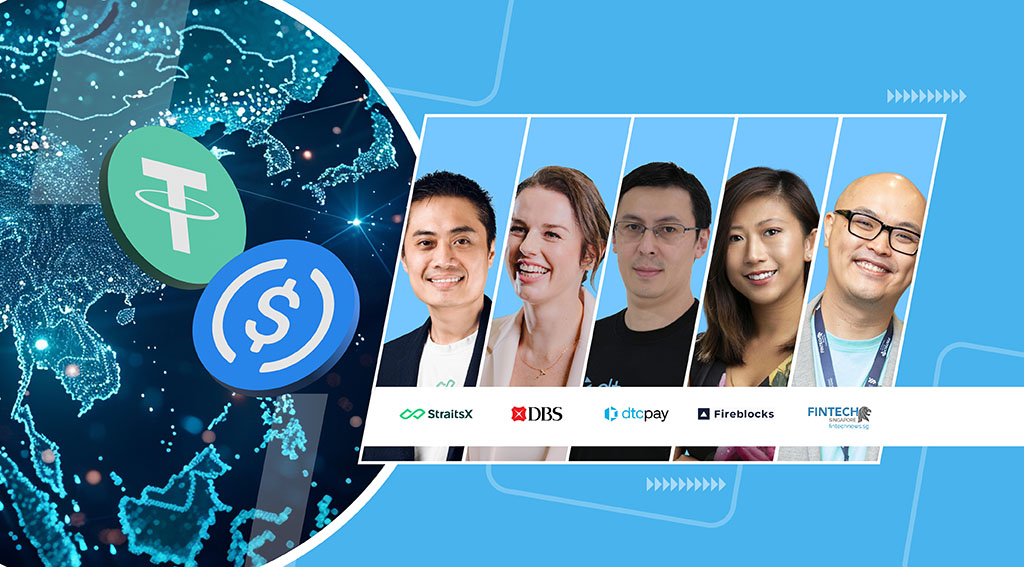
To explore what comes next, Fintech News Network’s Chief Editor, Vincent Fong, sat down with four leaders in this space: Tianwei Liu, CEO and Co-Founder of StraitsX; Evy Theunis, Head of Digital Assets at DBS Institutional Banking Group; Amy Zhang, Head of APAC at Fireblocks; and Lin Xin, COO of dtcpay.
What Are the Real Drivers of Stablecoin Adoption?
“When we look at the catalysts driving the industry’s maturity, two stand out: growing regulatory clarity and the natural, organic liquidity – both primary and secondary – that the stablecoin market has developed,” shared Amy Zhang, Head of APAC at Fireblocks.
According to Amy, two forces are behind the surge in adoption: clear regulations and the growth of organic liquidity. Rules give institutions the confidence to engage, but it’s liquidity that makes stablecoins usable in practice.
For a payment service provider, this means factors like knowing where they can access stablecoins, how to bridge them back into the traditional banking system, and which markets they can reliably move funds across.

Much of this liquidity was first built through digital asset trading. As trading platforms became more regulated and interconnected with traditional finance, they laid the groundwork for stablecoins to break free from their trading roots.
Today, banks, payment service providers, and corporations are tapping into these pools to build real services on top. This shift is visible in Fireblocks‘ own numbers. Amy added,
“Two years ago, looking at Fireblocks, about 70% of flows going through our platforms were crypto, and 30% were stablecoins. But just last month, we’re now having more digital assets in stablecoins being processed through the system than crypto. That’s a very exciting change.”
Fireblocks, which works with more than 300 banks and payment service providers, now processes over US$200 billion in stablecoin payments every month.
She continues, saying that when it comes to stablecoins, both banks and corporates are focusing on the issuance side of the house. She cites JD.com, which has announced plans to issue stablecoins in multiple jurisdictions, tailored to where its business needs are strongest.
StraitsX Shares on Settlement Without Friction
Tianwei Liu, CEO and Co-founder of StraitsX explained how regulatory clarity has been a game-changer for issuers as well as the CFOs and treasurers deciding whether to adopt stablecoins. The SEC’s recognition of fiat-backed coins as cash equivalents rather than securities shifted perceptions. This has been key in convincing larger financial institutions to adopt stablecoins as a form of settlement.

StraitsX has seen this play out through its partnerships with Grab and Ant International over the past year. What used to take days of cross-border settlement through traditional banking rails or SWIFT, delayed by business hours, holidays, and FX fluctuations, now happens instantly.
“A stablecoin transaction itself is a settlement,” Tianwei said. “I can take the token that you have just sent me immediately, use it for my payment. Use cases, immediately.”
For him, this is the real breakthrough: stablecoins turning cross-border payments into something that feels local. And it’s not only the payment service providers that are excited.
Increasingly, Southeast Asian SMEs are adopting stablecoins to settle cross-border trade with overseas partners, drawn by the speed, certainty, and possibly lower cost compared to traditional rails.
How DBS Embraces Stablecoins and Tokenised Deposits
When Vincent asked why DBS felt confident about embracing stablecoins and partnering with players like Ripple and Paxos, Evy Theunis, Head of Digital Assets at DBS Institutional Banking Group, pointed to the bank’s long track record in digital assets.

Years of industry experience gave DBS clarity on where the technology was heading and which areas merited investment.
“We definitely look at how we can maximise the potential of the technology and of the two worlds coming together.”
She elaborated that it came down to two pillars that the bank has been building in parallel. The first is tokenised deposits. Through pilots like the DBS Treasury Token, as well as participation in the e-HKD and e-CNY trials, DBS has been exploring how rules and conditions can be coded directly into transactions, embedding programmability into payments.
Its programmable payments pilot is one example of how deposits can be reimagined through smart contracts.
The second pillar is stablecoins. Here, DBS has taken on the role of reserve bank for issuers such as Paxos and StraitsX. USDC is already listed on the bank’s exchange, signalling DBS’ intent to bring stablecoins into regulated, institutional channels.
Why dtcpay Went All-In on Stablecoins
“If payments can be programmable, it means that there can be a lot of innovations deeper into the vertical industry itself, instead of just a method of payment.”
Lin Xin, COO of dtcpay, explained that dtcpay made a deliberate shift to focus solely on stablecoin payments, phasing out Bitcoin and Ethereum by the end of 2024. The decision followed more than a year of testing with merchants, where stablecoins consistently accounted for the vast majority of transactions.

Unlike BTC or ETH, whose price volatility complicated refunds and day-to-day transactions, stablecoins offered predictability and ease of use. For merchants, this made stablecoins a practical payment method rather than a speculative asset.
With stablecoins built on blockchain rails, payments can be embedded with rules and logic that enable entirely new use cases across industries, programmed far beyond simple settlement. For dtcpay, this is where the real innovation lies.
Where Could We Go With Stablecoins Next?
As the session drew to a close, Evy highlighted two near-term priorities for banks: programmability and yield. For Lin Xin, the immediate task is much simpler: fix the user experience.
Tianwei urged the audience to see stablecoins as more than a payment tool. In his view, they are becoming a new back-end layer for finance, with regulated issuers providing the trust that allows corporates and treasuries to hold and move them as confidently as fiat.
Amy closed on a pragmatic note: revenue, cost and risk. Payment service providers, she said, can already reduce costs and pre-funding burdens by adopting stablecoins, while banks can generate revenue by banking issuers and facilitating FX across different stablecoin currencies. The transaction fees may be small, but the strategic opportunities are anything but.
Together, the panel made one resounding point: stablecoin adoption in APAC has outgrown its crypto roots. The next phase is about scaling it safely, seamlessly, and strategically across the financial system.
Want to dive deeper into the full discussion on stablecoin developments? Watch the complete webinar on YouTube, where the panel unpacks more insights on the stablecoins landscape.
Featured image: Edited by Fintech News Singapore, based on the image by muhammadbilal56311 on Freepik
