




E-commerce is undergoing a profound transformation, triggered by artificial intelligence (AI) agents and the move from “machine-to-machine” (M2M) payments to truly autonomous “AI-to-AI” payments, says Sherman Jiang, a senior product executive specialized in consumer finance, fintech, and banking.
This shift requires a complete rethinking of payment systems and introduces new challenges for product leaders to tackle
In a recent post published on September 12, Jiang looks at the future of e-commerce and the potential impact of agentic AI on the space, and outlines the hurdles ahead.
According to Jiang, unlike their older, rule-based M2M payments, agentic payments involve reasoning, learning, and acting with a purpose. These systems go beyond simply reordering a product when a sensor hits a preset threshold, and are instead capable of autonomously detecting that a user is running low on a product, searching for the best-rated options from local producers, negotiating a discount based on flash sales, placing the order, and paying for it.

For product managers, this marks an unprecedented shift where the “customer” is no longer a single person anymore, but rather an intelligent, dynamic AI agent that needs new tools, new rails, and new safeguards. This requires product executives to build better wallets that can delegate payments securely, enabling commerce to become genuinely autonomous, he says.
Fraud and liability challenges
Though the shift to agentic commerce presents tremendous opportunities to improve customer support, drive greater efficiency, and offer tailored customer experiences, these changes also introduce new challenges, Jiang warns.
Because AI agents operate at machine speed and scale, their activity may resemble criminal behavior under today’s fraud detection models. This will require a complete overhaul of fraud prevention strategies, moving away from the know-your-customer (KYC) models and towards so-called “know-your-agent” frameworks.
The key here will be to build a trust infrastructure that’s capable of distinguishing a “good” AI from a “bad” one, a system which will likely rely on cryptographic tokens to prove identity and authority.
For example, a user could prove their identity with a User ID Token. This token would act as a digital identification card that confirms the person is real and verified. Similarly, an AI agent acting on behalf of a user could be issued an Agent ID Token, which would work like a passport for the AI and establish its identity in the system. Finally, a Delegation Token could connect the two, and clearly define what the AI is authorized to do. Together, these three tokens would form a chain of trust between the human, the AI agent, and the relationship between them.
Besides fraud, the shift towards agentic AI also raises new questions about liability and dispute resolution, in particular when an AI agent makes a purchase the user did not intend.
Most traditional legal frameworks depend on the idea that someone acted intentionally or negligently. However, because AI agents make purchases that are technically authorized but which may go against the user’s actual intent, it produces a liability grey area.
Compounding this is the so-called “agentic loyalty problem”, Jiang adds, where AI agents may prioritize the interests of the platform that deployed it rather the user’s best interests. For example, an agent could choose a more expensive item from a partner company even when a cheaper, more suitable option exists elsewhere.
Incompatibility and infrastructure gaps
Finally, the rise of agentic commerce also exposes limitations in legacy financial systems. These systems, which include credit cards, subscriptions, and batch settlements, are built for human-centric, high-value, low-frequency transactions. This makes them ill-fitted for high-frequency, low-value transactions that AI agents may need to make, such as paying for individual API calls, data, or computing resources on a “pay-per-use” basis, often for fractions of a cent.
To address this, crypto-native technology players are entering the space with blockchain-based micropayment systems as the foundation for this new economy. Coinbase, for example, launched in May 2025 x402, a payment protocol that enables instant stablecoin payments directly over HTTP. The solution is designed to let APIs, apps, and AI agents to transact seamlessly.
Beyond payments, blockchain-based infrastructure could also supply the core primitives that traditional systems lack, Jiang argues. This includes a secure and immutable ledger, verifiable identities, and smart contracts for autonomous value transfer.
AI agents see rapid adoption
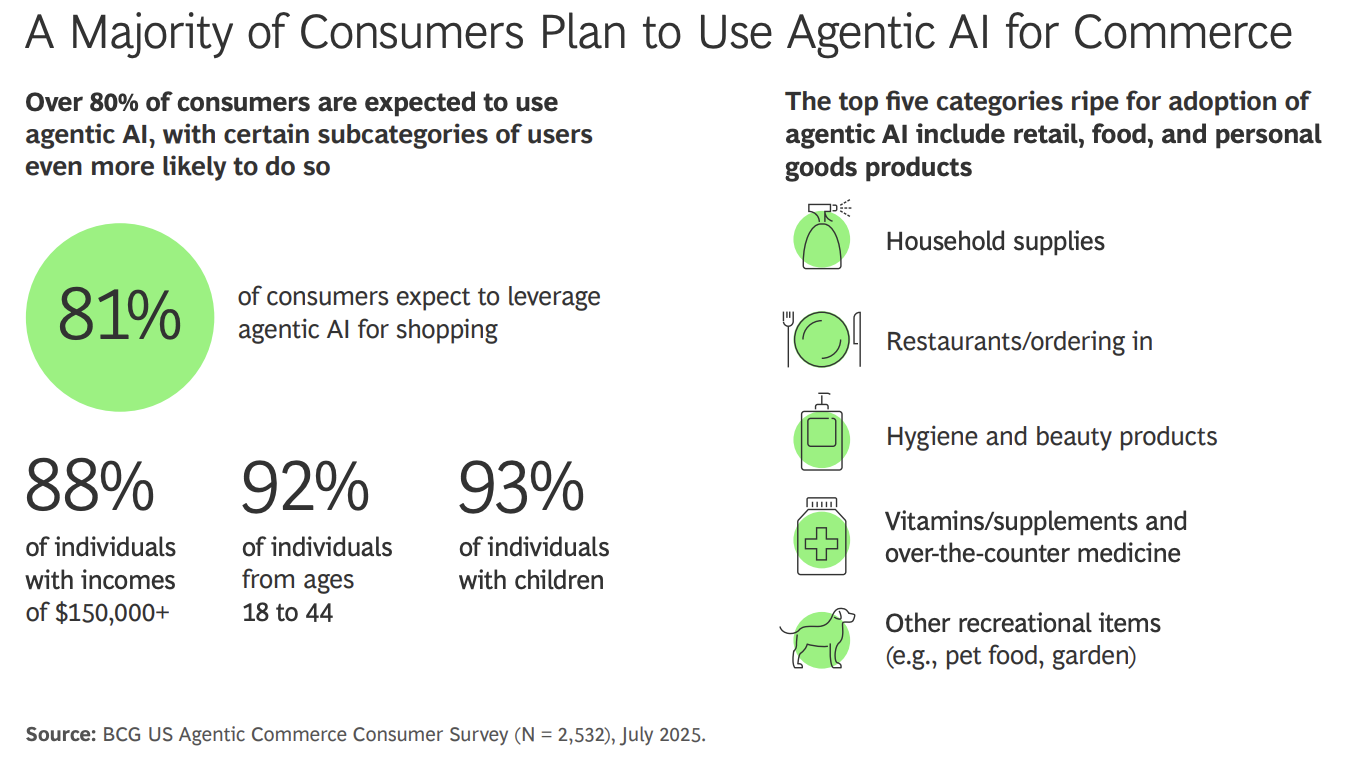
AI agents are rapidly entering digital commerce, driven by growing customer demand. A July 2025 US consumer survey by Boston Consulting Group (BCG) found that 81% of consumers expect to shop using agentic AI.
BCG estimates that in the coming years, more than US$1 trillion in spending, representing about 50% of total e-commerce expenditure today, could be agent assisted. Early adoption will likely be concentrated in routine and repeat purchases, such as household supplies, restaurant orders, personal care, and vitamins/supplements, rather than high-ticket or high-emotion purchases such as luxury goods or medical devices.
Major players, including Google, PayPal, Visa, and Mastercard, are already racing to capture the agentic AI shift.
Featured image by tete_escape on Freepik
