


Despite growing demand for product personalization, most banking customers are underwhelmed by the personalization they receive, underscoring a gap between between customer expectations and what banks are delivering in experience, according to a new study by Hong Kong-based strategy consultancy Quinlan and Associates in partnership with management consulting company Synpulse.
The study, which polled nearly 150 consumers in 2025, found that nearly three quarters (74%) of banking customers consider personalization critical to their banking experience. Yet 71% of those who value personalization say they have either not experienced it or are dissatisfied with what they are receiving. This suggests that, despite strong demand, only a small minority actually receive tailored experiences that meet their expectations and deliver real satisfaction.
Additionally, less than half (44%) of the customers who consider personalization important have actually experienced it at all. This reveals that many banks are still not equipped to provide meaningful, individualized value, suggesting that personalization remains an under-stated priority.
Even among those who have received personalized services, more than half (52%) are not satisfied, highlighting that banks’ personalization efforts lacked sufficient thought and implementation rigor.


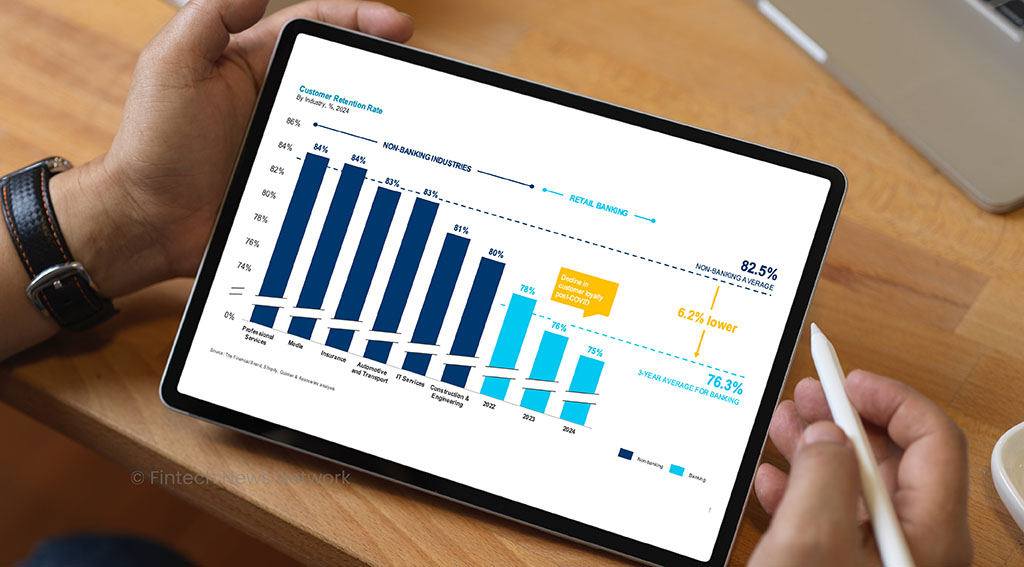
Underwhelming personalization and customer experience contribute to lower retention rates in the banking sector compared to other industries. The customer retention rate in banking stood at 75% in 2024, well below the non-banking average of 82.5%. Retention in the sector has declined in recent years, underscoring persistent gaps in service quality and customer satisfaction.

Rising competition in the banking landscape
Falling retention rates also reflect intensifying competition from digital banks that are elevating experience standards.
In Hong Kong, digital bank Mox Bank offers a streamlined onboarding process that takes just about 5 minutes on average, with roughly 70% of applicants being processed without the need for manual intervention.
Across Asia, UOB’s digital brand TMRW uses artificial intelligence (AI) to anticipate needs and deliver curated insights and rewards suited to individual preferences.
In China, Tencent-backed WeBank leverages AI, blockchain, cloud computing, and big data to serve underbanked individuals and small and medium-sized enterprises (SMEs), using these technologies for underwriting, product matching, and hyper-targeting.
Gains from addressing the personalization gap
The Quinlan and Associates research indicates that closing this personalization gap could unlock significant revenue for banks by improving customer acquisition, engagement, and loyalty.
By using first-party data, customer relationship management (CRM) insights, and third-party behavioral signals, banks can tailor product awareness and marketing campaigns to a customer’s life stage, goals, and financial context, potentially boosting customer acquisition by 63%.
In engagement, ads, emails, and push notifications can be dynamically adapted to a customer’s behavior, preferences, and interaction history to increase relevance and click-through rates, improving engagement by 36%.
Banks can also personalize the product journey by adapting product recommendations, featured presentation, and support to a customer’s profile, intent and behavior. Customers are found to be 94% more likely to purchase a personalized product than a generic offering.
Effective personalization also improves retention. Experiences tailored to tenure, life events, and transaction behavior can reinforce trust, and deepen engagement for long-term retention, increasing retention by 69%.

Results from the Quinlan and Associates study align with other recent research. Accenture’s Banking Consumer Study 2025, released in March, also underscores the critical importance of personalization. Polling more than 49,000 customers across 39 countries and 700 banks, the study found that a lack of connection in digital interactions is pushing customers to seek more personal banking experiences and diversify their banking relationships.
As a result, many customers are engaging with additional providers. 73% of customers now use multiple banks beyond their primary financial institution, and 58% have purchased a financial service or product from a new provider in the last 12 months.
Featured image: Edited by Fintech News Singapore, based on image by thanyakij-12 via Freepik
