



The success of the PromptPay payment system in Thailand is a testament of the power of a dual approach combining government leadership with private sector adoption.
This model could be applied to transform international trade infrastructure, building on PromptPay’s strong foundation in domestic digital payments, according to Rahul Bhargava, Interim Chief Operating Officer of Contour Network and Senior Financial Sector Advisor at the World Bank.
Trade finance inefficiencies
Speaking to Thairath Money at Money20/20 Asia 2026, Bhargava said that while consumer payments have advanced significantly, trade finance remains burdened by inefficiencies because of manual processes, and disconnected workflows. The sector still relies heavily on paper documents including letters of credit (LCs) but also for data verification, and transaction confirmation, and requires coordination among banks, buyers, sellers, logistics firms, and many related agencies.
A critical bottleneck, according to Bhargava, is the lack of true data integration. Each party often operates on separate systems, creating silos that hinder efficiency. Furthermore, discrepancies frequently arise when payment terms are altered via informal channels like email or WhatsApp while primary documents aren’t updated accordingly. This leads to disputes, operational errors, and trade delays.

In contrast, modern payment systems like PromptPay can automatically send “settlement confirmation” almost instantly, notifying recipients within seconds that funds have arrived. However, in trade finance, many organizations still rely on manual confirmations by banks made by phone calls or emails.
PromptPay: a viable model for trade
According to Bhargava, PromptPay’s success offers a viable model for the global trade sector. He attributes this success to the powerful synergy of top-down and bottom-up forces. From the top-down side, the Bank of Thailand (BoT) set clear roadmaps for PromptPay, established common standards for digital payments, and created regulatory sandboxes for innovation trials. From the bottom-up side, banks, payment providers, and citizens embraced the technology, driving transaction volumes from hundreds of thousands per day a year after the system’s launch to now over 81 million daily transactions.
Bhargava, a former executive with experience in cross-border payments who has worked at SWIFT, said he joined the Contour Network to address the systemic issues in the trade finance industry by integrating trade digitalization with payments and settlement within a unified ecosystem.
The Contour Network, which has been operational since 2017, provides banks and corporates with a production-grade, blockchain-enabled platform for digitizing LCs, reducing processing times from days to hours across live commodity and manufacturing trades. Originally launched by a consortium of global banks including HSBC, Standard Chartered, Citi, BNP Paribas, DBS, ING and others, the Contour Network continues to evolve to offer greater flexibility, scalability, and settlement optionality in response to changing regulatory changes and legal frameworks such as MLETR, industry initiatives including TradeTrust and ICC DSI, as well as growing institutional adoption of tokenized assets and regulated stablecoins.
Bhargava was named the Interim Chief Operating Officer of the Contour Network in February 2026, and is now leading the platform’s next growth phase, strengthening institutional engagement and advancing the integration of digitized trade finance with flexible, compliant settlement options across both traditional and regulated digital channels.
Changing payment preferences
Launched in 2016, PromptPay is a payment system infrastructure that allows users to transfer money using their citizen IDs, mobile phone numbers, or bank account numbers with minimal fees. Transfers are free for amounts under THB 5,000 (US$153), while larger transactions are charged nominal fees ranging from THB 2 (US$0.06) to THB 10 (US$0.31).
In addition to facilitating basic money transfers and payments, PromptPay is also a critical tool utilized by government for social welfare disbursement. It also offers a variety of services including an e-wallet service, tax reimbursement, business-to-business (B2B) payments, and electronic donation services.

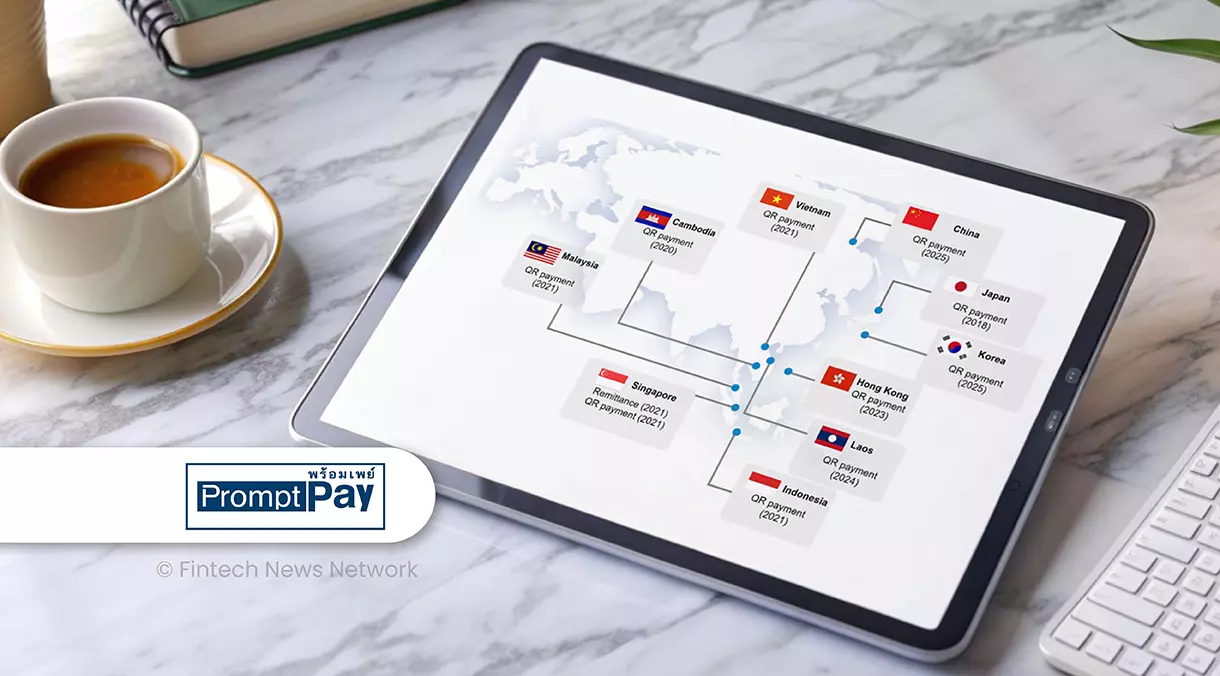
BoT is also actively working on connecting the PromptPay system with similar systems globally, including Malaysia’s DuitNow, and Singapore’s PayNow, to ensure seamless, instant cross-border payment transactions. It’s also enabling QR code payment connectivity with jurisdictions including Hong Kong, and Laos.

In Thailand, payment habits and preferences have shifted towards digital transactions, with PromptPay and QR code payments becoming the default payment methods. According to data compiled by the Emerging Payments Association Asia (EPAA), account-to-account (A2A) transactions accounted for 41% of all point-of-sale (POS) payment value in 2024, surpassing cash with a 31% share. Other digital payment methods accounted for 31% of POS transaction value, giving cashless payments a total share of 66% in 2024.

Digital banking is also surging, with 181.8 million accounts in January 2026, transaction volume up 10.6% YoY to 3.5 billion, and transaction value rising 17.5% YoY to THB 11.5 trillion (US$352 billion). Similarly, adoption of e-Money is accelerating, with 112.3 million accounts, transaction volume up 6% YoY to 493.3 million, and transaction value up 223.7% YoY to THB 362 billion (US$11 billion).

Featured image: Edited by Fintech News Singapore, based on image by wahyu_t via Magnific
