


The Singapore Fintech Festival (SFF) wrapped up its 2026 edition on November 20, welcoming an estimated 70,000 participants from more than 140 countries and regions to examine the changing architecture of global finance.
Organized by the Monetary Authority of Singapore (MAS) and the Global Finance and Technology Network (GFTN), in collaboration with the Association of Banks in Singapore, the 11th edition of SFF examined how five interconnected forces, namely technology, geoeconomics, capital, talent and policy, are transforming finance.
It featured keynote addresses, policy dialogues, industry discussions, and technology demonstrations tackling agentic artificial intelligence (AI), tokenization, digital money, and quantum technologies; shifts in trade, capital flows, and international cooperations; and changes in regulatory approaches to support financial innovation while safeguarding trust, resilience, and financial stability. The conference also addressed how capital is being mobilized to support innovation, infrastructure, and economic growth; and explored the implications of AI for jobs, skills, and entrepreneurs.
Like previous editions, SFF 2026 attracted major announcements from industry stakeholders, with government agencies, regulators, financial institutions, and startups capitalizing on the flagship event’s scale and reach to signal credibility, foster real business momentum, and generate outsized coverage.

Key announcements included initiatives from governments to foster agentic AI, cross-border commerce, and tokenization; new partnerships to advance innovation and address emerging risks; and findings from research projects to understand the challenges and opportunities arising in the fintech landscape.
Simpler, faster and cheaper digital transactions
During SFF 2026, government officials unveiled numerous initiatives designed to make digital payments more accessible and convenient.
Singapore Deputy Prime Minister, Minister for Energy, Trade and Industry (Trade), and Chairman of MAS, Gan Kim Yong outlined a planned PayNow upgrade that would let Singapore residents and tourists scan any SGQR+ code with a supported payment app they already use. The forthecoming SGQR+ National Switch would link participating payment networks so merchants could accept payments from different apps through a single QR code. The initiative aims to make payments simpler, safer and more accessible.

MAS also announced that it will test a dedicated payment system for microtransactions in 2027 to see if it can bring payment costs down.
PayNow and Singapore’s Fast and Secure Transfers (FAST) system are not designed to handle large volumes of tiny payments at low cost, the central bank said, calling for a dedicated system that could make it more practical to charge in small increments for digital services or process frequent payments from connected devices.
The proposed rail would work with FAST and PayNow, and is intended to operate around the clock and confirm payments immediately.
MAS and its industry partners will also test a separate prototype to see whether AI agents can use tokenized Singapore dollar bank deposits to make payments on a user’s behalf within approved limits.
Project Nexus readies 2027 launch
Project Nexus is targeting a 2027 launch for a network that would link instant payment systems in five Southeast Asian countries and India.
GFTN Chairman Ravi Menon said at the opening of SFF 2026 that each participating payment system would connect to a shared gateway to reach the other markets on the network without setting up a separate link with each one.

Across the region, several real-time, instant cross-border payment linkages already exist. For example, customers of participating banks in Singapore and Thailand can send money across the border using the recipient’s mobile number since PayNow and PromptPay were linked in 2021. Another link lets Indonesian shoppers in Malaysia scan a merchant’s DuitNow QR code with a participating payment app. The shopper pays in rupiah and the merchant receives ringgit.
AI for fraud prevention
Singapore also announced several initiatives to strengthen financial crime prevention. Gan unveiled at the event an initiative aimed at improving the detection of financial scams by analyzing transaction patterns across multiple banks. He claimed existing fraud detection systems are limited because banks generally monitor transactions within their own networks.
MAS will begin a study in early 2027 to design an industry-wide Scam Detection Utility. The system will build on earlier work involving five banks that pooled transaction information to assess whether broader data sharing could improve the detection of suspicious activity.
MAS will also work with the Future of Finance Institute (FFI) to make synthetic banking transaction data available to AI developers and researchers. The dataset, developed with Singapore’s Government Technology Agency, will reproduce patterns associated with interbank transfers and scam activity without exposing actual customer transaction records.
Technology companies, AI laboratories and research institutions will be able to apply for access to the dataset to develop and test AI solutions for scam detection through an initiative called the AI Innovation Arena.
New initiatives to support the use of AI in financial services
The AI Innovation Arena is part of a set of AI initiatives being undertaken by MAS and FFI in support of the National AI Missions for financial services.
Besides the AI Innovation Arena, these include the Agentic Money Sandbox, which will provide a controlled environment for financial institutions to develop and test AI agents. Initial use cases will include agent-initiated payments and treasury management across participating financial institutions.
FFI will also work with A*STAR’s Institute of Advanced Intelligence and Computing (IAIC) to advance the locally grounded speech-to-text AI work into live pilots for practical financial-sector applications. One application being explored is the use of speech-to-text capabilities to support real-time compliance monitoring for operational risk management.
Finally, FFI will partner with AI Singapore (AISG) to build AI talent for the financial sector through initiatives like apprentice programs.
MAS plans more tokenized bills
MAS announced plans to expand the use of tokenized MAS Bills as collateral after issuing S$100 million worth in a live trial.
The four-week MAS Bills were issued natively on the MAS-operated Singapore Dollar Test Network, an operational shared ledger infrastructure, and were settled using wholesale central bank digital currency (CBDC). This issuance approach eliminated the need for reconciliation and intermediaries, unlike instruments that are issued conventionally and tokenized subsequently, MAS said.
In the next phase of work, the central bank intends to scale up issuances, bring onboard more participating financial institutions, and expand the use of tokenized MAS Bills for collateral management.
Fintech trade groups and organizations team up
SFF 2026 also saw several industry trade groups and organizations team up to foster innovation and create synergies.
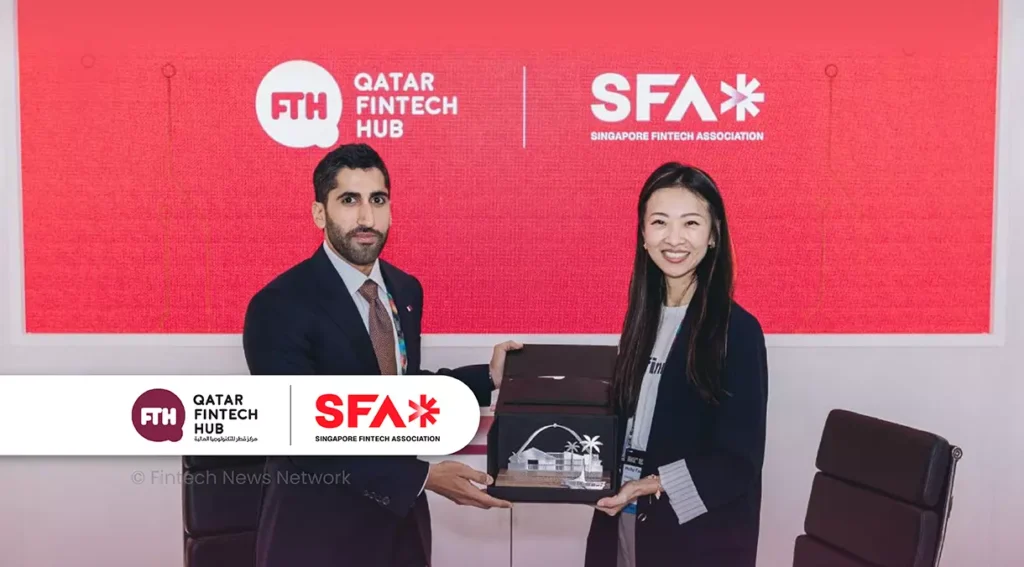
Qatar Fintech Hub (QFTH), which is part of Qatar Development Bank (QDB), signed an agreement with the Singapore Fintech Association (SFA) to explore opportunities to develop fintech ventures. The two organizations said they will focus on supporting the creation of innovative companies with potential for growth and international expansion.
GFTN also partnered with the Luxembourg House of Financial Technology (LHoFT) to launch the Future of Wealth Forum event series. The first edition will take place in Luxembourg City from September 27 to 29, 2027, and will explore the theme “Where Wealth Moves Next”.
The event will study how AI, new asset classes and the shift of wealth to the next generation are changing the sector. The program will feature five main areas focusing on portfolio management and advice; private markets, digital assets and new asset classes; succession; new wealth products; and customers’ expectations towards private banks and asset managers.
Finally, GFTN is collaborating with Banco de España to co-develop Black Swan Summit Spain 2027, a forum focused on financial cooperation between Europe and Latin America.
The inaugural summit will take place in Madrid from October 18 to 20, 2027, with around 2,000 policymakers, central bankers, financial institutions, investors and technology leaders expected to attend.
The summit will focus on payment interoperability, digital money, cross-border settlement and tokenization. It will also address cybersecurity, financial crime and financial stability.
AI payoff remains elusive
SFA, Airwallex and Kapronasia, released findings of a new study on AI at SFF 2026. The study, which polled 100 fintech leaders in Singapore and interviewed 10 senior industry practitioners, found that more than eight in ten Singapore fintech firms have deployed artificial intelligence (AI), and yet only 4% of respondents name new revenue as its biggest benefit.
Lower operating costs were the most common benefit, cited by 41% of respondents, followed by risk mitigation and compliance, at 28%, and employee efficiency and output speed at 19%.
61% of respondents expect returns of 26 to 50% on their AI investments, but only 42% reported returns in that range. Even so, 94% expect their AI budgets to rise in 2027.
The AI and finance talent shortage
A separate research by SFA but this time in collaboration with Page Executive revealed that Singapore’s fintech employers are struggling to fill jobs that combine technical skills with expertise in finance, regulation or risk.
Among the hardest jobs to fill are roles that involve applying AI in financial services, overseeing AI models, using technology to meet regulatory requirements, or analyzing data to detect fraud.
The study found that digital banks, payment firms, insurers and e-commerce platforms are looking for many of the same skills, and many are hiring in non-tech sectors. Tech employment in those industries grew 5.3% in 2025, compared with 1.8% in information and communications.
Visa unveils new agentic AI, stablecoin initiatives
At SFF 2026, Visa made a slew of announcements. First, the payment network debuted a new subscription tool called Visa Recurrent. The service lets people view and manage recurring payments through their bank’s digital channels.
Visa also unveiled new plans for AI payments, expanding its Agentic Ready program across Asia-Pacific (APAC) to over 50 partners, with more expected to join throughout 2027.
This next phase will focus on Acceptance, collaborating with acquirers, payment service providers, payment gateways and selected merchants to prepare for agent-initiated Visa transactions.
Visa is also working with Lianlian DigiTech to advance agentic business-to-business (B2B) commerce for small firms.
On stablecoins, Visa is planning to enable eligible clients in APAC to use stablecoins to fund cross-border payouts through its real-time money movement platform, Visa Direct. The company is piloting the capability with dtcpay, which will use supported stablecoins to prefund cross-border fiat payouts, giving businesses greater flexibility in how they fund and move money across borders.
Finally, on security, Visa is bringing its Threat Intelligence Platform to the region. The tool aims to help banks and other financial firms spot and respond to threats that can lead to fraud.
ASEAN Financial Health Challenge winners
At SFF 2026, the Bangko Sentral ng Pilipinas (BSP) and GFTN announced the winners of the ASEAN Financial Health Challenge, a competition recognizing innovative solutions helping individuals and households across Southeast Asia better manage their finances, withstand financial shocks, and build long-term resilience.
The three winners of this year’s competition are:
- Exoasia Innovation Hub, a Philippines-based company, which won in the Insurance and Financial Resilience category with Hermes, an AI-powered solution that connects households with licensed financial advisors;
- Blue River Technology, a Singapore-based technology company, which won in the Emergency Savings category for BufferCompass, a financial wellness platform designed to help individuals and families with irregular incomes build emergency savings; and
- Flow, a UK-based company, which won in the Responsible Credit category, recognized for its approach that combines technology, business data and human support to help provide collateral-free working capital to micro-businesses.

2026 Global Fintech Hackcelerator winners
MAS also announced the three winners of the 2026 Global Fintech Hackcelerator, a program that connects early-stage startups with financial institutions.
The companies each received S$80,000 for developing AI solutions in response to challenges set by GXS Bank, Julius Baer and Zurich Insurance. Finalists also got mentorship and access to investors, while having opportunities to explore pilot engagements with the corporate partners.
This year’s winners are:
- Finbox, from India, which offers the DeviceConnect module that captures consented behavioral signals and combines them with bureau data;
- LinqAlpha, from Singapore, which provides an AI advisory agent that works directly within the client’s email inbox and a web application; and
- PROSPERO, from Indonesia, which provides the SME RiskLens, an AI layer that translates a small business’s data into a plain-language risk profile and identifies gaps in its insurance coverage.
2026 Fintech Excellence Awards
Alongside the 2026 Global Fintech Hackcelerator winners, MAS announced the winners of the 2026 Fintech Excellence Awards. The corporate finalists were assessed on impact, sustainability, practicality, how well their products work with other systems and how original they were. The mentors were assessed separately on their contributions to Singapore’s fintech sector. The companies received S$50,000 each, while the fintech mentors received S$5,000 each.
- Singapore’s ContexQ won the Emerging Fintech Award for SarasW, a risk platform that connects customer records and payment logs with external sources such as sanctions lists, company registries and negative news coverage;
- Payoneer Singapore won the Financial Inclusivity Award for its Global Financial Platform, which gives small businesses a way to send and receive cross-border payments, hold multiple currencies, and access working capital;
- FinregE from the UK won the Regulatory Leader Award for its Regulatory Operating System, which tracks rule changes across sectors including banking, insurance and payments;
- ESGSAT from the US won the Sustainable Innovator Award for Orbit, which combines satellite imagery and sensor data to monitor environmental risks across several tiers of suppliers; and
- Singapore-based insurtech bolttech won the AI Champion Award for its AI-enabled insurance distribution platform.
Carney Mak, Partner at FXHB Asset Management, Naveed Weldon, CEO of FlexM, and Ragunandhan Senthil Kumar, Chief Technology Officer of Bank-Genie, received the individual Fintech Individual Mentor Award.

Featured image: Edited by Fintech News Singapore, based on image by Singapore Fintech Festival