


What does someone entering financial services need to know today?
Finance still matters, of course, even as the work surrounding it has changed.
Banks and fintech companies increasingly run more of their operations through software, with data and AI shaping how many of those systems work.
A lending model, for example, is only useful if the people building or using it understand the credit decision behind it, and similar dependencies appear in other parts of financial services.
Digital payments rely heavily on security expertise, while quantitative teams use modelling to test how financial systems could respond under different conditions.
Specialists increasingly need enough knowledge of adjacent fields to work with the teams around them.
Nanyang Technological University‘s School of Physical and Mathematical Sciences (SPMS) is responding to that shift through several postgraduate programmes, led by its Master of Science in Financial Technology (MSFT).
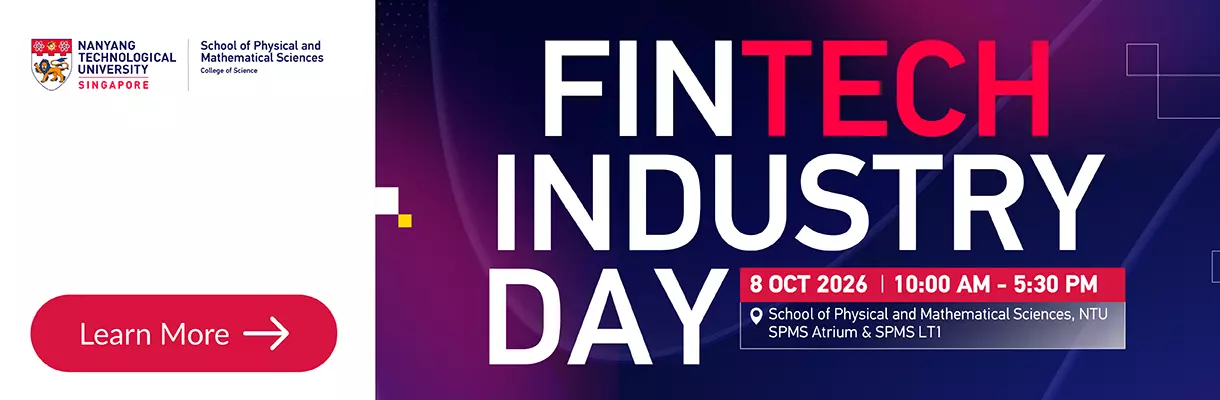
Those changing skill requirements will also feature at NTU FinTech Industry Day 2026 on 8 October, where executives and academics will discuss how AI and other technologies are changing financial services.
A Fintech Degree Now Covers More Ground
NTU’s Master of Science in Financial Technology places finance alongside the technical capabilities increasingly used to build and operate digital financial services.
Students choose between two specialisations, Intelligent Process Automation (IPA) and Digital Financial Services (DFS).
IPA takes the more technical route, with a curriculum covering areas such as machine learning and automation for financial applications.
DFS looks more closely at how technology is applied within financial services, including how digital financial products operate in practice.
The two tracks reflect the breadth of work now grouped under Fintech, since someone building a financial product may need a very different skill set from the person responsible for implementing or managing it.
Some Skills Fall Outside the Fintech Label
Data is one area where the boundary becomes less obvious.
On the one hand, financial institutions already generate and collect large volumes of information, but having more of it does not automatically improve a decision.
Banks still need people who can work out whether patterns in the data are meaningful enough to inform a business decision.
SPMS’ Master of Science in Analytics develops those capabilities through statistical and analytical methods used across business and finance.
On the other hand, some decisions require a different approach.
A bank may want to understand how a system could behave when market conditions change or when certain assumptions no longer hold.
Mathematical and computational models let organisations test those scenarios before committing to a decision.
NTU’s Master of Science in Modelling and Simulation focuses on those methods, with Economics and Finance among its specialisation areas.
Security becomes harder to separate from these questions as more financial activity moves online.
Payments and financial data depend on infrastructure that can withstand attacks, while newer developments in AI and quantum computing are changing how organisations think about protecting that infrastructure.
SPMS’ Master of Science in Cybersecurity (Applied Cryptography) covers areas such as network security and privacy-preserving technologies. Students can also study post-quantum cryptography and security in AI.
Those disciplines often overlap once institutions put the work into practice.
A model built around financial data, for example, still has to operate within systems that teams can secure and maintain.
NTU FinTech Industry Day Puts the Theory Into Context
Coursework can provide the technical foundation, but students also need to see how those ideas are being applied and debated by companies.
NTU FinTech Industry Day 2026, taking place on 8 October, gives students that industry exposure.
The programme includes “Future of FinTech in the Age of AI”, followed later by “Beyond FinTech: AI, Web3 and the Future of Global Financial Infrastructure.”
The speaker line-up reflects the range of organisations involved in those discussions.

BNY and Moomoo Singapore will be represented alongside the Singapore Fintech Association (SFA), with FOMO Group, Monee, Binance and PwC also taking part.
The second panel broadens the discussion beyond conventional Fintech roles.
AI systems depend on data and secure infrastructure, while modelling remains useful when financial institutions need to test how systems could behave under changing conditions.
SPMS teaches these as distinct areas of study, although companies often draw on several of them when developing financial technology.
FinTech Industry Day gives students a chance to hear how those connections are playing out beyond the classroom.
The Job Title May Change Before the Skills Do
As financial institutions change how they use those systems, the roles around them will change too.
Training for a job title that may look very different in five years has obvious limits.
SPMS keeps the programmes specialised while exposing students to fields that increasingly overlap with their own.
The Master of Science in Financial Technology sits closest to the intersection of finance and technology, with Analytics, Modelling and Simulation, and Cybersecurity offering deeper routes into related technical fields.
The job titles may change, but graduates will still need to understand where their expertise fits into the systems financial institutions actually use.
Considering postgraduate study in FinTech? NTU’s Master of Science in Financial Technology outlines how the programme is structured and what students can specialise in.
Click on the banner below to know more:
Featured image: Edited by Fintech News Singapore based on an image by riskytolen31 via Magnific.
