



The Singapore Fintech Festival (SFF) will return this year from November 18 to 20, convening global technology and finance leaders to examine the forces reshaping the global financial system.
Organized by the Monetary Authority of Singapore (MAS) and the Global Finance and Technology Network (GFTN), in collaboration with the Association of Banks in Singapore (ABS), this year’s event will focus on five themes examined across three days of stage programming and an exhibition floor spanning multiple halls.
The first theme, technology, will examine how financial institutions can harness innovations, especially artificial intelligence (AI), to stay ahead of new forms of scams, cyber threats and the coming quantum challenge. The second, geoeconomics, will discuss how financial networks are adapting to trade, investment and capital flows shifts and new economic corridors.
The third theme, capital, will ask whether productivity gains and revenue growth can sustain an investment boom. The fourth, talent, will explore how financial institutions can enhance the skills and capabilities of their workforce to stay competitive. Finally, the fifth theme, policy, will discuss how policy, governance and risk frameworks can keep up as technology races ahead, enabling innovation without compromising trust and resilience.

Among the many sessions scheduled for SFF 2026, several are standing out for bringing together respected industry stakeholders and thought leaders to address the sector’s most pressing issues and biggest opportunities. These sessions will cover the impact of AI on employment, the evolution of digital payments, financial innovation, investment opportunities and the next generation of financial infrastructure, among key themes.
Together, these discussions will help define the direction of the global financial ecosystem and provide a valuable opportunity for participants to hear directly from the policymakers, financial institutions and technology leaders shaping what comes next.
Must-attend sessions on Day 1 of SFF 2026
The conference will open with the “AI and Employment Equation: Balancing Productivity, Displacement, and New Jobs” session, featuring Stanford Professor Dr. Michael Spence and former MAS Managing Director Ravi Menon. The conversation will examine whether AI-driven productivity gains will translate into shared prosperity or deepen economic inequality, and how governments and businesses can prepare for a rapidly changing labour market.

Turning from labour markets to regulation, the “Policymakers’ Dialogue: The Next Chapter in Financial Innovation” session will bring together European central bank leaders from Deutsche Bundesbank, Bank of Spain and Danmarks Nationalbank to discuss how policymakers can balance innovation, financial stability and sovereignty as AI, digital money and tokenised markets reshape the financial landscape.

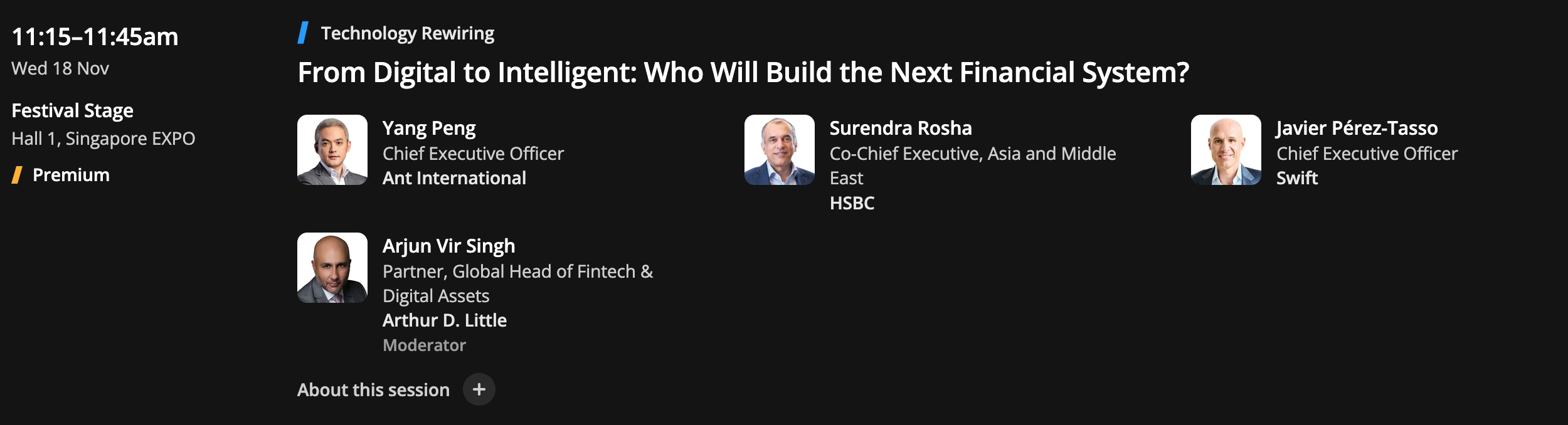
Following this, the “From Digital to Intelligent: Who Will Build the Next Financial System?” session will feature leaders from Ant International, HSBC and Swift exploring who will build, and control, the next generation of financial infrastructure. The conversation will examine how technology and traditional finance will converge, where new sources of competitive advantage will emerge, and whether Asia will pioneer a fundamentally new model for intelligent, interconnected finance.
At lunchtime, the “Central Banks and Future Payment Systems: Priorities, Trade-offs, and Opportunities for Cross-Border Collaboration” session will discuss the key building blocks for the next generation of payments and where deeper cross-border collaboration can deliver capabilities that individual jurisdictions cannot achieve alone.
Running alongside this, the “Quantum Finance in Practice: Early Results, New Applications and the Path to Advantage” session will explore emerging applications of quantum computing in financial services, including early industry experiments, potential opportunities and risks, and the launch of a global quantum finance challenge.
The afternoon will then turn to the commercial implications of AI with the “How Can Agentic AI Create a Commercial and Competitive Advantage?” session. Featuring senior executives from FIS, OCBC, and DBS, the discussion will explore how financial institutions can turn agentic AI into sustainable competitive advantages through new business models, proprietary data and smarter operations.
Later, the “Cross-Border Connectivity: How Regional Blocs are Building Their Own Financial Integration” session will explore how regional partnerships are creating alternative models for financial integration, pooling resources and connecting payment systems where global infrastructure remains fragmented.
The investment outlook for Southeast Asia will then take center stage in the “Is Southeast Asia’s Capital Winter Structural, Or Cyclical?” session, which will address how regional general partners (GPs) are deploying funds, what alternative capital stacks are stepping into the void, and where funding will genuinely flow.
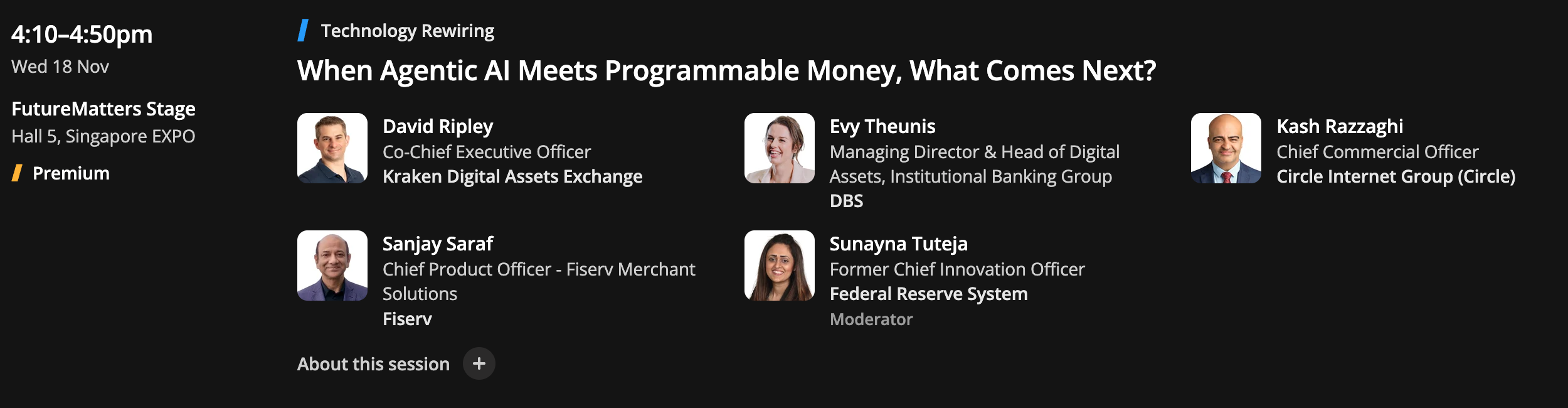
Closing the day, the “When Agentic AI Meets Programmable Money, What Comes Next?” session will bring together senior representatives from Kraken Digital Assets Exchange, DBS, Circle Internet Group (Circle) and Fiserv, to explore the convergence of autonomous AI agents, programmable stablecoins and real-time payment infrastructure. The discussion will consider how these technologies could fundamentally transform money movement, compliance and the future of financial transactions.
Day 2 highlights
Day 2 will place agentic AI and programmable finance in the spotlight, beginning with the “The Autonomous Economy: Where the Intelligence Layer Meets Programmable Finance” session. Featuring leaders from
Sumitomo Mitsui Banking Corporation (SMBC), Ant International and Visa, this panel will examine how autonomous AI agents and programmable money could enable machine-to-machine (M2M) commerce, reshape payments and settlement, and introduce new questions around accountability and risk.
This session will be followed by “From Intelligence to Action: The New Architecture of Competitive Advantage” where executive from Nasdaq, Tencent, UOB, and Mastercard, will explore how agentic AI is reshaping the architecture of business from the systems that connect people, data and machines to the operating models that enable speed, adaptability and differentiation.
The morning program will continue with the “One World, Many Rails: Defining the Next Chapter of Money Movement” session, featuring leaders from Ripple, Schroders, Banking Circle, Binance, and JP Morgan. This session will examine how instant payment systems, stablecoins, card networks and central bank digital currencies (CBDCs) can coexist and interoperate in an increasingly fragmented global payments ecosystem.
In the afternoon, the “Designing for Real Life: Innovating for Financial Health” session will bring together leaders across policy, fintech, banking, and insurance to examine how public-private collaboration can turn innovation into better financial outcomes. The discussion will dive into how technology and human-centered design can address deep financial health challenges, where education needs to complement innovation, and how fintechs are developing and scaling new approaches across ASEAN.
The panel will conclude with an unveiling and the prize presentation of the 3 winners of the ASEAN Financial Health Challenge.
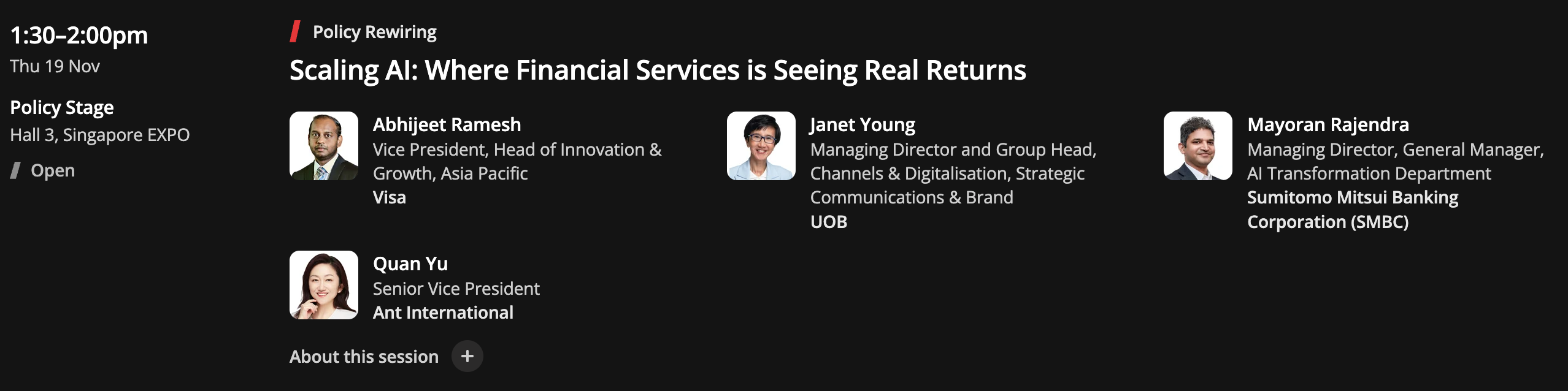
Meanwhile, the “Scaling AI: Where Financial Services is Seeing Real Returns” session will bring together leaders from Visa, UOB, SMBC and Ant International to explore where AI is creating tangible impact today, what it takes to scale successful deployments across the organization, and the operational, cultural, and governance challenges that determine whether AI delivers lasting value. The discussion will also examine how institutions are prioritizing AI investments, measuring success beyond productivity gains, and building the data, operating models, and organizational capabilities needed to move from isolated use cases to enterprise-wide transformation.
The regional growth agenda will then take center stage with the “From market entry to regional scale: What does it take to win across ASEAN?” session. Featuring founders and executives from StashAway, Pints AI and Airwallex, this discussion will explore how fintech companies can navigate different regulatory environments, establish strategic partnerships, and expand successfully across Southeast Asian markets.
Attention will then turn to machine-led commerce with the “Who Owns the Moment an Agent Decides to Pay?” session. In this session, top executives from Fiserv, Green Dot Corporation, Pine Labs and Ant Group will examine how AI agents are changing the payment experience and raise important questions around identity, authorization, liability and who ultimately controls the transaction.

Later on, the “Agentic Payments: Are Our Rails Ready?” session will see senior representatives from Google, Mastercard and Ant International exploring whether existing payment infrastructure can support autonomous transactions at scale, and what safeguards are needed to make agentic commerce secure, inclusive and reliable.
The conversation will then continue with the “Governance-by-Design: Can compliance move at the speed of code?” session. Featuring top representatives from Binance, TRM Labs, Cleanverse International, and Banque de France, this discussion will examine how anti-money laundering controls, sanctions compliance and accountability must evolve as programmable money and smart contracts become more prevalent.
In parallel, the “Price of Connection: What It Actually Takes to Build Cross-Border Payment Cooperation” session will bring together the networks, national payment schemes, policymakers and multilateral hubs working to make cross-border payments more connected, examining where regulatory and commercial frictions persist, how different payment ecosystems can connect and scale across markets, and what smaller or newer markets need to participate on viable terms.
The discussion will also explore where cross-border payment cooperation is working in practice, what it takes to make connections sustainable, and whether the biggest barriers to greater connectivity are technical, regulatory or commercial.
The day will conclude with the “Everyone’s Piloting Agents. Why Don’t They Reach Production?” session during which tech and enterprise leaders from Tencent Cloud, Nucleus Software, ShopBack and Salesforce will explore why so many AI agent initiatives struggle to move beyond demonstrations. The session will examine the infrastructure, operating models, governance and human oversight needed to deploy agents reliably at enterprise scale.
Day 3 highlights
Finally, the third and last day of the SFF 2026 conference will open with the “Fintech Has Scaled. Now Comes the Hard Part” session. This session will bring together founders and CEOs from GCash, Tazapay, NIUM and Pine Labs to discuss what it takes to build enduring fintech businesses beyond their initial growth phase. The conversation will explore the realities of scaling across markets, navigating regulation, managing capital requirements and evolving from payments providers into broader financial platforms.

The payment agenda will continue with the “New Economics Across the Payments Value Chain” session. Featuring leaders from Visa, Hitachi Payment Services, MUFG, and NTT DATA Japan, this session will examine where future value and profitability are shifting, particularly towards data, embedded finance, fraud intelligence and software-enabled services.

In the afternoon, the “Keeping Money Moving: Financial Resilience in an Age of Emerging Risks” session will bring together perspectives from central banking, financial regulation and digital money to examine how financial systems can prepare for emerging threats, including quantum computing, AI-enabled cybercrime and the growing complexity of tokenized financial infrastructure.
This session will be followed by “The Future of Trust: Deepfakes, Synthetic Identity and Proof in the Age of Generative AI”, which will examine how financial institutions can verify identities and prevent synthetic fraud through advanced risk detection, cryptographic identity verification and trusted digital credentials.

The “Skills Gaps and the Shape of Tomorrow’s Financial Institutions” session will then look at how the availability and location of skilled talent are increasingly influencing where financial institutions establish their technology and operational hubs.
Finally, the last sessions will turn to the next frontiers of payments and commerce. The “Missing Middle: Powering the Next Wave of Commercial Payment Corridors” session will examine the persistent fragmentation of B2B and merchant payments across Asia, the Middle East and Africa, and what financial institutions and payment providers must do to build more efficient cross-border commercial corridors, while the “Uneven Map: Where AI Rewrites Commerce First” session will bring together leaders from Toss Bank, Pine Labs and Google to explore where agentic commerce is likely to gain traction first, and how identity, payment acceptance, settlement infrastructure and customer trust will determine its adoption.
Fintech News Network readers enjoy an exclusive 20% off the tickets. Register now via this link.
Featured image: Edited by Fintech News Singapore, based on image by Singapore Fintech Festival
