




As fraud losses mount, organizations across sectors including fintech, e-commerce, and gaming, are accelerating their integration of artificial intelligence (AI) into fraud, risk, and compliance functions.
A new study by SEON, a fraud prevention and AML compliance specialist, polled 1,010 fraud, risk, and compliance leaders, and found that AI is now baseline infrastructure for digital-first organizations, with 98% of respondents reporting that their teams already integrated AI into day-to-day workflows.
Transaction monitoring is the most common and mature application of AI and machine learning (ML), utilized by 30% of the organizations polled. This adoption highlights the effectiveness of AI in fraud detection and compliance amid an increasingly complex regulatory landscape and an evolving risk landscape.
After transaction monitoring, 14% of respondents use AI systems that not only assess risk, but also provide clear, understandable explanations that analysts and reviewers can examine and interrogate. Following closely, 12% have deployed AI-generated summaries for alerts and cases. These tools allow organizations to reduce manual narrative work and accelerate investigations.


High confidence and measurable gains
Respondents shared high confidence in the reliability of AI. 95% of respondents were at least somewhat confident that AI can detect and prevent fraud, while 52% described themselves as very confident.
Early adopters are already realizing tangible benefits. According to a report by the Harvard Business Review, false alerts have fallen by as much as half among financial services providers thanks to AI, and many banks are now able to automate routine human legwork in document evaluation.
For example, using AI, PayPal was able to cut its false alerts in half. Meanwhile, Royal Bank of Scotland prevented losses of over US$9 million to customers after conducting a year-long pilot with Vocalink Analytics, a payments business, to use AI to scan small business transactions for fake invoices.
Looking ahead to 2026, the SEON study found that 83% of respondents expect their fraud and AML budgets to increase. Hiring is also surging, with 94% of leaders planning to add at least one full‑time fraud/AML hire. Of these, one-third are planning three to five hires, another third aim for six to ten, and 17% intend to add more than ten roles.

AI agents in support
Regarding the role of AI, executives overwhelmingly view the technology as an enhancer. About 80% of respondents place AI agents in a supporting or augmenting role, rather than a replacement role.
In particular, 40% believe agents should support analysts with recommendations and summarization based on standard operating procedures. 38% think agents should augment investigators, providing a starting point for deeper investigations, but not replacing them.
In contrast, only 12% believe AI agents will replace analyst tasks entirely. These findings suggest that AI is perceived as an effective tools to handle volume, and repetitive analysis, while human roles is steadily evolving toward designing, supervising, and explaining these systems.
Emerging risks
However, the increased use of AI and automation has not slowed adversaries. Instead, it has forced criminals to become more adaptive, cross-channel and sophisticated.
As organizations automate routine defense mechanisms and deploy ML models to detect anomalies, attackers are abandoning static, brute-force methods in favor of more adaptive strategies, leveraging instead their very own AI tools to generate highly convincing social engineering content, automate vulnerability discovery, and dynamically alter attack patterns in real-time to evade signature-based defenses.
For example, AI-enabled botnets can now scan for system vulnerabilities, bypassing verification mechanisms such as CAPTCHA tests, and sustaining high-volume spam or denial-of-service campaigns with limited oversight. One recent case involved the AkiraBot spam network, which used AI to bypass human verification protocols and post automated content across over 80,000 websites.
AI is also being used to generate synthetic media, commonly referred to as “deepfakes”. Deepfakes are AI-generated images, videos, or audio files produced through advanced ML techniques that create highly convincing but fabricated portrayals of individuals.
In Southeast Asia, criminal exploitation of deepfake technology has risen sharply, particularly in the context of business email compromise and impersonation scams. In one high-profile incident reported in early 2024, a finance worker based in Hong Kong was deceived into transferring US$25 million in what has become one of the most infamous cases of deepfake fraud to date.
Since this case, other similar scams have been reported throughout Southeast Asia. In March 2025 a Singapore based finance director was contacted by scammers over WhatsApp impersonating the company’s CFO.
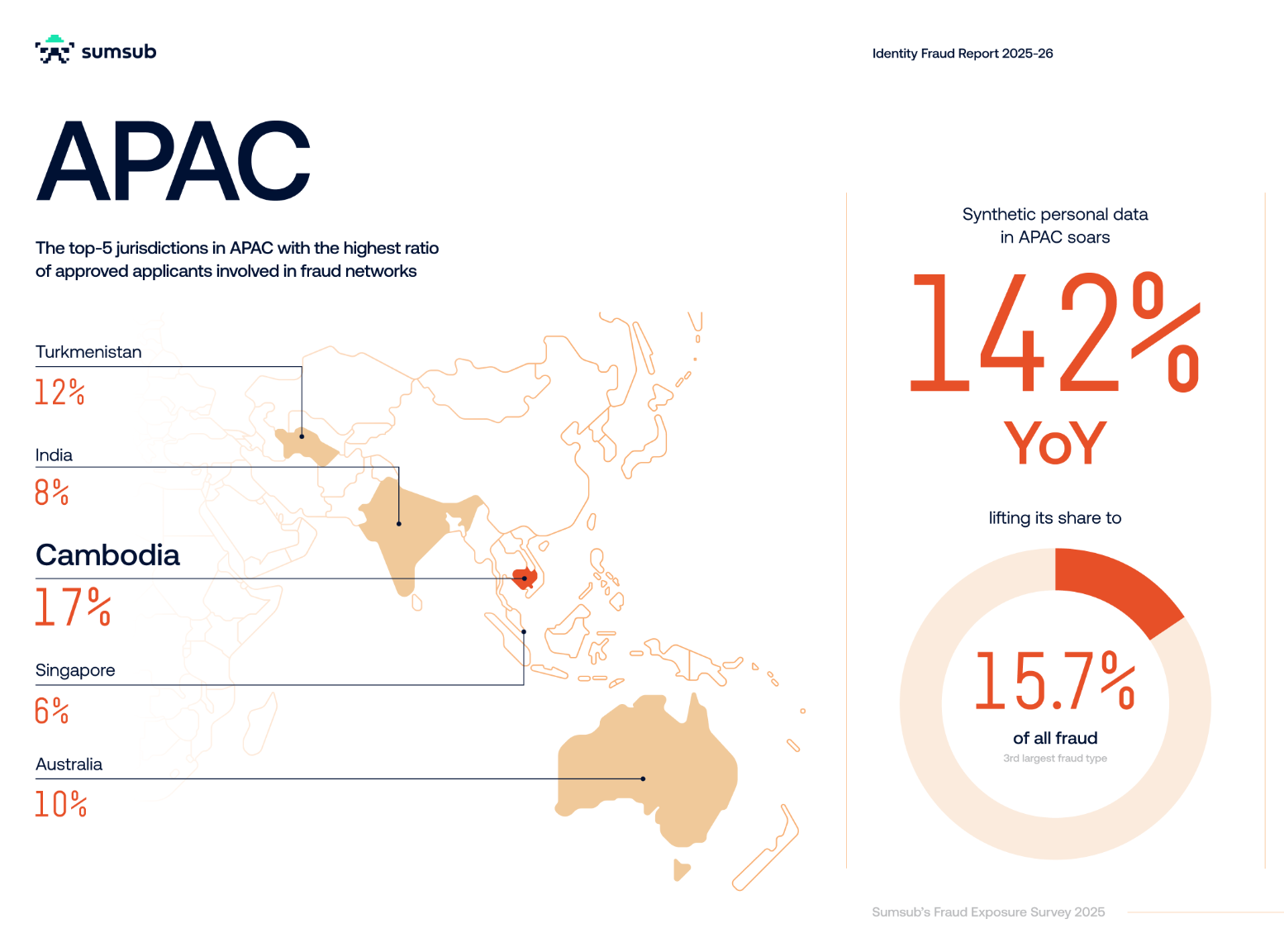
In Asia-Pacific (APAC), deepfake fraud jumped 142% in 2025, according to verification platform Sumsub. This method accounted for 15.7% of all regional fraud attempts that year, ranking as the region’s third-largest category.
Featured image: Edited by Fintech News Singapore, based on image by freepik and via utaem2022 Freepik
