




AI-linked layoffs across fintech and financial services were relatively modest in 2025, with seven announcements affecting around 8,200 roles over the entire year. Quite a number, but not that eye-opening.
Now, roughly seven months into 2026, the tally has made the figure seem a little dwarfed.
Between January and July, our Fintech News Network AI Fintech Layoffs Tracker recorded 20 announcements affecting 70,415 roles, more than eight times the number reported throughout 2025.
Measured month by month, the acceleration is even more pronounced.

The tracker recorded an average of 683 affected roles per month in 2025, while the monthly average has exceeded 10,000 so far in 2026.
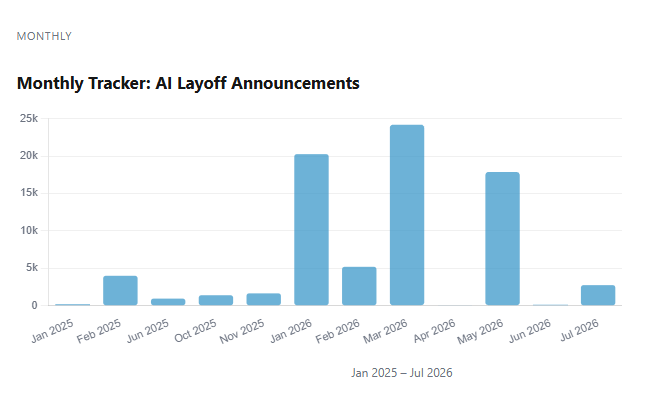
Which means that AI-linked job cuts are now running at nearly 15 times last year’s pace.
But when we dived deeper, frequency only explains part of the jump.
The reductions themselves have become considerably larger, with the average announcement rising from around 1,170 roles in 2025 to more than 3,500 this year.
Our tracker now covers 78,615 roles across 27 announcements since January 2025, and nearly 90% of those roles were added in 2026 alone.
Several global banks have put tens of thousands of roles into multi-year restructuring programmes where AI and automation feature prominently.
At the same time, fintech executives are speaking more openly about using AI to operate with smaller teams.
And the change goes beyond the number of companies cutting jobs.
The scale of the programmes has grown, and AI is becoming more closely tied to decisions about how many people companies expect to employ.
Global Banks Account for Most of the Surge
A handful of large banking programmes have driven much of the gulf between the two years.
HSBC, Citigroup and Standard Chartered alone represent around 47,000 roles in the 2026 tracker.
Adding Morgan Stanley, Commerzbank and Nordea, it now brings the six banking groups to roughly 54,000 roles, more than three-quarters of this year’s total.
Earlier this year, HSBC said that it’s weighing cuts of around 20,000 roles as the company examines how AI could reshape middle and back office functions over the next three to five years.
No final decision has been made, and natural attrition could account for some of the eventual reduction as HSBC reshapes its business.
Chief Executive Georges Elhedery has nevertheless become increasingly candid about the employment implications of AI, warning in May that the technology would change the shape of work across financial services.
Citigroup accounts for another 20,000 roles as part of a wider restructuring that predates the latest generative AI boom, dating back to a 2024 plan to simplify management layers and cut costs.
Its Chief Executive Jane Fraser’s January memo pushed for a leaner, more disciplined culture, though her own remarks centred on performance rather than singling out AI as a driver.
Standard Chartered said that it plans to remove more than 7,000 corporate function roles by 2030, with automation expected to reduce work across some of those functions as the bank redirects spending towards technology.
However, nothing in the 2025 tracker approached that scale, with DBS’ planned reduction of around 4,000 temporary and contract roles being the largest entry last year.
Two programmes of around 20,000 roles each have appeared in 2026.
Larger Cuts Are Spreading Beyond Banking
Banks were seen to dominate the headcount of layoffs, but payments, crypto and insurance have also pushed up the number of companies appearing in the tracker.
Visa confirmed plans to cut around 2,600 jobs in July, mainly across technology and product teams.
Ryan McInerney, the company’s CEO, cited that AI is changing how Visa operates as the company pushes for greater efficiency.
Crypto executives have been more explicit about running smaller teams.
Coinbase announced a roughly 14% workforce reduction, affecting around 700 roles, while Chief Executive Brian Armstrong pushed the exchange towards smaller “AI-native” teams.
Crypto.com cut around 12% of its workforce as CEO Kris Marszalek accelerated the company’s adoption of AI.
Block went considerably further when it cut around 4,000 roles, close to 40% of its workforce, after Jack Dorsey argued that AI tools had reduced the number of people needed to run parts of the company.
The rhetoric around AI has consequently become much more concrete.
Companies are moving beyond discussions about pilots and employee productivity and starting to factor the technology into decisions about staffing levels and team structure.
Not Every Role Can Be Put Down to AI
More than 70,000 roles have entered the tracker this year, although that does not mean artificial intelligence has already replaced 70,415 people directly.
Some cases make the connection clear where Coinbase is openly redesigning teams around AI, while Crypto.com tied its reduction to a wider AI push.
Others are harder to separate from conventional restructuring.
Block, for example, grew from fewer than 4,000 employees in 2019 to more than 10,000 by 2025, leaving room to question how much of its latest reduction reflects AI-driven efficiency and how much amounts to correcting earlier expansion.
HSBC’s potential 20,000-role reduction remains under review and would unfold over several years if implemented at that scale.
DBS presents another distinction where its 4,000 temporary and contract positions are expected to disappear largely through natural attrition as contracts expire, rather than conventional redundancies.
The tracker also captures those nuances without treating every role as having the same relationship with AI.
2026 Is Already in a Different League
Around 683 affected roles entered the tracker each month in 2025. Seven months into 2026, that monthly average has exceeded 10,000.
Huge banking restructurings account for much of the increase, while fintech executives are becoming more willing to connect AI adoption directly with smaller teams and lower staffing requirements.
Some programmes remain prospective, while others involve restructuring well beyond AI. Even allowing for those qualifications, 2026 represents a sharp break from what we recorded only a year earlier.
By the end of July, affected roles were entering the tracker at nearly 15 times the monthly rate recorded in 2025.
And there are five months of 2026 remaining.
Editor’s Note:
For easier reading, we classify each entry in our tracker by how directly AI contributed to the reduction.
EXPLICIT means the company itself named AI, automation or machine learning as a factor.
REPORTED applies where credible reporting established the connection without company confirmation, while MIXED covers cuts involving AI alongside restructuring, market conditions or broader cost reduction.
We update the AI Fintech Layoffs Tracker every month, checking new entries against company statements or credible reporting before adding them.
Stay tuned as the next update is due at the end of August.
Featured image: Edited by Fintech News Singapore based on an image via Magnific.
